Is the Trinity in the Gospel of Mark?
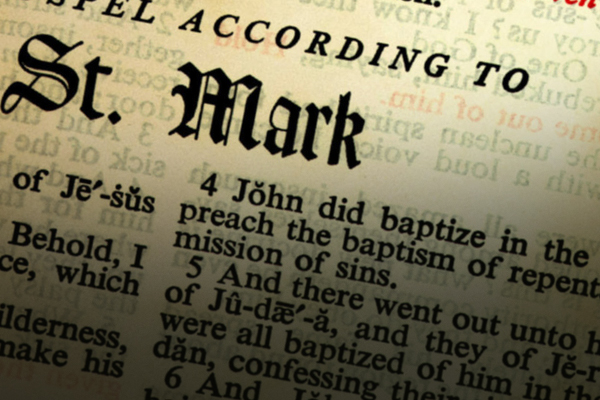
What are the scriptures that the gospel Mark is teaching about God? Is the Trinity in Mark? — Is Jesus Christ God Almighty, and also God the Son, or is he the Son of God, the Messiah, and the Son of Man? Is the holy Spirit portrayed as a person in Mark
Mark 1:1 – “The beginning of the gospel of Jesus Christ, the Son of God” (ESV).
Mark opens his gospel by briefly mentioning basically the theme of his gospel, and what it will prove — ‘that Jesus Christ is the Son of God’.
“Some important manuscripts here omit the Son of God” (NAB note on Mark 1:1). One important point that we can glean from these Manu script variations is that out of the reservoir of about 1,600 manuscript, is that no manuscripts of Mark 1:1 calls Jesus ‘God,’ or ‘God the Son.’
Mark 1:2-4 – “As it is written in Isaiah the prophet: ‘I will send my messenger ahead of you, who will prepare your way–‘a voice of someone calling in the wilderness’ — ‘Prepare the way for the Lord, make straight paths for him.’ And so John the Baptist appeared in the wilderness, preaching a baptism of repentance for the forgiveness of sins” (NIV). Mark quotes from two prophecies, and applies them to Jesus. The first is: “‘Behold, I am going to send My messenger, and he will prepare the way before Me. And the Lord, whom you seek, will suddenly come to His temple; and the messenger of the covenant, in whom you delight, behold, He is coming’, says Yahweh of hosts” (Malachi 3:1 LSB). It is sometimes claimed that “the Lord” here is Jesus, who is supposed to be “God in the flesh”, but such claims contradict the scriptures. The scripture clearly says that Yahweh God is the speaker. The ‘messenger preparing the way’ for, “Jesus Christ, the Son of God”, is identified in Mark 1:1-4 as “John the Baptist”. ”
The Lord, whom you seek” is identified at Malachi 2:16 as “Yahweh, the God of Israel”. How can we be so sure? He is foretold to “suddenly come to His temple”. Jesus concurred with this description, that the temple belonged to his Father, by referring to “my Father’s house” (Luke 2:49; John 2:16). Further identification that the temple referred to belongs to the Father is made at Hebrews 3:6, “Christ was faithful as a son placed over his house” (NAB).
“The messenger of the covenant” is Jesus Christ, who said, “This cup is the new covenant established by My blood; it is shed for you” (Luke 22:20 HCSB), and is identified as “the mediator of a new covenant” (Hebrews 9:15).
The second prophecy Mark quotes from is, “A voice is calling, Prepare the way for Yahweh in the wilderness, Make smooth the desert highway for our God” (Isaiah 40:3 LSB). Jesus is asserted by the “Jesus is God” adherents to be Yahweh God, since Isaiah 40:3 applies to Yahweh God and Mark 1:3 applies to Jesus.
How did John the Baptist “make ready the way of Yahweh” (Mark 1:3 LSB margin)? Does that mean Jesus is Yahweh God? No, because Jesus said, “I have come in My Father’s name”, and, “He who sent Me is with Me; He has not left Me alone, for I always do the things pleasing to him”, and, “I am not alone, because the Father is with me” (John 5:43; 8:29; 16:32 LSB).
Mark 1:9-11 – “Jesus came from Nazareth of Galilee and was baptized in the Jordan by John. On coming up out of the water he saw the heavens torn open and the Spirit, like a dove descending upon him. And a voice came from the heavens, ‘You are my beloved Son, with you I am well pleased'” (NAB). In this scene, Jesus is in the water, and is obviously not the holy Spirit that came down upon him, or God, who is in heaven. The holy Spirit, rather than being portrayed as a person, or intelligent entity, is coming down in the air “like a dove”. Trinitarians assert that these scriptures support the Trinity in Mark. How? Trinitarians count, one, two, three . . . there’s the Trinity! The mention of the three together doesn’t make them a Trinity in Mark, any more the mention of “Stephanus, Fortunatus and Achaichus” (1 Corinthians 16:17) together make them a Trinity. As we can see, not one aspect of the Trinity doctrine is supported in these verses. There is no equality, no existing from eternity, nothing about being Almighty, nothing about all three being God, being the same “being”, or of the same “essence”, or “substance”, etc.
Mark 1:13 – “He remained in the desert for forty days, tempted by Satan” (NAB). – Since “God cannot be tempted” (James 1:13 NRSV), Jesus cannot be God, because “Jesus, the Son of God . . . was tempted in every way, just as we are — yet he did not sin” (Hebrews 4:14-15 NIV). Jesus was “tempted” because he was “fully human in every way” (Hebrews 2:17 NIV). But “God is not human” (Numbers 23:19). Also, since James 1:13 says, “God cannot be tempted”, there is no way that Jesus can be God.
Mark 1:24 – “Jesus of Nazareth . . . I know who you are–the Holy One of God!” (NAB) – “The Holy One OF God”, Jesus, is obviously not God. Demons knew who Jesus was. They knew he wasn’t God!
Mark 2:5-7 – “When Jesus saw their faith, he saw to the paralytic, ‘Child, your sins are forgiven.’ Now some of the scribes were sitting there asking themselves, ‘ Why does this man speak that way? He is blaspheming. Who but God alone can forgive sins?'” (NAB). Does this assertion made by Jesus’ enemies, that, ‘only God can forgive sins’, mean that Jesus is God, as “Jesus is God” adherents claim? Notice next — Jesus’ favorite title that he uses to describe himself:
Mark 2:10 – “The Son of Man has authority to forgive sins on earth” (NAB). – “The Son of Man” cannot be God, since “God is not a human being” (Numbers 23:19 NAB), whereas “the Word [Jesus] became flesh” (John 1:14). When Jesus was born on earth, he was “fully human in every way” (Hebrews 2:17 NIV), so he could not be God. The ‘authority to forgive sins’ had been bestowed on Jesus as God’s “representative” (John 5:43 Williams New Testament), obviously. God doesn’t need anyone’s authority to do anything. “He does whatever he pleases” (Job 23:13 NIV). Regarding Jesus’ authority, Matthew 9:8 says, “The crowd . . . praised God for sending a man with such great authority” (NLT 2013 edition). Jesus admitted, “I have not spoken on my own authority, but the Father who sent me has himself given me commandment – what to say and what to speak” (John 12:49 NLT). Jesus said, “God sent me” (John 8:42 NIV), so he could not be God.
Mark 2:28 – Jesus once again refers to himself as “the Son of Man”. “The Son of Man” cannot be God, because “God is not a man” (Numbers 23:19).
Mark 3:11 – “You are the Son of God”. Even the demons, whom he cast out, knew who he was, and admitted it. He was never called “God”, or “God the Son,” a Trinitarian concoction never used in the Bible.
Mark 5:7 – “Jesus, Son of the Most High God”. Once again, Jesus is called ‘God’s Son’, this time by a demon-possessed man, but not “God the Son,” a Trinitarian mythological concoction never used in the Bible.
Mark 6:4 – “A prophet is not without honor except in his his native place and among his own kin and in his own house” (NAB)– Jesus calls himself “a prophet” – which is one who represents God. A prophet, by definition, cannot be God himself. Jesus said, “I came as my Father’s representative” (John 5:43). “God spoke in partial and various ways to our ancestors through the prophets. In these last days, he spoke to us through a son” (Hebrews 1:1-2 NAB). Jesus is the final prophet to God’s people (Matthew 21:33-42)..
Mark 7:7,13 – “Man-made ideas” that “cancel the word of God” (NLT) describes Trinitarian concepts, such as, “three persons in one God”, “all three equal, eternal, and Almighty”, which contradicts “the Scriptures . . . the word of God” (John 10:35 NLT). Jesus used the scriptures as the basis of his teachings, and we should too, following his perfect “example” (1 Peter 2:21 NIV).
Mark 8:29 – “‘Who do you say that I am?’ Peter answered and said to him, ‘You are the Christ'” (LSB). Only “the Christ”, and not “God”? The often mentioned “God the Son” is a Trinitarian concoction that is never used in the Bible. This would have been the ideal time to identify Jesus as God, if that’s what Peter believed. It would also have been the time for Jesus to adjust Peter’s thinking, and let him know he was God or Trinity, if that were the case.
Mark 8:31 – “the Son of Man must suffer”. “Although He was a Son, He learned obedience from the things which He suffered. And having been made perfect . . .” (Hebrews 5:8,9 LSB). God has never been on earth, so he has never suffered. “No one has ever seen God” (1 John 4:9). Since Jesus suffered on earth, and was seen by many, he cannot be God. God is “perfect in knowledge” (Job 36:4; 37:16), so he does need to learn anything. Since Jesus did learn from his sufferings, for this reason also, he can’t be God.
Mark 8:38 – “the Son of Man… when he comes in his Father’s glory”. The Son of Man is not God, because “God is not a man” (Numbers 23:19). Since Jesus “comes in his Father’s glory”, that means the Father’s glory “is greater than” the Son’s glory (John 14:28), which eliminates the equality aspect of Trinitarianism. Without equality, there is no Trinity doctrine.
Mark 9:7 – “a voice came from the cloud: ‘This is my Son.'” – In this transfiguration scene, “God [is] in heaven” (Luke 15:18,21), Jesus is on earth, and God calls him his “Son”. Obviously, they are two entirely separate and distinct, different people, who are not of the same “essence”, or “substance”, or “being”.
Mark 9:9 – “until the Son of Man had risen from the dead” – The Son of Man is not God, because “God is not a man” (Numbers 23:19). Also, “God . . . will never die” (Habakkuk 1:12 NIV), and “this Jesus God resurrected” from the dead (Acts 2:32 HCSB; Revelation 1:18). According to the Trinity doctrine, ‘the Son is eternal’. The scriptures prove otherwise. Someone who isn’t dead cannot ‘rise from the dead’.
Mark 9:12 “the Son of Man must suffer much”. God is not the Son of Man, because “God is not a man” (Numbers 23:19), and stayed in heaven (Matthew 6:9), not suffering on earth.
Mark 9:31 – “the Son of Man is going to be delivered into the hands of men … and they will kill him” – The Son of Man can’t be God, because “Christ died” (1 Corinthians 15:3), whereas “God . . . will never die” (Habakkuk 1:12 NIV)..
Mark 9:41 – “you belong to the Messiah“. The Messiah obviously cannot be God. The scriptures refer to, “the kingdom of our Lord and of his Christ” (Revelation 11:15 LSB), “the kingdom of our God and the authority of his Christ” (Revelation 12:10). The scriptures make clear that Jesus is the Lord God’s Christ, and not the other way around. This plainly illustrates the superiority of God over Christ, dispelling any notions of equality.
Mark 10:17,18 – “A man ran up to Him and knelt before Him, and began asking Him, ‘Good Teacher, what must I do to inherit eternal life?’ And Jesus said to him, ‘Why do you call me good? No one is good except God alone.'” (NIV). Trinitarians falsely claim that Jesus was coyly implying that he is Almighty God, when the man called him “Good Teacher”, and by saying, “Why do you call me good? No one is good except God alone” (Mark 10:18). The account begins with Jesus responding to a man who called him “Good Teacher.” These are the words Jesus is responding to when he asks why he had been called good. And then he further clarifies by saying, “No one is good but God alone.” Since he was called “Good Teacher,” Jesus is responding specifically to being called “Good TEACHER.”
The Trinitarian interpretation of Mark 10:18 contradicts Scripture. They are interpreting Jesus at Mark 10:18 to mean that no one can ever be called morally “good,” except God alone. However, the scriptures do indeed call people “good” in reference to moral goodness, thus demonstrating that the Trinitarian interpretation of Mark 10:18 cannot be correct. Notice:
“The good man brings out of his good treasure what is good”. (Matthew 12:35).
“Well done, good and faithful servant.” (Matthew 25:21, 23).
“And a man named Joseph, who was a member of the Council, a good and righteous man” (Luke 23:50).
“For [Barnabas] was a good man, and full of the Holy Spirit and of faith.” (Acts 11:24).
Notice what Jesus said about his teaching:
“What I teach is not my own teaching, but it comes from God, who sent me” (John 7:16 GNB)
Trinitarian claims about Mark 10:18 thus contradict the scriptures. Obviously, Jesus was saying that he’s not only not God, but is inferior to God. Thus, the scriptures disprove the “equality” aspect of the Trinity doctrine.
Mark 10:33 – “the Son of Man will be delivered over”. The son of Man is not God, because “God is not a man” (Numbers 23:19).
Mark 10:40 – “James and John . . . said to Him, ‘Grant that we may sit, one on Your right and one on Your left, in Your glory . . . But to sit on My right or on My left, this is not Mine to give'” (LSB) – If Jesus says he doesn’t even have that much authority, then who does? – It must be his Father. Jesus here shows his inferiority to his father. Jesus admitted, “I have not spoken on my own authority, but the Father who sent me has himself given me a commandment what to say and what to speak” (John 12:49 ESV). “He has given him authority to judge because he is the Son of Man” (John 5:27 NIV). Jesus is totally dependent upon his Father for his authority. “Clearly, God has put everything under Christ’s authority. When God says that everything has been put under Christ’s authority, this clearly excludes God, since God has put everything under Christ’s authority” (1 Corinthians 15:27 GOD’S WORD Translation). This verse provides extremely strong evidence that God “the Father is greater than” Christ (John 14:28). “The Father” is referred to as being Jesus’ “God.” This could not be the case if Jesus was God.
Mark 10:45 – “The Son of Man did not come to be served, but to serve, and to give his life as a ransom for many” (NIV). God is served by others, but doesn’t serve anyone, and for that reason alone, this scripture proves Jesus can’t be God. Also, the scriptures tell us that, “Yahweh . . . God . . . never dies” (Habakkuk 1:12 NJB), whereas “Christ died for our sins” “as a ransom” (1 Corinthians 15:3; Mark 10:45), and “was dead” (Revelation 1:18), which means Christ can’t be God.
Mark 10:47 – “When he heard that it was Jesus of Nazareth, he began to shout ‘Jesus, Son of David.'” – Notice, Jesus is never called “God”, or “God the Son”, but here he’s called “the Son of David”, an expression that cannot apply to God. God is no one’s son. This is another proof that Jesus cannot be God.
Mark 10:51 – “The blind man said, ‘Rabbi,'” – He called Jesus “Rabbi”, meaning teacher, not God. Teacher is one of Jesus’ titles, but God isn’t.
Mark 11:9 – “Blessed is he who comes in the name of the Lord.” This is a fulfillment of Psalm 118:26, “Blessed is the one who comes in the name of Yahweh'” (LSB margin), referring to Jesus coming in the name of Yahweh God, which means that Jesus cannot be Yahweh God. Jesus made clear, “I came in the name of my Father . . . yet if another came in his own name, you will accept him” (John 5:43 NAB). As Jesus made clear that he came in his Father’s name, he was also implying that he didn’t come in his own name, which emphasizes the truth that Yahweh God is the Father, and that Jesus cannot be Yahweh God.
Mark 11:21– “Peter said to Him, “Rabbi . . . ‘” (NASB) – Rabbi means teacher, which was one of Jesus’ titles, but Peter did not call Jesus God. In fact, neither did anyone else in the Bible.
Mark 11:22 – “Jesus said to them in reply, ‘Have faith in God'” (NAB), which means Jesus isn’t God, referring to his Father as God. Jesus was illustrating in the case of the withered fig tree, how faith in God can ‘move mountains’ (verse 23).
Mark 11:25 – “So that your Father in heaven may forgive you” (NIV). The Father in heaven is the one who has the ultimate authority to grant forgiveness of sins, not Jesus. It is true that, “The Son of Man has authority to forgive sins on earth” (Mark 2:10 NAB). Where did Jesus get his authority to forgive sins? Matthew 9:8 says, “The crowd . . . praised God for sending a man with such great authority” (NLT 2013 edition). He got the authority to forgive sins from God the Father. This scriptural truth proves that, “the Father is greater than” the Son, thus eliminating any possibility of equality between them (John 14:28). Without equality, the Trinity doctrine is proven to be a “false doctrine” (1 Timothy 1:3 ISV).
Mark 11:28,29 – “Who gave You this authority? . . . by what authority I do these things “ – Someone gave Jesus his authority. Who? Mark 11:33 – “Jesus said, ‘Neither will I tell you by what authority I do these things'” (NIV). Where does Jesus’ authority come from? Jesus said, “I have not spoken on my own authority” (John 12:49 ESV). “The Father . . . has given him authority to judge because he is the Son of Man” (John 5:27 NIV).Jesus’ authority comes from God the Father, which proves he is not only not God, he’s not even equal to God. “Clearly, God has put everything under Christ’s authority. When God says that everything has been put under Christ’s authority, this clearly excludes God, since God has put everything under Christ’s authority” (1 Corinthians 15:27 GOD’S WORD Translation). This verse provides extremely strong evidence that God “the Father is greater than” Christ (John 14:28). “The Father” is referred to as being Jesus’ “God.” This could not be the case if Jesus was God.
Mark 12:6 – “They will respect my son.” – Jesus, the Son, inferior to his Father.
Mark 12:7 – “took the son, killed him” – Jesus “Christ died” (1 Corinthians 15:3)
Mark 12:12 – “knew that the story was about them” – That is, killing the Son, Jesus. Since “God . . . never dies” (Habakkuk 1:12 NJB), Jesus cannot be God.
Mark 12:14 – “You teach the truth about God’s way.” – Not Jesus’ way, or the Trinity way, but “God’s way”.
Mark 12:29 – “Jesus answered, “The foremost is, ‘HEAR, O ISRAEL! Yahweh OUR GOD IS ONE Yahweh”‘” (LSB margin) – The greatest commandment is to love God, not Jesus or Trinity. “One” is the Greek word “heis”, meaning the numerical one, not a compound unity, as Trinitarians would have us believe. Not two or three persons within one God,, not Trinity. The main teaching of Jesus, he said, was that ‘Yahweh God is one person only’, “God is only one [Greek: “heis”] (Galatians 3:20 NASB), which flatly contradicts the Trinity doctrine of a 3-in-1 God. “Heis” is the numeral one. Don’t let Trinitarianism bamboozle you into thinking “one” here means some kind of “compound unity.” It doesn’t. Jesus said, “the testimony of two witnesses is true. I am one who testifies about myself; my other witness is the Father, who sent me” (John 8:17-18 NIV). It took “two or three witnesses” to convict someone. “No one is to be put to death on the testimony of only one witness” (Deuteronomy 17:6 NIV).
Mark 12:32,33 – “the scribe said to Him, ‘ . . . HE IS ONE, AND THERE IS NO ONE ELSE BESIDES HIM; AND TO LOVE HIM WITH ALL THE HEART . . . ” (LSB). God is referred to as being only “one” person.The scribe described him by the singular personal pronouns “he” and “him”. Jesus agreed with the scribe’s characterization of God as being “he” and “him” (Mark 12:34). On the other hand, if God was really “eternally three coequal and coeternal persons” “within the one being that is God” (The Forgotten Trinity, p 23) as so boldly asserted, what should have been said was, “they are one and there is no other but them“. Not only is the Trinity doctrine not found in the scriptures, the scriptures resoundingly prove the Trinity to be one of the “false doctrines” that Christians are “not to teach” (1 Timothy 1:3 NIV).
Mark 12:33 – “sacrifices we offer to God”, not to Jesus, or Trinity.
Mark 12:35 – “the Christ is the Son of David” – God is not the son of David, nor is he anyone’s “son”.
Mark 13:26 – “the Son of Man is coming” – God is not the Son of Man. God is no one’s Son
Mark 13:32 – “No one knows… not even the Son. Only the Father knows.” – Trinitarians claim that Jesus is omniscient. This verse proves otherwise, because Jesus admitted he didn’t know when the end would come. If Jesus is God, how could he not know everything? – The Son, Jesus, doesn’t know the day and hour, only God the Father does – obviously the two are separate and distinct individuals, they’re not of the same “being”, “substance”, or “essence”, and the Father is superior to the Son. Trinitarians’ claim that Jesus was Almighty God on earth is soundly refuted by this one scripture.
The same thing is true for the holy Spirit, that is, that no one knows the exact time of Jesus’ return but the Father. If the Holy Spirit is really a person, the third person of the Trinity, how could it be kept out of the loop about this extremely important prophetic event? Are we to believe that one or two members of this exclusive Trinitarian “Godhead” could keep a secret from the other two members, while at the same time sharing the same eternal and divine “essence” of being the one true God?
Since God knows things the Son doesn’t, obviously, God is superior to Jesus, they are two different, distinct and separate individuals, who are not of the same “substance”, or “being”.
Mark 14:21 – “For the Son of Man must die, as the Scriptures declared long ago” (NLT). “The Son of Man” is Jesus, not God. “Christ died” (1 Corinthians 15:3), but “Yahweh . . . God . . . never dies” (Habakkuk 1:12 NJB), so Jesus cannot be God
Mark 14:24 – “This is my blood of the covenant, which will be shed for many” (NAB). – Yahweh God, the superior one, makes “the new covenant” and seals it with Jesus’ blood. Jesus is “the mediator of a new covenant” (1 Timothy 2:5; Hebrews 9:15). “SAYS YAHWEH . . . I WILL MAKE A NEW COVENANT” (Hebrews 8:8 LSB margin). Jesus’ blood was shed in his sacrificial death. Yes, “Christ died for our sins” (1 Corinthians 15:3). Since “God . . . never dies” (Habakkuk 1:12 NJB), Jesus cannot be God. Jesus also said, “God is a spirit” (John 4:24 GWT), and spirits don’t have blood (Luke 24:39; 1 Corinthians 15:50), which is another reason Jesus can’t be God.
Mark 14: 36 – “Abba, Father! All things are possible for You; remove this cup from Me; yet not what I will, but what You will” (LSB). – Obviously Jesus is speaking as a subordinate to his Father, which proves they are separate persons, and that “the Father is greater than” Jesus (John 14:28).. Jesus was not praying to himself, nor was he praying to a Trinity. In saying ‘all things are possible for you’, Jesus is referring to his Father’s Almightiness, in contrast to his total dependence upon his Father (John 5:19; Hebrews 5:7,8). By mentioning both his will and his Father’s will as being different, the separate identities and beings of Jesus and his Father are highlighted.
Mark 14:41 – “Son of Man”, who, by definition, cannot be God., since God has never been anyone’s son.
Mark 14:61 – “Are you the Christ, the Son of the blessed God?” – Jesus is referred to as the Son of God, but never in the scriptures as “God the Son”.
Mark 14:62 – “You will see the Son of Man sitting at the right hand of God.” – This makes Jesus entirely separate and distinct from God. “Sitting at the right hand of God” means that Jesus cannot be God. God is shown to be an entirely separate person.
Mark 14:64 – “You’ve heard him dishonor God! What’s your verdict?” All of them condemned him with the death sentence.” (GWT) – “Dishonor God”? Wait a minute, Trinitarians would have us believe that Jesus is God himself, and he went around telling people he was Almighty God himself, “God the Son”. By contrast, his murderous, conniving enemies slanderously accused Jesus of speaking against God, not against himself. Obviously, his opponents did not think that Jesus claimed to be God.
Mark 15:2 – “Pilate asked Jesus, ‘Are you the King of the Jews?'” – There was no charge from anyone of Jesus being God, “God the Son”, or claiming to be God..
Mark 15:18 – “Hail, king of the Jews” – Jesus was accused of being a king, but not of trying to be God.
Mark 15:26 – “A sign with this charge against Jesus written on it: The King of the Jews.” There was nothing about Jesus supposedly claiming to be God.
Mark 15:32 – “The Christ, the King of Israel”. Jesus was accused of being a king, but not of trying to be God.
Mark 15:34 – “My God, my God, why have you abandoned me?” – Obviously, Jesus is not claiming to be God, because he’s crying out to “God, his God” (Hebrews 1:9), “his God and Father” (Revelation 1:6). Jesus refers to God as someone other than himself.
Mark 15:39 – “Truly this man was the Son of God!” (NAB). The Roman army officer at the execution site correctly perceived that Jesus was “the Son of God”, and had no thought that Jesus might be God himself. Neither did anyone else observing.
Mark 16:6 – “Jesus the Nazarene, who was crucified. He has been resurrected! He is not here! See the place where they put Him” (HCSB; NAB; NRSV). – Jesus is often asserted to be God himself, but this verse is one of hundreds that prove that idea false. Since God is “eternal” and “never dies” (1 Timothy 1:17; Habakkuk 1:12 NIV), Jesus can’t be God because “Christ died”, and “was dead” (1 Corinthians 15:3; Revelation 1:18), and, “God has resurrected this Jesus” (Acts 2:32 HCSB). Most translations render the verse to make it appear that Jesus resurrected himself, like this: “He has risen”. Using accurate translations helps us to more accurately know the truth.
Is the Trinity in Mark? Throughout the Gospel of Mark, Jesus is called the Son of God, the Son of Man, the Son of David, and other titles, but never is he called God, or God the Son. The holy Spirit is not shown to be a person in the Gospel of Mark. We have now thoroughly examined the Gospel of Mark on this subject, and have not found any evidence of any aspect of the Trinity doctrine.