Browsed by
Category: Archaeological Evidence

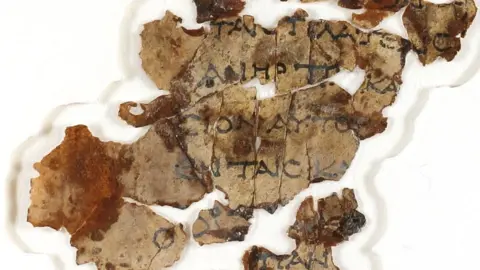
Greek Minor Prophets Scroll Has God’s Name In Hebrew
Greek Minor Prophets Scroll Has God’s Name In Hebrew

Israel Antiquities Authority Fragments of parchment found in the Cave of Horror

The Greek Minor Prophets Scroll is pictured above.

The early Christians in the 1st century used both Hebrew and Greek (called the Septuagint, abbreviated LXX) manuscript scrolls of the Old Testament (OT). The early Christians used the Greek Septuagint Version (LXX) for much of their reading the Hebrew Scriptures, commonly known as the Old Testament (OT)., as reflected in many New Testament (NT) quotes from the OT. Most extant copies of the LXX have the Greek “kyrios” (“Lord”) rather than “Yahweh” (“YHWH” in Hebrew). Why? read more

Did Moses Write the Torah, or Pentateuch? – Why It Matters

Did Moses Write the Torah, or Pentateuch? – Why It Matters

An opened Torah scroll (Book of Genesis part).

Many modern “scholars” believe the first five books of the Bible, called the Torah, or Pentateuch, written after the exile, that is, after 586 BCE, while the older Jewish and Christian view is that Moses wrote it. Did Moses write the Torah, or Pentateuch? Why does it even matter?

The Torah was originally one scroll when originally written in ancient Hebrew, which had no written vowels. The reader would supply the vowel sounds, and people would listen when it was publicly read by the priests so they could learn the correct pronunciations. Later, in the 3rd century BCE, when the Torah was translated into Greek, which had written vowels, it became necessary to divide the Torah into five parts, which came to be called, Genesis, Exodus, Leviticus, Numbers, and Deuteronomy. From this the name Pentateuch was used to describe these five books, which were originally only one scroll in the ancient Hebrew. In any case, the entire Torah, or Pentateuch, is often referred to in the scriptures as, “the Law”, “the Law of Moses”, or sometimes, as just “Moses”. read more

Assyrian Cuneiform Seal Discovered Reveals Judah Tax Bill

Assyrian Cuneiform Seal Discovered Reveals Judah Tax Bill

Assyrian Cuneiform Seal discovered in 2025   “The mouths of liars will be silenced”—Psalm 63:11 NIV   Until the 1840’s critics claimed the Bible’s many references to the Assyrians were fictional, because there no external evidence outside of the Bible of an Assyrian kingdom. However, these critics claims were silenced with numerous independent archaeological discoveries supporting the Bible’s record of the Assyrian kingdom. Archaeological discoveries continually uncover artifacts which support the Bible record as being authentic and true. One headline described a recent sensational find this way:
Archaeologists Uncover 2,700-Year-Old Inscription Under the Western Wall on the Temple Mount
THE 2025 DISCOVERY OF THE ASSYRIAN CUNEIFORM SEAL  Details of this discovery are quoted here in this article.  
Archaeologists Found an Ancient Tablet Inscribed With an Ominous Royal Threat

Death and taxes have always been inevitable, even in the ancient world.
Here’s what you’ll learn when you read this story:
A fragment of a cuneiform seal that’s now the first direct evidence of official communication between the kingdoms of Judah and Assyria has emerged at an archaeological site in Israel.
According to the cuneiform writing on the seal, which was meant to summarize a longer document, the king of Assyria demanded that the king of Judah pay his taxes.
The seal is thought to be from the same time period when Assyria conquered Judah and made it a vassal state required to pay tribute to the Assyrian king.—Popular Mechanics, November 3, 2025 read more

Critics Wrong & the Bible Right About the Hittites

Critics Wrong & the Bible Right About the Hittites

Map of the Hittite Empire at its greatest extent, with Hittite rule c. 1300 BC

There are over 50 mentions in the Bible of a people called Hittites. However, no such people are mentioned in the histories of Greece, Egypt or any other ancient national group. By the 19th century, skeptical scholars had relegated these Biblical accounts to the realm of myth. With no archaeological evidence and no mention in known ancient sources, the Hittites seemed to be just another Biblical “myth.” However, archaeological discoveries in the late 19th and early 20th centuries produced evidence that the critics were wrong and the Bible right about the Hittites. read more

Was Quirinius Governor of Syria When Jesus Was Born?

Was Quirinius Governor of Syria When Jesus Was Born?

Mary and Joseph register for the census before Governor Quirinius. Byzantine mosaic at the Chora Church, Constantinople 1315–1320.

Critics and skeptics of the Bible claim that Luke 2:2 contradicts history by saying that Quirinius was “governor of Syria” at the time of Jesus’ birth, because reliable historical records indicate that Quirinius held the position from 6 to 9 CE.

“In those days a decree went out from Emperor Augustus that all the world should be registered. This was the first registration and was taken when Quirinius was governor of Syria. all went to their own towns to be registered. Joseph also went from the town of Nazareth in Galilee to Judea, to the city of David called Bethlehem . . . He went to registered with Mary, to whom he was engaged and who was expecting a child. While they were there, the time came for her to deliver her child”—Luke 2:1-6 NRSV read more

Was Egypt Devastated, as Ezekiel 29:1-16 Predicted?

Was Egypt Devastated, as Ezekiel 29:1-16 Predicted?

Is the Bible reliable?
Can the Bible be trusted that Egypt was devastated?
 

Skeptics and critics have asserted that Ezekiel’s prophecy is false. Was Egypt literally devastated, as Ezekiel 29:1-16 predicted? Could the prophecy have only been fulfilled in a figurative sense?

WHAT SKEPTICS CLAIM

Here is an example of the assertions of skeptics and critics of the Bible:

Possibly the most pessimistic of the Old Testament prophets, Ezekiel proclaimed impending doom upon everyone from Judah itself to the enemy nations surrounding it. The failure of his prophecies to materialize as he predicted makes a compelling argument against the Bible inerrancy doctrine. In one of his doom’s-day prophecies, Egypt was to experience forty years of utter desolation: read more

Bible Accurately Mentions Oasis of Tema (Job 6:19)

Bible Accurately Mentions Oasis of Tema (Job 6:19)

Is the Bible reliable?
The Bible refers to the oasis of Tema accurately.

Ancient long distance travelers were dependent upon having adequate water during their journeys, which could take days or months. This was especially true when traveling through deserts. In the case of caravans of animals carrying heavy loads, the need of large amounts of water was extremely important. That made the oasis of Tema a popular and indispensable stop for Sabean traders traversing across the major north-south in the Arabian desert. Notice the Bible’s passing reference to the oasis of Tema: read more

King’s Gate Found at Susa Confirms the Bible Book of Esther

King’s Gate Found at Susa Confirms the Bible Book of Esther

Is the Bible reliable?
The King’s gate found at the ancient Persian city of Susa confirms what the Bible says in the book of Esther.

Susa (Shushan) was the city of the summer palace of ancient Persian kings. It is the setting of the Bible book of Esther. “At that time King Xerxes reigned from his royal throne in the citadel of Susa” (Esther 1:2 NIV). A team of French archaeologists working there during the 1970’s discovered some locations mentioned in Esther. One of these very interesting finds is was a large gate at Susa, known as “the King’s gate,” (also called the Great Gate), which is mentioned 11 times in Esther (Esther 2:19,21; 3:2,3; 4:2,6; 5:9,13; 6:10,12). read more

Gallio Inscription & the Bema Confirm Historical Accuracy of Acts

Gallio Inscription & the Bema Confirm Historical Accuracy of Acts

Is the Bible reliable?
The historical accuracy of Acts has been confirmed

The historical accuracy of Acts has been questioned, and asserted to be inaccurate. Many discoveries have confirmed the historical accuracy of Acts, two of which are the Gallio Inscription and the Bema in ancient Corinth.

“Paul stayed in Corinth for a year and a half, teaching them the word of God. While Gallio was proconsul of Achaia, the Jews of Corinth made a united attack on Paul and brought him to the place of judgment”—Acts 18:11,12 NIV

The Gallio Inscription, consists of nine fragments found near the Temple of Apollo in Delphi, Greece, in 1908, mentions “Lucius Junius Gallio, my friend, and the proconsul of Achaia.” It is a copy of a letter from Roman Emperor Claudius and indicates that Gallio was the proconsul of Achaia at the time. The inscription further states that Claudius was confirmed Emperor for the 26th time, which dates it to late April/early May of the year 52 CE. read more

Archaeological Discoveries of Baalis, King of Ammon

Archaeological Discoveries of Baalis, King of Ammon

Is the Bible reliable?
Archaeological discoveries of Baalis, king of Ammon, help confirm the Bible’s accuracy

Critics claim the Bible is largely a work of fiction. However, archaeological discoveries of Baalis, king of Ammon help to prove the Bible’s authenticity.

“Now Johanan, son of Kareah, and all the military leaders in the field came to Gedaliah in Mizpah and said to him, ‘Surely you are aware that Baalis, the Ammonite king has sent Ishmail, son of Nethaniah, to assassinate you?’ But Gedaliah, son of Ahikam, would not believe them”—Jeremiah 40:14 NAB

Even in minor details, the Bible proves true, when examined in the light of external evidence. “Baalis, the Ammonite king” is mentioned only once in the Bible (Jeremiah 40:14), and that in a very incidental way. A seal and a seal impression with the name of Baalis have been discovered. read more

WP2Social Auto Publish Powered By : XYZScripts.com