Ancient Bible Manuscript Detail Comparisons
CONCLUSION
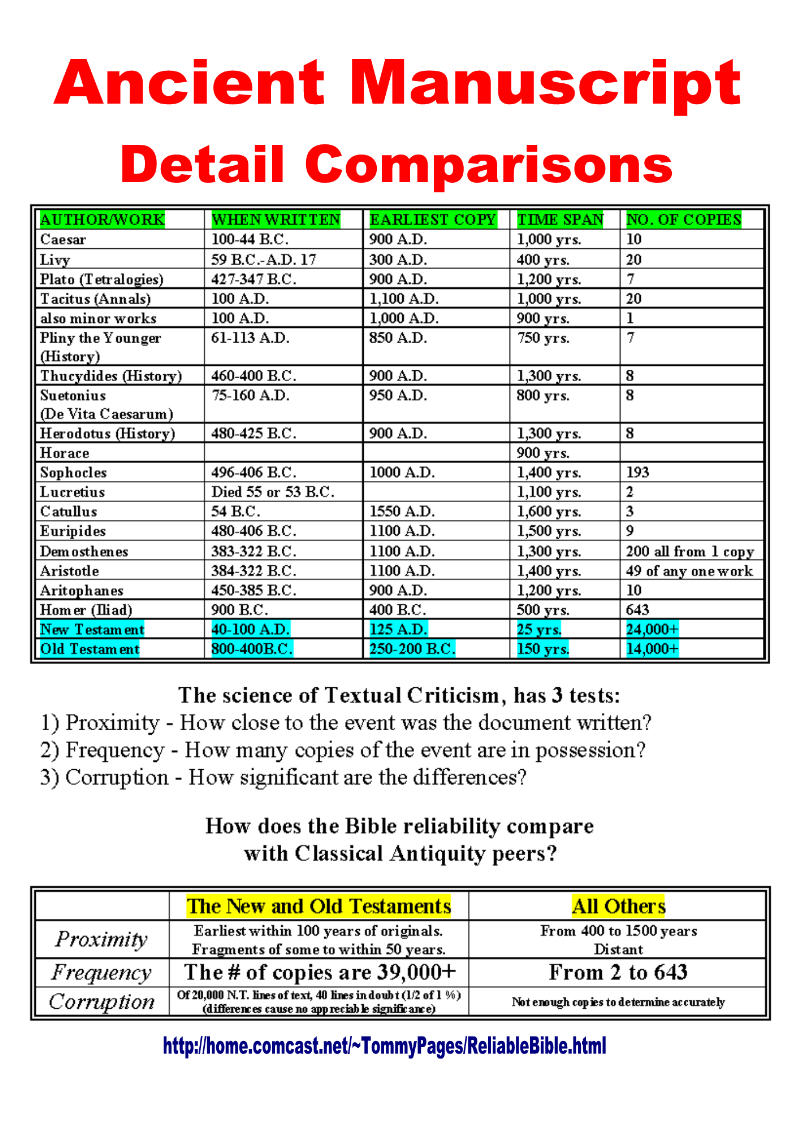
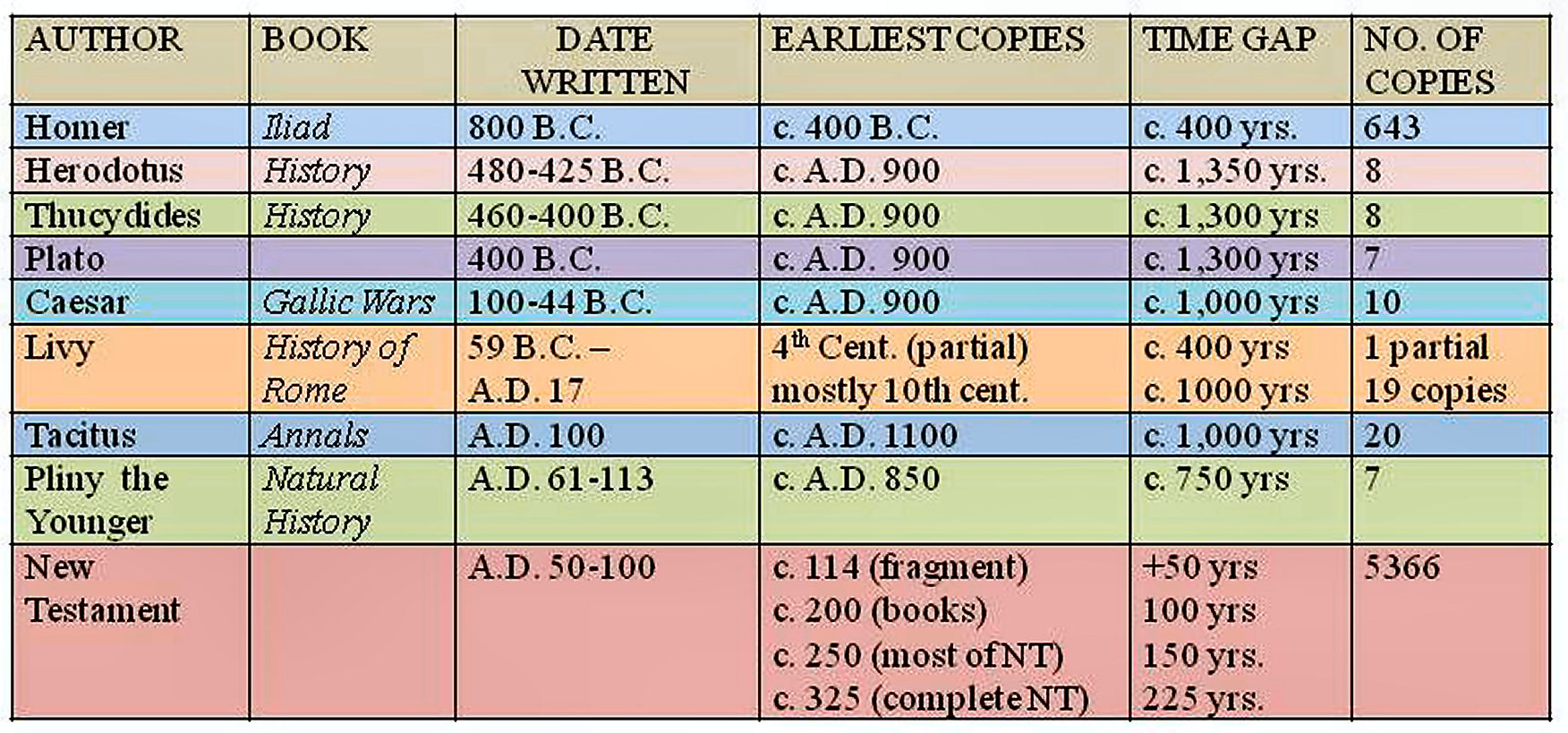
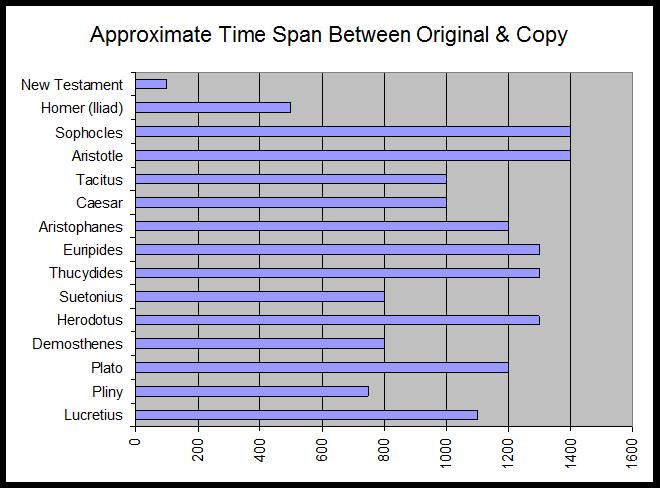
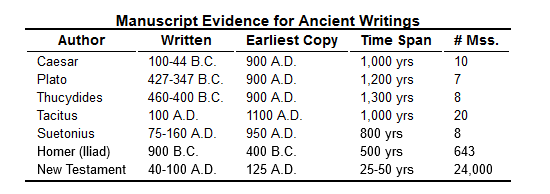
These ancient Bible manuscript comparisons illustrate that there is no other ancient work that has anywhere near the authenticity of the Bible. This is what we would expect from something that is truly “inspired by God” (2 Timothy 3:16 NAB).
For more information related to this subject, please see the following articles on this website:
“What Is Textual Criticism? Has the Bible Been Changed?” – https://bibleauthenticity.com/textual-criticism/
“The Rylands Papyrus 457 Dated to 125-135 CE” – https://bibleauthenticity.com/?s=457
“Oldest Most Complete Hebrew Manuscript W/Punctuation & Vowels” – https://bibleauthenticity.com/oldest-most-complete-hebrew-scripture-manuscript-with-punctuation-and-vowels/
“Advantages of Using Multiple Bible Translations” – https://bibleauthenticity.com/why-using-10-bible-translations-may-be-better-than-knowing-biblical-greek/
“‘The Most Correct Book’ of Mormon Plagiarizes the KJV” – https://bibleauthenticity.com/the-most-correct-book-of-mormon-plagiarizes-the-kjv/
Love your work!
Thank you so much!
God is good and you are awesome. All my friends need to know this Jesus Christ in my heart.
Praise God, and thank you so much! I feel as Jesus said we should, “So you also, when you have done everything you were told to do, should say, ‘We are unworthy servants; we have only done our duty'” (Luke 17:10 NIV).
Yes, you’re in a very good position to be able to share with your friends “the good news about Jesus the Messiah, the Son of God” (Mark 1:1 NIV), especially since you already have a relationship with them. The apostle Paul is a good one to imitate. “He reasoned with them from the Scriptures, explaining and proving that the Messiah had to suffer and rise from the dead” (Acts 17:2,3 NIV), and advised, “Always give yourself fully to the work of the Lord, because you know that your labor in the Lord is not in vain” (1 Corinthians 15:58 NIV). Praying for you!
This does not show the authenticity of the content of the Bible. It is simply showing that copies are more likely to be exact replicas of the original, as the amount of time between original and copy and is diminished as compared to other texts.
Please see the article on this site, “EVIDENCE of EARLY NEW TESTAMENT CANON by c. 100 CE”.
Thank for your response.
You’re right, these charts are not intended to “show the authenticity of the content of the Bible.” They do indeed show “that [the] copies are more likely to be exact exact replicas of the original[s], as the amount of time between original and copy is diminished as compared to other texts.” These charts do a good job of showing these things, but do not cover everything there is to cover about the authenticity of the Bible. There are other articles which do that.
If you have any questions, let us know.
The fact that the extant ancient manuscript copies of the scriptures enable textual scholars to create Hebrew-Aramaic Old Testament, and Greek New Testament Master Texts which accurately to a very high degree represent the original writings, does authenticate the content of the Bible. God has preserved his word (1 Peter 1:24,25).
Some of the information in the images above is deceptive. For example, the earliest “copy” of the New Testament does not date from 125 A.D.; rather, it’s only a papyrus fragment of John’s Gospel. And: Is it tens of thousands of New Testament manuscripts . . . or, just over 5,000?
MA—Some of the information in the images above is deceptive. For example, the earliest “copy” of the New Testament does not date from 125 A.D.; rather, it’s only a papyrus fragment of John’s Gospel.
BA—The John Rylands Manuscript 457 (P52) is a copy of a few verses of the New Testament (John chapter 18), and is the earliest copy of the New Testament, even though it’s only a tiny fragment.
“Your new birth was not from any perishable seed, but from imperishable seed, the living and enduring Word of God. For all humanity is grass, and all its beauty like the wild flower’s. As the grass withers, the flower fades, but the word of the Lord remains for ever. And this word is the Good News that has been brought to you”—1 Peter 1:24,15 NJB
“This disciple is the one who testifies to these events and has recorded them here. And we know that his account of these things is accurate”—John 21:24 NLT
Almighty God promised to preserve his word, and he has done just that!
The Rylands Papyrus 457 (P52) is the oldest copy yet discovered of any portion of the New Testament, having been paleographically dated back to the first half of the second century CE, about 125-135 CE A tiny fragment of a codex (a leaf-form text, like a modern book, in contrast to a scroll) of the Gospel of John, it contains parts of John 18:31-33 on one side and John 18:37-38 on the other side. It was acquired in Egypt in 1920 and is now in the John Rylands Library in Manchester, England.
Despite its tiny size (less than 3.5 in. [9 cm] from top to bottom), this papyrus fragment is highly significant. It testifies that by the first half of the second century the Gospel of John was already being read in Egypt, far from Ephesus in Asia Minor, the most likely place of its composition by the apostle John. It seems unlikely that John’s Gospel could have been composed any later than the end of the first century, the late 90’s, since it would have taken time for it to have been accepted and disseminated so far from its place of origin. The manuscript, of which P52 is a fragment, must have been copied within 25 to 30 years of the composition of the Gospel itself. It gives us strong evidence that John’s gospel was written by the apostle John prior to the end of the first century. John’s gospel itself gives us strong clues that he wrote it himself (John 19:35; 20:30,31; 21:24).—Quoted from an article about the The John Rylands Manuscript 457 (P52), on this website
MA—And: Is it tens of thousands of New Testament manuscripts . . . or, just over 5,000?
BA—Over 5,800 Greek,10,000 Latin, and 9,300 manuscripts in other ancient languages.
The New Testament has been preserved in more manuscripts than any other ancient work of literature, with over 5,800 complete or fragmented Greek manuscripts catalogued, 10,000 Latin manuscripts and 9,300 manuscripts in various other ancient languages including Syriac, Slavic, Gothic, Ethiopic, Coptic, Nubian, and Armenian. The dates of these manuscripts range from c. 125 (the 52 papyrus, oldest copy of John fragment) to the introduction of printing in Germany in the 15th century. —Wikipedia