Greek Minor Prophets Scroll Has God’s Name In Hebrew
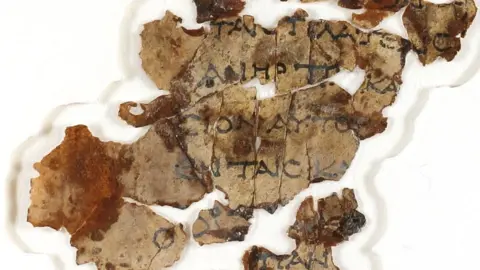
The Greek Minor Prophets Scroll is pictured above.
The early Christians in the 1st century used both Hebrew and Greek (called the Septuagint, abbreviated LXX) manuscript scrolls of the Old Testament (OT). The early Christians used the Greek Septuagint Version (LXX) for much of their reading the Hebrew Scriptures, commonly known as the Old Testament (OT)., as reflected in many New Testament (NT) quotes from the OT. Most extant copies of the LXX have the Greek “kyrios” (“Lord”) rather than “Yahweh” (“YHWH” in Hebrew). Why?
THE HISTORICAL FACTS
There are numerous extant Hebrew manuscripts of the Old Testament containing God’s name “YHWH” (Yahweh) in the text. Many Greek speaking Jews were living in Alexandria, Egypt and other places who were not fluent in Hebrew in the 3rd century BCE. To meet this need, scholars translated the Hebrew Scriptures into Greek. While it is widely acknowledged that the Hebrew manuscripts had God’s name in the text, many think that the Septuagint (LXX) had entirely replaced God’s name YHWH, Yahweh, with Kyrios, Lord, throughout the Greek text. This is because the oldest extant copies of the LXX, the 4th century Vatican 1209 and the Sinaiticus manuscripts, and the 5th century Alexandrine manuscript, have “Kyrios”, “Lord”, not YHWH (Yahweh) in the text.
Several fragments of the LXX of Genesis and Deuteronomy, dated to the 1st century BCE, and one of Job 42, dated to 50 BCE to 50 CE, have been discovered, which YHWH in Hebrew within the Greek text of the OT. However, since the New Testament Greek text has “Kyrios”, “Lord”, not YHWH (Yahweh), it was thought that by the latter half of the 1st century CE, YHWH had been completely replaced by substituting Kyrios in the text as copies were made of the LXX.
THE DISCOVERIES
But then, in March 2021, an amazing thing happened! Fragments of a Biblical scroll of the Minor Prophets, called the Greek Minor Prophets Scroll, were discovered in Dead Sea Cave 8, called The Cave of Horrors, and were pieced together to reveal the Biblical text of Zechariah 8:16-17 and Nahum 1:5-6. One very interesting fact about this discovery was that at Zechariah 8:17, God’s name in ancient paleo-Hebrew letters was used, not the Greek word Greek “kyrios” (“Lord”). Here’s how the verse is translated:
“‘Let none of you devise evil in your heart against another, and do not love false oaths, for all these are what I hate,’ declares Yahweh”—Zechariah 8:16-17 LSB
The Greek Minor Prophets Scroll was apparently stored in Cave 8 during the Bar Kokhba Revolt of 132-136 CE, and is thought to have been written during the 1st century CE, or possibly early in the 2nd century CE. These facts give evidence, not only that the 1st century Christians must have used LXX manuscripts with ‘Yahweh” in the text, but copies of the LXX were still being made that used “Yahweh”, and not “Lord”.
NEWS REPORTS OF THE DISCOVERY
Let’s look at two news reports of the March 2021 discovery.
BBC 16 March 2021
The words were written in Greek, apart from that of God, which was in Hebrew
Fragments of a Biblical scroll and other relics have been found in what officials call an “historic discovery” in desert caves in Israel.
The dozens of pieces of parchment were written in Greek, with just the name of God appearing in Hebrew.
The scroll is believed to have belonged to Jewish rebels who fled to the hills following a failed revolt against Roman rule in the 2nd Century.
They were found during an operation to prevent caves in the area being looted.
Israel Antiquities Authority Fragments of parchment found in the Cave of HorrorIsrael Antiquities Authority
The words were written in Greek, apart from that of God, which was in Hebrew
It is the first such find of its kind since the early 1960s when similar fragments and some 40 skeletons were discovered at the site which became known as the Cave of Horror.
The newly found remnants contain verses from the books of Zechariah and Nahum, which form part of writings known as the Book of the Twelve Minor Prophets.
Excerpted from William. A Ross, Professor of Biblical Studies, Cambridge University
These fragments are already being studied under the superintendence of Tanya Bitler, Oren Ableman, and Beatriz Riestra. So far, eleven lines of text have been reconstructed from Zech. 8:16-17 and Nah. 1:5-6 (in two different scribal hands), in which an example of the Tetragrammaton appears written in paleo-Hebrew.
ANALYSIS
It is often claimed that Jesus being called “Lord” in the NT means he’s Yahweh. Therefore, it is claimed that the use of Kyrios, Lord, in Septuagint OT solidifies the case that Jesus is Yahweh. However, as more discoveries are made, evidence reveals that is not the case.
Discoveries of early manuscripts of the LXX dated to the 1st century and earlier, with YHWH in the text give evidence that the LXX copies NT writers originally quoted from may have had YHWH in the text, and, therefore, Yahweh may have even been in the text of the NT where it quotes from the OT.
“Yahweh says to my Lord: ‘Sit at My right hand Until I put your enemies as a footstool for Your feet'” (Psalm 110:1 LSB margin). This is the way the Hebrew text reads.
“The Lord said to my lord, ‘Sit on my right until I make your enemies a footstool for your feet” (Psalm 110:1 [109:1 LXX] NETS). This is the way the extant Greek text of the LXX reads. The first “Lord” is clearly “Yahweh” God the Father, and the second “lord” is clearly his Son, Jesus Christ.
Psalm 110:1 is quoted in its entirety in the New Testament Greek text at Matthew 22:44; Mark 12:36; Luke 20:42 and Acts 2:34-35, using “Lord” in place of “Yahweh”, and this is the way almost all translations render the Greek into English. The marginal reading of the LSB translation uses “Yahweh” in each of the NT quotes, since Yahweh is in the Hebrew Scriptures.
CONCLUSION
Whereas it was once thought that God’s name “YHWH” was not in the Greek Septuagint Version, recent discoveries have revealed that “YHWH” was in at least some of copies of the LXX. The fact of 1st century Christians using copies of the Septuagint with “Yahweh” in them punctures the theory that 1st century Christians thought of Jesus as Yahweh.
For more information related to this subject, please see the following article on this website:
“Is God’s Name Yahweh, God, the LORD, or Jehovah?” – https://bibleauthenticity.com/is-gods-name-yahweh-god-the-lord-or-jehovah/