In Paul’s final canonical letter, and now facing certain execution at the hands of the Romans, we would expect Paul to at least make some mention of the doctrine of Trinity, if it is true, since it is purportedly the “primary doctrine of Christianity”. “Paul, an apostle of Christ Jesus by the will of God, in keeping with the promise of life that is in Christ Jesus” (2 Timothy 1:1 NIV). “Christ Jesus” and “God” are introduced here in the opening line of Paul’s letter to Timothy. There is no mention in this opening greeting of the holy Spirit, or a Trinity. Why not, if the holy Spirit is a person, and the Trinity is true doctrine. God, not Jesus, obviously is the one who is supreme, since Paul is “an apostle of Christ Jesus by the will of God“. There is no mention, nor is there any evidence of, any personhood of holy Spirit, or of any “equality” between God and Jesus, or the existence of a Trinity “Godhead”.read more
“Do not believe every spirit, but test the spirits to see whether they are from God, because many false prophets have gone out into the world. ” (1 John 4:1 NIV) Is the Trinity in James?
Is the Trinity in James? James’ short general letter to early Christians doesn’t have a plethora of references to God, Jesus, and the holy Spirit, but what it does have is more than enough to figure out whether the Trinity doctrine is in the book of James. First of all, notice who James is a servant of:
“James, a servant of God and of the Lord Jesus Christ” (James 1:1 NIV). We immediately notice that “God” is identified as being someone other than “the Lord Jesus Christ”. James identifies himself as serving two distinct personages, namely Almighty God and Jesus Christ. These two are not mysteriously merged together, as Trinitarians assert. Their distinctive separateness is maintained. Notable by absence are references to the Trinity and the holy Spirit. If these are real, why isn’t James serving them?—Perhaps because the Trinity is fictional. He’s not serving the holy Spirit because it is not a person, even though it is real. “The holy Spirit” is called “it” at John 1:32 (ESV); 14:17 (NAB, REB), Acts 2:33; 8:16; 11:15 NAB, and Romans 8:16,26,27 (NAB; REB). Persons are not called “it”. The holy Spirit is God’s “power” (Acts 1:8), not a person.read more
Is the Trinity doctrine in the book of Colossians? Let’s examine all the verses in this Bible book where God and Jesus are mentioned in relation to each other. Also. let’s look for any references to the holy Spirit, which is said to be the third person of the Trinity. Then, let’s see whether what Bible says agrees with Trinitarianism, or proves it to be false. Notice all the references in this letter to the superior position of Almighty God toward his Son, Jesus Christ, and the subordinate position of Jesus Christ in relation to his heavenly Father.read more
2 Peter—Is Jesus Christ Almighty God, or Part of a Trinity?
Trinitarian bias has influenced translators to render the first verse of the letter of 2 Peter in a way that makes it appear as though Jesus is Almighty God. For example,
“by the righteousness of our God and Savior Jesus Christ” (2 Peter 1:1ESV). read more
Can God the Father of the Bible be the only Almighty?
“The Father is Almighty, the Son is Almighty, and the
Holy Spirit Almighty. And yet they are not three Almighties, but one Almighty. So the Father is God, the Son is God, and the Holy Spirit is God. And yet there are not three Gods, but one God”—The Athanasian Creedread more
The Fixed New Testament Text – a Huge Problem for Trinitarianism!
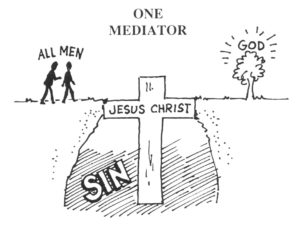
“There is one God and one mediator between God and mankind, the man Christ Jesus, who gave himself as a ransom for all”—1 Timothy 2:5,6 NIV
“Mediator. One who represents God to humans and humans to God–and who removes all alienation between them by offering himself as a ransom for ‘all'”—NIV Study Bible footnote on 1 Timothy 2:5
The Bible says that Jesus Christ is the mediator BETWEEN God and mankind.
“GOD-MAN” MEDIATOR CLAIMS
Trinitarians claim that Jesus is God, and their “God-man” also. How do they explain this apparent contradiction?
They claim that only Jesus could be the mediator because he is the “God-man”, that is, he’s “fully god, fully man”, they claim”, thus being part and parcel of both parties he represents.
Jesus is the Mediator between God and mankind. Yet, Trinitarians claim Jesus is also God, and call him “God-man.”Trinitarians say: “Jesus MUST be God in order to be our mediator.”
That is the crux of their argument. Since there is nothing in the scriptures to support such an idea, Trinitarians resort to equivocation by changing the meaning of “mediator”, since Jesus being the mediator BETWEEN humans and God (1 Timothy 2:5) presents a huge problem for their Trinity doctrine. (2 Corinthians 10:3-4).
Trinitarians ask: “If he did not share God’s nature, how could he bring us to God and God to us?”
“GOD-MAN” MEDIATOR CONCEPT IS SELF-DEFEATING
And the Biblical answer is…
“Christ offered himself to God as a perfect sacrifice for our sins. THAT IS WHY HE IS THE ONE WHO MEDIATES a new covenant between God and people” (Hebrews 9:14-15 NLT).read more
The Bible says God cannot die. Yet Trinitarians assert that Jesus must be God himself in order to die for the sins of mankind stands in stark contradiction to all scriptural evidence. It was Jesus, not God, who died for sins.
It was Jesus – not God – who died for the sins of mankind
“LORD [Yahweh], are you not from everlasting?My God, my Holy One, you will never die” (Habakkuk 1:12 NIV)
From this scripture, we can see that it is impossible that Jesus could be the God who would die for the sins of mankind, since the prophecy of Habakkuk was written over 600 years prior to Jesus and clearly states that God will never die.
“For you know that it was not with perishable things such as silver or gold that you were redeemed from the empty way of life handed down to you from your ancestors,butwith the precious blood of Christ, a lamb without blemish or defect. ” (1 Peter 1:18,19 NIV)
Again, contrary to the Trinitarian assertion that without Jesus being God, then his blood is “ordinary”, and could not atone for sins, we see clearly stated that Jesus’ blood is precious, and does indeed atone for our sins. Why? Because, “God cannot be tempted” (James 1:13 NIV). Jesus is the only one who has
Are God, Jesus and the holy Spirit part of a Trinity? Is Jesus God? Let’s take a look at the Bible book of Titus to find some clues to answer these questions.
What does the Book of Titus say about God, Jesus, and the holy Spirit?
“Paul, a servant of God and an apostle of Jesus Christ.” (Titus 1:1NIV) “God” is named as being someone other than “Jesus Christ”. If Jesus was God, as Trinitarians claim, why are God and Jesus are referred to separately? It’s because they are separate and distinct individuals, and not merged into a mysterious Trinity! Why does Paul not say that he is a servant of the holy Spirit, or the Trinity? Because, even though the holy Spirit is real, it’s not a person, and the idea any sort of Trinity is not found in the Bible.
“Grace and peace from God the Father and from Christ Jesus our Savior.” (Titus 1:4 NIV) “God” is identified as someone other than Jesus, and is named as “the Father,” not the Son, or the holy Spirit, or the Trinity. Jesus is separate and distinct from God. “Grace and peace” are not said to come from the Trinity, because it is fictional, nor are they said to come from the holy Spirit, because it is not a person.
Many translations render Titus 2:13 as though Jesus and Almighty God are the same being, essence, or substance, due to Trinitarian bias, like this: “the appearing of the glory of our great God and Savior, Jesus Christ” (Titus 2:13 ESV). More accurately, however, the verse is translated as in the following fourteen Bible translations:
“As we await the blessed hope, the appearance of the glory of the great God and of our Savior Jesus Christ” (Titus 2:13 NAB).
“looking for the blessed hope and the appearing of the glory of glory our =&0=&
“Looking for that blessed hope, and the glorious appearing of the great God and our Saviour Jesus Christ” (Titus 2:13 KJV).
“the appearing of the glory, of the great God and of our savior, the Anointed One, Jesus” (Titus 2:13Hart)
“While we wait for the blessed hope and the manifestation of the glory of our great God and our Savior, Jesus Christ” (Titus 2:13 NRSV margin).
“looking for the blessed hope and appearing of the glory of the great God and our Saviour Jesus Christ” (Titus 2:13 ASV).
“Looking for the blessed hope and coming of the glory of the great God and our Savior Jesus Christ” (Titus 2:13 Douay)
Who is the ultimate authority? Most Churches believe, preach and teach the following:
“In this Trinity . . . None is greater, or less, than another. But the whole three Persons are . . . coequal”—Athanasian Creed
The Trinity is implied to be the ultimate authority in the famous creed quoted above. Not all Christians are in agreement about the roles of God the Father, Jesus, the holy Spirit and the Trinity. Some say God is the ultimate authority, some say Jesus is the ultimate authority, and some say the Trinity is the ultimate authority, and a few even say the holy Spirit is the ultimate authority . Some say they are equal. And some say Jesus is Almighty God. Red-letter Bibles put words the editors think were spoken by Jesus in red, which implies that Jesus’ words are more important than God’s words. But what does the Bible say? Let’s examine some scriptures to find the answer.
“All authority in heaven and on earth has been given to me…” – by whom?
“He has given him authority to judge because he is the Son of Man” (John 5:27). “I am not here on my own authority but he who sent me is true.” (John 7:28) Jesus plainly states his authority came from his Father, and that he didn’t come on his own authority, but God sent him.
“If anyone’s will is to do God’s will, he will know whether the teaching is from God or whether I am speaking on my own authority.” (John 7:17 ESV).”I do not speak on my own authority.” (John 14:10)read more