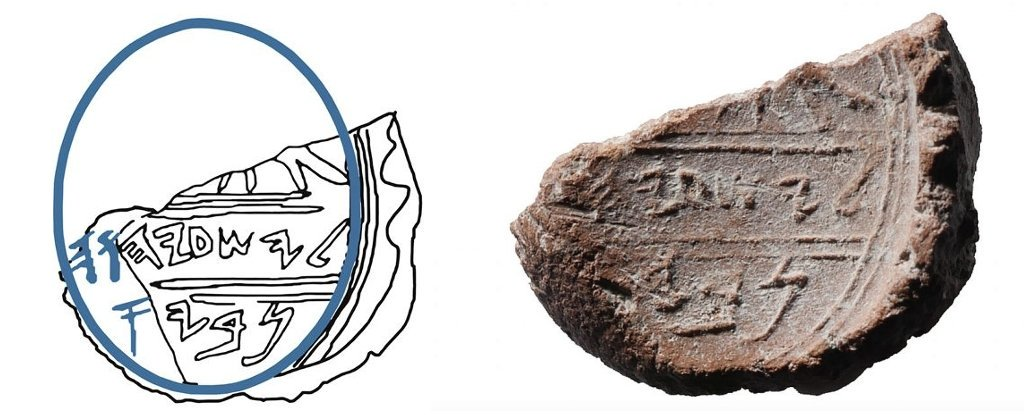
Critics of the Bible claim that it is largely a work of fiction. However, recent archaeological discoveries are proving the Bible true and its critics wrong. Two examples od this are the discoveries of the clay seals of the prophet Isaiah, and of King Hezekiah.
For the first time, archaeological evidence (a seal impression) of Isaiah has been discovered, it seems. See the article by Michelle Starr published on February 23, 2018. The book of Isaiah is quoted more often than any other prophetic Old Testament book, and is second only to Psalms in overall New Testament quotes. Below is the article about the discovery of the clay seal of the prophet Isaiah:
The Biblical figure Isaiah who prophesied the coming of the Messiah may have been an actual real person.
Researchers have found an ancient clay seal from around the time he was reportedly alive, marked with his name.
Called a bulla, the seal was retrieved from a 2,700-year-old midden in the Ophel, dating it to around 8th century BCE, and it’s inscribed with the Jewish prophet’s name.
It was found just 3 metres from where the bulla of King Hezekiah of Judah, to which Isaiah was an adviser, was found in 2015.
“We appear to have discovered a seal impression, which may have belonged to the prophet Isaiah, in a scientific, archaeological excavation,” said lead author Eilat Mazar of the Hebrew University in Jerusalem.
“If it is the case that this bulla is indeed that of the prophet Isaiah, then it should not come as a surprise to discover this bulla next to one bearing King Hezekiah’s name given the symbiotic relationship of the prophet Isaiah and King Hezekiah described in the Bible.”
The bulla, sadly broken, is about a centimetre (0.4 inches) in diameter, stamped with the name Yesha’yah[u] (Isaiah) in Hebrew letters. Following it were the letters NVY, which are the first three letters of the Hebrew word for prophet, which is spelled nun-beit-yod-aleph.
Whether or not the aleph was present is impossible to determine, since the bulla is broken after the yod. But if it had been, the seal would have read, in its entirety, “Isaiah the Prophet.”
“The absence of this final letter … requires that we leave open the possibility that it could just be the name Navi,” Mazar said. “The name of Isaiah, however, is clear.”
The seal could have belonged to some other Isaiah hanging around at the time, since the name was a common one, and bullae commonly reference the signatory’s father. Isaiah’s father was not Navi, but Amoz.
However, if the bulla does refer to Isaiah the Prophet, it would constitute the first evidence for his existence outside of religious texts, including the Bible, where his exploits are described in the Book of Isaiah.
The authorship of the Book is unclear, but he seemed to be very close to King Hezekiah, who ruled between around 727 and 698 BCE. It was Isaiah, according to the Bible, who advised Hezekiah to resist the warring Assyrians, preventing the invasion of Jerusalem by way of divine intervention.
Although the bulla can’t constitute definitive proof that Isaiah existed, it’s still an extraordinary find, Mazar said. Its proximity to the bulla of Hezekiah and the fact that only persons of status used bullae at least opens the very plausible possibility that the seal belonged to the Biblical Isaiah.
Also, fascinatingly, on the reverse side is the imprint of weave, indicating that the seal had been used to close a cloth package – and it’s marked by the fingerprint, likely from the person who sealed the package. Perhaps this was Isaiah himself.
“The discovery of the royal structures and finds from the time of King Hezekiah at the Ophel is a rare opportunity to reveal vividly this specific time in the history of Jerusalem,” Mazar wrote in her paper.
“The finds lead us to an almost personal ‘encounter’ with some of the key players who took part in the life of the Ophel’s Royal Quarter, including King Hezekiah and, perhaps, also the prophet Isaiah.”
The paper has been published in the journal Biblical Archaeology Review. read more
 Assyrian Cuneiform Seal discovered in 2025
“The mouths of liars will be silenced”—Psalm 63:11 NIV
Until the 1840’s critics claimed the Bible’s many references to the Assyrians were fictional, because there no external evidence outside of the Bible of an Assyrian kingdom. However, these critics claims were silenced with numerous independent archaeological discoveries supporting the Bible’s record of the Assyrian kingdom.
Archaeological discoveries continually uncover artifacts which support the Bible record as being authentic and true. One headline described a recent sensational find this way:
Assyrian Cuneiform Seal discovered in 2025
“The mouths of liars will be silenced”—Psalm 63:11 NIV
Until the 1840’s critics claimed the Bible’s many references to the Assyrians were fictional, because there no external evidence outside of the Bible of an Assyrian kingdom. However, these critics claims were silenced with numerous independent archaeological discoveries supporting the Bible’s record of the Assyrian kingdom.
Archaeological discoveries continually uncover artifacts which support the Bible record as being authentic and true. One headline described a recent sensational find this way: