Robber Fly – Highly Adapted By Evolution, or Designed By God?
The robber fly is a powerfully built, bristly fly with a short, stout proboscis enclosing the sharp, sucking hypopharynx. The name “robber fly” reflects its notoriously aggressive predatory habits; it feeds mainly or exclusively on other insects and as a rule it waits in ambush and catches its prey in flight.
“God said, ‘Let the waters swarm with living creatures, and let birds and other winged creatures fly above the earth in the open expanse of the sky’” (Genesis 1:20 EHV).
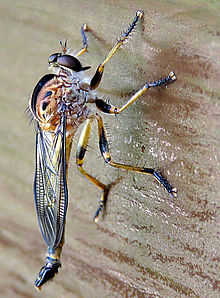
A BBC News article published on March 9, 2017, entitled “Robber fly: Hunting secrets of a tiny predator revealed,” reports that the mid-air hunting strategy of the robber fly has been revealed by an international team of scientists.
Robber fly: Hunting secrets of a tiny predator revealed
The mid-air hunting strategy of a tiny fly the size of a grain of rice has been revealed by an international team of scientists.
Holcocephala, a species of robber fly, is able to intercept and “lock on” to its prey in less than a second.
Researchers used high-speed cameras to show exactly how the fly positioned itself to capture a moving target in mid-air.
The results are published in the journal Current Biology.
Paloma Gonzalez-Bellido from Cambridge University explained that, normally, “when we think of hunting animals we think of excellent vision and speed, but when you’re so very tiny, you have a very small brain and limited sensory capacity”.
She added: “We wanted to know how [this fly manages] this predatory behaviour.”
Dr Gonzalez-Bellido and her colleagues created a miniature outdoor studio – filming the fly from two angles to capture its movement in 3D.
They discovered that the fly maintained what they described as a “constant bearing angle” – keeping its prey in the centre of its field of vision.
PhD student Sam Fabian explained: “They’re not sticking to a trajectory; if the target changes direction, they compensate, so this is reactive.”
In doing this, the insects are essentially using a very old navigation rule employed by sailors, Dr Gonzalez-Bellido explained.
“If another vessel is not moving within your field of view, and it’s getting bigger and closer, you’re on a collision course,” she said.
The team also studied the fly’s eyes, revealing that part of its hunting secret was contained in its highly adapted vision. Larger lenses and a high density of extremely tiny sensors at the centre of its eyes allow it to see its prey from a distance and to accurately “lock on” as it approaches.
“This gives this fly a resolution in this area that’s the same as much larger dragonflies,” explained Dr Gonzalez-Bellido. “It’s an extreme adaptation.
The next step for scientists is to find out exactly how Holcocephala’s brain takes this visual information and turns it into a stealth hunting manoeuvre in the blink of an eye.”
“Highly adapted?”
This tiny fly, “the size of a grain of rice,” is much more complex than a jet plane and a helicopter rolled into one! Jet planes and helicopters are designed, yet this much more complex flyer was not?
“How numerous Your works are, O Yahweh!
In wisdom You have made them all;
The earth is full of Your possessions.“
(Psalm 104:24 LSB)
The “wisdom” of God that designed this tiny creature and billions of others is beyond the scope of human knowledge. Yet they want “to find out how it works!”?
“I know every bird in the mountains,
and the insects in the fields are mine.“
(Psalm 50:11 NIV)
Better yet, humans would profit much more by finding out who this designer of “insects” such as Holocephala is.
“O the depth of the riches and wisdom and knowledge of God! How unsearchable are His judgments and unfathomable His wisdom is” (Romans 11:33 LSB).
Darwinian Macro-Evolution could never in trillions of years of time ever produce such a complex and highly efficient flying creature as this fly. Such an accomplish could only be achieved by “Yahweh, . . . Lord God, the Almighty” (Revelation 19:6 HCSB), “who is perfect in knowledge” (Job 36:4 LSB).