Failed Biosphere 2 – Evidence God & Bible Are True
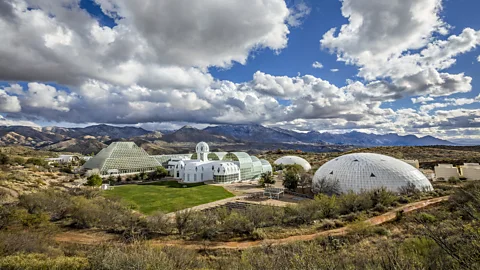 re 2 facility in Arizona (Credit: Steven Meckler)" />
The failed Biosphere 2 experiment of the early 1990’s illustrates what the Bible said all along. Scriptures are interspersed throughout this article amidst quotes from the BBC article about Biosphere 2.
“In the beginning God created the heavens and the earth” (Genesis 1:1).
“How the Biosphere 2 experiment changed our understanding of the Earth—July 5, 2025
In the early 1990s, a small team tried to survive in a hermetically sealed space containing replicas of Earth’s ecosystems. Their trials and discoveries still have repercussions today.
Glittering in the vast expanses of the Arizona desert lies a structure that seems torn straight out of the pages of science fiction.
Inside a massive complex of glass pyramids, domes and towers, spread across three acres (1.2 hectares), stands a tropical rainforest topped by a 25ft (7.6m) waterfall, a savannah and a fog desert. They sit alongside a mangrove-studded wetland and an ocean larger than an Olympic swimming pool which includes its own living coral reef.
It’s seemingly a little capsule of Earth, which is why the structure is called Biosphere 2 – named after our own planet, Biosphere 1.
The desolate landscape forms the perfect backdrop for the futuristic experiment that once took place here. In the early 1990s, eight people locked themselves inside, sealed off from the outside world for two years, to explore the challenges of living in a self-contained system – a prerequisite for building colonies in outer space. They fed themselves from the crops they grew, they recycled their own wastewater and they tended to the plants that produced their oxygen.
“Yahweh, who created the heavens (He is the God who formed the earth and made it; He established it and did not create it a formless place, but formed it to be inhabited)”—Isaiah 45:18 LSB
In terms of sustaining human life, the experiment did not go well. As one commentator put it in the 2020 documentary Spaceship Earth, “everything that could go wrong went wrong”. Oxygen levels plummeted, making the inhabitants sick, while carbon dioxide (CO2) levels increased. Countless animals died, including the pollinators the plants needed to reproduce. And although the “biospherians” did survive on their homegrown food, they lost weight to the point where they became a case study for calorie restriction. When supplementary oxygen needed to be brought in, commentators decried the project as a failure, calling it a “flop” and “new-age drivel masquerading as science”. (Hear more about the “Biospherians” and why the Biosphere 2 experiement was one of the most controversial human experiments of the 20th Century in this BBC podcast.)” —-BBC article
“I know, O Yahweh, that a man’s way is not in himself, Nor is it in a man who walks to direct his steps”—Jeremiah 10:23 LSB
“In recent years, however, many experts have come to see the Biosphere 2 experiment in a new light, with valuable lessons about ecology, atmospheric science and importantly, the irreplaceability of our own planet.
Lisa Rand, a historian of science at the California Institute of Technology, argues that these lessons are especially worth revisiting today as billionaires advance private space programmes and float the idea of space colonies while our own planet is increasingly suffering from climate change and other man-made problems. And to environmental scientists, the Biosphere 2 experiment also demonstrates the value of bold experiments to better understand how the natural world works.
In fact, today, the facility is bustling with scientists testing the effects of climate change on its living ecosystems. Far from helping humans escape Earth, Biosphere 2 seems to have become one of our best tools to understand Biosphere 1.
‘It wasn’t a failure,’ Rand says. ‘I think it was actually ahead of its time.'”
“How numerous are Your works, O Yahweh! In wisdom You have made them all; The earth is full of Your possessions. This is the sea, great and broad, There the creeping things are without number, Creatures both small and great”—Psalm 104:24,25 LSB
The most pressing issue for the biospherians was the decline in oxygen levels, which dropped from normal levels – roughly 21% of the atmosphere – to about 14% after 16 months. That’s equivalent to oxygen levels at about 3,350m (11,000ft) above sea level. Until supplementary oxygen was brought in, the biospherians grew tired and weak from altitude sickness, making farming and other work arduous, Nelson recalls. These and other problems took scientists a while to figure out, says David Tilman of the University of Minnesota Twin Cities, who was part of a committee of ecologists that reviewed the experiment after it concluded. “It was very clear to us that the problem was much more complex than you might imagine at first,” he says.
Experts worked out that the cause was the extremely rich, young soils that had been introduced to fuel rapid growth of crops and other vegetation. This created a lot of food for bacteria and fungi, which, like us, consume oxygen and emit CO2. The trees and shrubs in the new ecosystems – which take up CO2 and release oxygen – were too young and too outnumbered by microbes to counterbalance this effect. “I think that was a really important lesson to learn: that that [soil] microbiome, even though we can’t see it, is extremely influential,” Adams says.
I firmly believe that this really is our only planet ever – David Tilman”—BBC article
What is immensely interesting here is that, not only does this ecologist confess that earth’s vast ecosystems are far more complex than humans have imagined, but he now believes the earth to be the only planet for humans forever.
“Were you there when I made the world? If you know so much, tell me about it”—Job 38:4 Good News Translation
“Fortunately, the rise in CO2 – a greenhouse gas that heats up the atmosphere – was buffered by the fact that much of it got soaked up by the facility’s concrete surfaces. The biospherians also did their best to stem the rise as well as boost oxygen levels. They cut dead grasses in the savannah and trimmed fast-growing rainforest species to stimulate new growth – storing the cut vegetation in dry conditions to slow down its decomposition, a process that releases CO2, Nelson says. They also planted fast-growing plants like sugarcane and created a bed of algae in the basement – but oxygen levels still waned.
While some “extinctions” within the ecosystems were expected as they settled into an equilibrium, the vanishing of pollinating insects was an unexpected problem for plant life. Nelson attributes this to an explosion in the population of longhorn crazy ants that prey on pollinators, while ecologist Brian McGill of the University of Maine suggests they may have died off because the glass enclosing Biosphere 2 blocked ultraviolet light, which the insects needed to find flowers. “Bees in particular see in the UV spectrum,” he says.
The issue wasn’t urgent as most of the ecosystems’ flowering plants were long-lived, but some biospherians pollinated a few species by hand, brushing pollen into flowers so seeds could form, Nelson says. The long-term plan was to control the ant populations and introduce new pollinators from the outside world.
Scientists made other interesting observations. Some trees, they realised, became weak and more prone to breaking, likely because of the lack of wind, which triggers trees to produce “stress wood” that strengthens them, McGill says. Marine biologist and geoscientist Diane Thompson, who now directs marine research at the facility, says that scientists also learned a lot about the kinds of light that corals need to thrive in captivity.
But the most important lesson from the biospherians’ experience, experts agree, is the realisation of how difficult it would be to live anywhere else than on Earth. Humans can’t exist in isolation; they come in “biospheric packages”, as Nelson puts it, and recreating these complex systems is no easy task. While Tilman reckons that some of the problems may have been solvable, it was clear during his visit to the facility that it was a long way away from being able to sustain human life. “It really impacted me when I saw that, because… my initial guess was that you would probably make it work,” he says. Now, “I firmly believe that this really is our only planet ever”.”—BBC article
“The heavens are the heavens of Yahweh, But the earth He has given to the sons of men”—Psalm 115:16 LSB
By extension, the experiment therefore deeply underscored the need to protect our planet in an intact state. Consider the immense technological costs – not to mention the hard physical work by the biospherians – to keep the atmosphere and life support systems intact. Tilman estimates that, if future space colonies are anything like Biosphere 2, they’d cost $82,500 (£61,000) per person a month to live in, and even that would be no guarantee of sustaining human life. “It’s incredibly expensive to try to replace the services that the Earth’s ecosystems provide for free to humanity,” Tilman says.
To Nelson, realising that his own survival was entirely dependent on the health of the ecosystems around him was transformative, as he wrote with colleagues in the book Life Under Glass. Being a biospherian meant living as sustainably as possible – using the gentlest of farming practices, avoiding pollution anywhere inside Biosphere 2, and respecting every oxygen-producing plant. “Just being in a small system where you see that reality – that you’re part of that system, and that system is your life support – changes the way you think at a very deep level,” Nelson says.
But ecology’s mega-experiment doesn’t only help us better understand the intricacies of the living world and how it’s changing amid planetary upheaval. Its story, Nelson says, should also inspire and help every one of us to take better care of our only life-sustaining planet, Biosphere 1. Ultimately, we are all biospherians.”
“O my God . . . Of old You founded the earth, And the heavens are the work of your hands”—Psalm 102:24,25 LSB
What Biosphere 2 has helped to prove is that humans are totally dependent upon Almighty God. Only he could create the universe, including a livable planet, such as earth. Only he can maintain the universe and the one known livable planet, biosphere 1 — the earth!