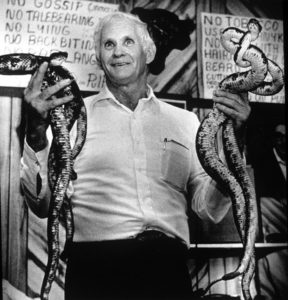
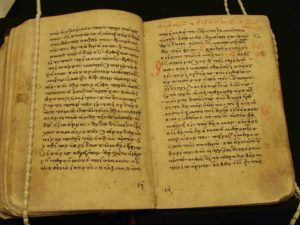
Where does the gospel of Mark end? Modern day snake handlers derive their practice from Mark 16:17-18 (KJV)
Where does the gospel of Mark end?
“I testify to everyone who hears the words of the prophecy of this book: If anyone adds to these things, God will add to him the plagues that are written in this book”—Revelation 22:18 NKJV
Promoters and believers in faith healing often use Mark 16:17-18 as Biblical support for their healing practices:
“They will lay their hands on the sick and they will recover” (Mark 16:18 NKJV).
SNAKE HANDLING AND DRINKING POISON
These last few verses of Mark are very important to snake handling “Christians” because they say: “They will take up serpents” (Mark 16:18 NKJV). The Weymouth translation reads, “They shall take up venomous snakes”. read more
The woman caught in adultery story is well known today among Christians, and even in popular Western culture, but there are questions about it’s authenticity.
THE INSPIRED SCRIPTURES ARE FLAWLESS AND CANNOT BE IMPROVED
“Yahweh’s promises are promises unalloyed; natural silver which comes from the earth seven times refined”—-Psalm 12:6 NJB
“Every word of God is flawless . . . Do not add to his words or he will rebuke you and prove you a liar”—Proverbs 30:5,6 NIVread more
Belshazzar – Discoveries Prove Bible True and Critics Wrong!
The ancient Greek historian Herodotus recorded history that confirms the Bible’s predictions of the fall of Babylon.
“Babylon will suddenly fall and be broken”—Jeremiah 51:9 NIV
“A drought will strike her water supply, causing it to dry up”—Jeremiah 50:38 NLT
“Her mightiest warriors no longer fight. They stay in their barracks, their courage gone . . . The news is passed from one runner to the next as the messengers hurry to tell the king that his city has been captured. All the escape read more
Antiochus IV Epiphanes–Accurately Foretold by Daniel
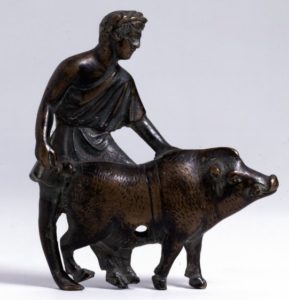
Antiochus IV Epiphanes ruled the Seleucid (Syrian) kingdom from 175 to 164 BCE, and was foretold by Daniel, prophet of Yahweh. Epiphanes means “manifest,” and the name indicates that he claimed to be the earthly manifestation of Zeus. Antiochus attempted to unify his empire by imposing Hellenistic culture upon all its inhabitants. This policy brought him into sharp conflict with the Jews of the region later known as Palestine. Most Biblical scholars believe Antiochus to have been the “small” horn in Daniel 8:9 and the “contemptible person” of 11:21. His relations with the Jews are recorded in 1 and 2 Maccabees (Apocryphal books) and are prophetically depicted in Daniel 8:9-14,23,25 and 11:21-34. “Then from one of the prominent horns came a small horn whose power grew. very great. It extended toward the south and the east and toward the glorious land of Israel” (Daniel 8:9 NLT). He was infamous for establishing pagan worship in the Jerusalem temple.Roman bronze of a man leading a boar to be sacrificed (Jews did not sacrifice swine of any kind)
In about 174 BCE, Jason, the leader of a pro-Greek faction in the Jerusalem priesthood, bribed Antiochus to install him as high priest, after which Jason set about turning Jerusalem into a Greek city (2 Maccabees 4:7-22). In 171 BCE, however, another man, Menelaus, in turn bought the priesthood from Antiochus. Jason, believing that Antiochus had died, seized Jerusalem by force. But Antiochus returned in 169 and carried out a massacre of the city. “Its power reached to the heavens, where it attacked the heavenly army, showing some of the heavenly beings and some of the stars to the ground and trampling them” (Daniel 8:10 NLT). He then moved upon Egypt but was humiliated by the Roman legate C. Popilius Laenas and forced to make an undignified withdrawal to the north. Thereafter, this tyrant vigorously sought to Hellenize Jerusalem.
In 167 BCE, Antiochus dispatched his tax collector Apollonius against Jerusalem with 22,000 men. They attacked on the Sabbath, killing most of the male population and enslaving the women and children. Jerusalem’s walls were demolished and a Seleucid military garrison stationed immediately south of the temple. All Jewish rites were outlawed, resulting in the cessation of the daily sacrifice. An altar to Zeus was erected over the Jewish altar of burnt offerings, and worship of Zeus was instituted in the temple.
“It even challenged the Commander of heaven’s armies by canceling the daily sacrifices offered to him and by destroying his Temple.The army of heaven was restrained from responding to this rebellion. So the daily sacrifice was halted, and truth was overthrown. The horn succeeded in everything it did” (Daniel 8:11,12 NLT). read more
The Book of Revelation is without doubt the most complicated, controversial, and esoteric of the entire Bible! Some even doubt that it should even be in the Bible at all, and assert that its place in the Bible Canon was controversial from the start. This is false. Why? The early acceptance of Revelation by the Christian Church is proof that the book is divinely inspired.
EVIDENCE OF THE EARLY ACCEPTANCE OF REVELATION
We have early, widespread and consistent reception of Revelation. Papias (c 125), Justin Martyr, Irenaus, the Muratorian Fragment, Hippolytus, Clement of Alexandria, Tertullian, and Origen all accepted Revelation as authentic. That’s impressive! Every one of these accepted Revelation as inspired, on the basis that John, the apostle was the recorder. B W Bacon was so impressed with the initial widespread acceptance of Revelation, that he wrote: “There is no other book in the entire NT whose external attestation can compare with that of Revelation, in nearness, clearness, defintiteness, and positiveness of statement” (The Making of the New Testament, 190).
Objections to Revelation were later and limited. Gaius in the early 3rd century rejected Revelation, thinking it was a forgery of the apostate Cerinthus. This is the first real objection.
Objections to Revelation were not on any historical basis. Gaius rejected the literal millennnial reign of Christ, so he thought the reference in chapter 20 of such had to be a product of the apostate Cerinthus.
Any such objections were resolved early. It was accepted by the synods of Hippo (393) and Carthage (397), by Philastrius of Brescia (c 385), Rufinus of Aquilia (c 404), Jerome (c 414), and Augustine (c 426). They accepted Revelation as authentic because it was accepted by the early Christians as authentic.
There are many quotations from Revelation by early writers, who quoted it as being authentic.
“I shall bring my work to an end here too. If it is well composed and to the point, that is just what I wanted. If it is worthless and mediocre, that is all I could manage”—2 Maccabees 15:37-38 NJB. The writer of the Apocryphal book 2 Maccabees, in effect, admits that he is not inspired by God.
WHAT IS THE APOCRYPHA?
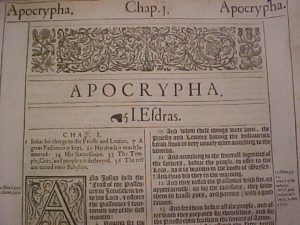
The Apocrypha is accepted as being genuine by some people and some large religious organizations, such as the Roman Catholic Church, today, but rejected by many others. Some of it is included in various versions of the Bible, but is absent in most. The Apocryphal books accepted as canonical and part of the Old Testament (OT), by the Roman Catholic Church are: Tobit, Judith, 1 Maccabees, 2 =&0=&
Is it inspired by God, or invented by humans? Let’s examine some evidence to see if we can find the answer.
Is the Apocrypha inspired by God or invented by humans?
THE JEWS VIEW OF THE APOCRYPHA
The Jews knew of the Apocrypha, but NEVER ACCEPTED any of it as canonical. For the Jews, any books written after Ezra, Nehemiah and Malachi’s time (such as the Apocrypha) were not considered inspired. They considered the canon closed after this time (by circa 400 BCE or before).
Jesus said, “Whoever serves me must follow me.” (John 12:26 NIV) He spoke against those who “nullify the word of God by your tradition.” (Mark 7:13 NIV) What did Jesus consider the Old Testament (OT) to be?
“The Law of Moses, the Prophets and the Psalms.” (Luke 24:44 NIV) What books were included in the Law, the Prophets and the Psalms (the Writings)? There were 24 by their count; 39 by our count today.
The Law contained five books: Genesis, Exodus, Leviticus, Numbers and Deuteronomy.
The Prophets was composed of eight books: Joshua, Judges, Samuel, Kings, Isaiah, Jeremiah, Ezekiel, and the Twelve Minor Prophets (as one book).
The Writings included eleven books: Psalms, Proverbs, Job, Song of Solomon, Ruth, Lamentations, Ecclesiastes, Esther, Daniel, Ezra-Nehemiah (one book) and Chronicles.
Notice that no Apocryphal books are included in these three OT sections! Jesus and the New Testament (NT) writers quoted from all three of these OT sections, but THEY NEVER QUOTED FROM THE APOCRYPHA! Since most of the NT quotes of the OT are from the Greek Septuagint Version (LXX), the absence of even a single quote by Jesus or NT writers from any of the numerous Apocryphal books speaks volumes!
The above Scriptures were kept at the Temple according to Deuteronomy 31:24-26 and 1 Kings 22:8-13 and Josephus, down to the time of its destruction in 70 CE. But the APOCRYPHAL BOOKS WERE NEVER KEPT AT THE TEMPLE.
The Jewish Council of Jamnia (90 CE) explicitly excluded all Apocrypha. The canon they accepted were the 22 books that both Josephus and Jerome said were inspired (our 39 today), and none of the Apocrypha! The Jews were aware of the Apocrypha, but did not accept any of it as inspired.
The expressions below include the 39 OT books, but none of the Apocrypha:
“The Law or the Prophets.” (Matthew 5:17 NJB) The entire OT – but no Apocrypha.
“From the blood of Abel to the blood of Zechariah.” (Matthew 23:35 NJB) From the beginning to the end of the OT, as arranged in Jewish Bible – but no Apocrypha.
“Beginning with Moses and all the Prophets.” (Luke 24:27 NIV) The entire OT – but no Apocrypha.
“Everything must be fulfilled that is written about me in the Law of Moses, the Prophets and the Psalms.” (Luke 24:44 NIV) The entire OT – but no Apocrypha.
Although it is popular to do so, we should not measure the existence of the New Testament (NT) canon (authoritative, or inspired, books) just by the existence of lists, which came into being somewhat later than the New Testament canon itself coming into existence. When we examine the way the NT books were viewed and used in the very early days of Christianity, we can determine the de facto existence of a functioning New Testament canon by about 100 CE.
Did it take until the fifth century to finalize the New Testament canon?
The views expressed here are admittedly a little different than the traditional, or orthodox, view of how the New Testament canon, in particular, and the Bible as a whole, came into acceptance. The views presented here actually stand in stark contrast to modern-day populist scholars, like the agnostic Bart Ehrman.
“Jesus replied, “Blessed are you, Simon son of Jonah, for this was not revealed to you by flesh and blood, but by my Father in heaven.” (Matthew 16:17). The New Testament canon was not revealed by humans, but by God.
The books of the Bible did not become the Word of God because people decided it to be so. A book became canonical if it was inspired by God (2 Timothy 3:16,17; 2 Peter 1:20,21). Inspiration by God, and not humanly contrived lists, determines canonization.
“That by revelation there was made known to me the mystery, as I wrote before in brief. By referring to this, when you read you can understand my insight into the mystery of Christ, which in other generations was not made known to the sons of men, as it has now been revealed to His holy apostles and prophets in the Spirit” (Ephesians 3:3-5). Canonical books (inspired books of the Bible), prophecy, and revelation were revealed by the holy Spirt, not man-made councils.
The Roman Catholic Church (RCC) claims responsibility for the decision as to which books should be included in the Bible canon. However, the NT canon was settled long before then – not by any council’s decision, but by the same holy Spirit that inspired the Bible in the first place (2 Timothy 3:16; 2 Peter 1:20,21).
“And we also thank God continually because, when you received the word of God, which you heard from us, you accepted it not as a human word, but as it actually is, the word of God, which is indeed at work in you who believe.” (1 Thessalonians 2:13) The NT canon was accepted as the word of God by the early church, shortly after each book was written, which was long before the RCC came into existence in the 4th century.
There is no evidence that any book in our canon today gradually gained acceptance over time. There were no stages of acceptance for each individual canonical book.
“Dear friends, although I was very eager to write to you about the salvation we share, I felt compelled to write and urge you to contend for the faith that was once for all entrusted to God’s holy people ” (Jude 3). This body of truth, or faith, contained in the New Testament canon, was delivered “once for all” time, being completed prior to 100 CE, according to the evidence.
“Just as our dear brother Paul also wrote you with the wisdom that God gave him. He writes the same way in all his letters, speaking in them of these matters. His letters contain some things that are hard to understand, which is ignorant and unstable people distort, as they do the other Scriptures, to their own destruction (2 Peter 3:15,16). This gives scriptural status to all 14 of Paul’s letters, by placing them as having equal status with the Hebrew Scriptures. Why can we say this?
Since Peter wrote to the “exiles scattered throughout [5] provinces” or regions (1 Peter 1:1), it is reasonable that Peter was referring to the entire collection of Paul’s letters available at the time. Peter probably knew all but possibly one or two of Paul’s letters that were available at the time. Not only would this mean that Peter was well aware of Paul’s writings, but as a leading apostle, he affirmed them. It’s obvious that Paul’s letters had a widespread reputation. From this we can infer that they were circulating possibly as a corpus, or body, in the 60’s. Ignatius of Antioch in the early 100’s, and Polycarp in the mid 100’s show familiarity with Romans, 1 Corinthians, Galatians, Ephesians, Philippians, Colossians, 1 and 2 Thessalonians, 1 and 2 Timothy, and Hebrews – eleven of Paul’s letters! The Chester Beatty papyrus 46, dated to around 200 CE, is a collection of most of Paul’s letters, including Hebrews. The facts solidly prove that the Pauline corpus was circulating early, long before the Roman Catholic Church (RCC) councils of the latter part of the 4th century.
From this platform of Paul’s 14 letters circulating as scripture from the 60’s on, we can verify the rest of 13 NT books.
“For the Scripture says… ‘The worker deserves his wages.'” (1 Timothy 5:18) Paul apparently quotes from Luke 10:7, which says “…for the worker deserves his wages”, and also quotesDeuteronomy 25:4, calling both “Scripture”. This quote of 1 Timothy 5:18gives scriptural status, or acknowledges the scriptural status, of Luke’s writings, namely volume 1 – Luke, and volume 2 – Acts.
Since Luke and Acts comprise Volumes 1 and 2 of Luke’s history (“my former book” – Acts 1:1), we can conclude that they both were circulating as scripture in the 60’s. Polycarp cites some verses in Luke, in the mid-100’s.
“Remember what the apostles of our Lord Jesus Christ foretold.” (Jude 17) The word of the apostles was authoritative. The New Testament was written by four apostles directly chosen by Jesus, namely, Matthew, John, Peter and Paul. Four other close associates of the apostles, namely, Mark, Luke, James, and Jude, wrote the rest of the New Testament.
In the 60’s, when Jude wrote his letter, the apostles and their very close associates’ writings were considered authoritative. Papias and Justin Martyr referred to Matthew and Mark’s books, with Mark named as Peter’s secretary.
“The church in Babylon, also chosen, sends you greetings, as does Mark, my son” (1 Peter 5:13). Mark was a very close associate of Peter, apparently his secretary, writing the book of Mark. So Mark’s book had apostolic authority.
Polycarp and Justin Martyr in the mid-100’s referred to 1 John and John, respectively. Ignatius of Antioch, who was martyred c. 110 CE, makes clear references to John’s writings.
The Muratorian fragment of c. 170 CE named 23 of the 27 NT books as authentic. Only Hebrews, James and Peter’s 2 letters were omitted. This proves widespread circulation and approval of, and for, the 23 books some time prior to this. Since the Muratorian document is fragmentary – omission from it does not imply non-acceptance.
John and Peter’s status as prominent apostles gave them outstanding authority, and their writings would have been received as such.
1 Corinthians 15:7 – “Then he appeared to James, then to all the apostles.” Jesus appeared to James, his half-brother.
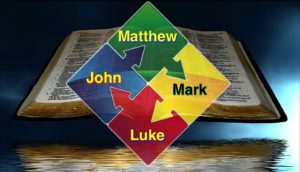
History says Matthew, Mark, Luke and John wrote the books with those titles. People seem to have a highly variable standard in their assessment of what ancient writings are genuine, especially the Bible. What do we mean? Here is an example:
Did Matthew, Mark, Luke and John really write the Gospels, or were these names attributed later?
Most people accept Alexander the Great as a real historical figure. Yet, the two earliest biographies of Alexander the Great were written by Arrian and Plutarch more than 400 years after the Great One’s death 323 BCE. Legends about him developed centuries after these two writers. Yet, Alexander’s true, accurate history is viewed as being preserved for hundreds of years prior to these legends.
Let’s clear up a misunderstanding about the titles of the Gospels by considering the manuscript evidence: True, there was no “uniformity of the titles.” Yes, there were many variances. But, the one thing that is 100% consistent about the titles is that in the reservoir of several thousand manuscripts of the gospels, they all attribute writership to Matthew, Mark, Luke and John respectively. The exact wording of the titles in various early manuscripts were different, not the same, but they all list Matthew, Mark, Luke and John as the writers. None of the titles indicates anonymity..
In every single instance, the names included Matthew, Mark, Luke, and John respectively. While there was not uniformity of the titles, there was 100% agreement on writership.
The popular agnostic Bible scholar Bart Ehrman claims that the titles of the Gospels were added by later scribes. But, as is well known, even experts can be wrong. Ehrman’s theory about the titles contradicts the facts.
An interesting point to note here is that while there are four gospel accounts, there is in reality only one gospel that runs through the entire New Testament – the Gospel of, and about, Jesus Christ. As Mark opens his account:
“The beginning of the gospel of Jesus Christ, the Son of God.” (Mark 1:1LSB; NASB)
The Gospel is the theme of the four accounts of Jesus’ life, ministry, death and resurrection. Hence, the titles were drawn from this. Notice:
“Jesus went throughout Galilee, teaching in their synagogues, proclaiming the good news of the kingdom, and healing every disease and sickness among the people.” (Matthew 4:23)
“The Spirit of the Lord is on me, because he has anointed me to proclaim good news to the poor. He has sent me to proclaim freedom for the prisoners and recovery of sight for the blind, to set the oppressed free” (Luke 4:18)read more
The New Testament canon was established early, by Holy Spirit
The New Testament canon was established early, by Holy Spirit
The New Testament canon was established in the first century by holy Spirit. Let’s examine some scriptures which confirm this fact:
2 Peter 1:16-21 – Peter affirms Old Testament prophets wrote God’s word. He puts himself and other apostles in the same category.
2 Peter 3:15-16 – Paul’s letters were on the same level as all the “rest of the scriptures.” That is, inspired of God. Early Greek manuscripts show Paul writing 14 letters.
2 Timothy 3:16-17 – The rest of the scriptures (the Old Testament) are inspired of God. We can broaden this now, and apply the principle to all 66 canonical books as shown below:
Acts 1:1-3 – “In my former book, Theophilus…” (NIV) So he implies Acts is the second volume.
Jude 17 – “But you, my dear friends, must remember what the apostles of our Lord Jesus Christ said.” Jude was apparently referring to Acts 20:29; 1 Timothy 4:1-2; 2 Timothy 3:1-5; 2 Peter 2:1-3; 2 John 7. Apostolic authority carried great weight. The apostles’ writings apparently were considered scripture.
Galatians 1:17-20 – Paul put his own apostleship in the same category as the original twelve apostles. Jesus’ brother James was considered an apostle by this time, and likely their brother Jude was also.
So books by Matthew, John, Paul, Peter, James (Jesus’ brother) and Jude were considered scripture. Mark wrote for Peter. Luke wrote for Paul and interviewed many eyewitnesses.
Increase in the knowledge of God
The Old Testament predicted an increase in the knowledge of God when Christ comes with the new covenant:
“They will neither harm nor destroy on all my holy mountain, for the earth will be filled with the knowledge of the Lord as the waters cover the sea.” (Isaiah 11:9)
“I will give them a heart to know me, that I am the Lord. They will be my people, and I will be their God, for they will return to me with all their heart.” (Jeremiah 24:7)
“‘This is the covenant I will make with the people of Israel after that time,’ declares the Lord. ‘I will put my law in their minds and write it on their hearts. I will be their God, and they will be my people. No longer will they teach their neighbor, or say to one another, ‘Know the Lord,’ because they will all know me, from the least of them to the greatest,’ declares the Lord. ‘For I will forgive their wickedness and will remember their sins no more.'” (Jeremiah 31:33-34)
“For the earth will be filled with the knowledge of the glory of the Lord as the waters cover the sea.” (Habakkuk 2:14)