Did Jesus claim to be God when he was in court, on trial for his life? Like Jesus’ enemies, Trinitarians often assert that Jesus was “claiming to be God” (John 10:33 REB). However, Jesus flatly refuted that false charge by saying, “I am God’s Son” (John 10:36). Like Jesus’ enemies, once again, Trinitarians also falsely assert that Jesus “was claiming equality with God” (John 5:18 REB). Jesus flatly refuted that false charge also, by saying: “In all truth I tell you, by himself the Son can do nothing; he can do only what he sees the Father doing” (John 5:19 NJB). read more
Who should we worship? “The true worshippers will worship the Father” (John 4:23). Jesus very clearly and unmistakably said that we should “worship the Father”. Trinitarians often claim “we should worship the Trinity” as their Athanasian Creed says. Most often they talk about worshipping Jesus, and sometimes they even claim to worship the Holy Spirit. But, the Bible is crystal clear on this subject. This is not a gray area. There are no accurately translated scriptures that either direct us to worship, or have anyone worshipping, Jesus, as is often heard. Jesus said in prayer that his “Father” is “the only true God” (John 17:1,3).read more
The Bible’s final book, Revelation, predicts the future for the Church and humankind. The Trinity doctrine is said to be the main doctrine of Christianity, so we would expect to find the Trinity in Revelation, if the doctrine is true. The very first verse of the Book of Revelation gives us a clue as to the answer to the question of whether the Trinity doctrine is in Revelation:
“The revelation from Jesus Christ, WHICH GOD GAVE HIM to show his servants what must soon take place” (Revelation 1:1 NIV). [Emphasis ours]. Trinitarians claim that the Son of God, Jesus Christ, is “fully God”. How can that be, since, first of all, in this verse, we see that “God” is someone other than “Jesus Christ”. Next we notice that “God gave him” “the revelation”. If Jesus was Almighty God, as Trinitarians claim, he would not have to be “given” anything, much less the Revelation by God–he would already have it–and know it! The Trinity doctrine not only is not in the scriptures, it contradicts the scriptures, and it makes no sense! “God is not the author of confusion” (1 Corinthians 14:33 KJV).read more
Did Jesus really die on the cross? Some critics claim he didn’t die on the cross, but only appeared to be dead, and later awakened in his tomb, and escaped. Let’s look at the evidence.
“But when they came to Jesus and found that he was already dead, they did not break his legs. Instead, one of the soldiers pierced Jesus’ side with a spear, bringing a sudden flow of blood and water” (John 19:33-34NIV).
“Jesus, whom you put to death by hanging on a tree” (Acts 5:30 LSB).read more
Is the Trinity Doctrine Taught in 1 Peter, or Contradicted?
The book of 1 Peter opens up with a statement that has been that has been used to support the Trinity doctrine. The question for us to consider is, “Do we find the Trinity in 1 Peter?”
Written some 30 years or so after Jesus’ death and the start of Christianity, 1 Peter is rich in doctrine. This is why we should find some evidence of the Trinity in 1 Peter, if the doctrine is true.Trinitarians point to the naming of the three who are said to be in the Trinity as proof of its existence. For example:
“Who have been chosen according to the foreknowledge of God the Father, through the sanctifying of the Spirit, to be obedient to Jesus Christ and sprinkled with his blood” (1 Peter 1:2 NIVread more
Are Jesus, God, and the holy Spirit a Trinity in 1 Timothy?
It is frequently asserted by Bible preachers and teachers that Jesus Christ is “God the Son”, along with “God the Father”, and “God the Holy Spirit,” they are part of a Trinity “Godhead”. If this is so, then we should find plenty of scriptural evidence to support it. Do we find the Trinity in 1 Timothy? Since 1 Timothy was written by the renowned Bible scholar and teacher, the apostle Paul, to counter false teachers and false teachings, including “false doctrines”(1 Timothy 1:3-4), let’s see what it says.
“Paul, an apostle of Christ Jesus by the command of God our Savior and of Christ Jesus our hope” (1 Timothy 1:1 NIV). God and Christ are here clearly portrayed as two separate and distinct individuals. As if this is not enough, this point is further emphasized in verse 2: “Grace, mercy and peace from God the Father and Christ Jesus our Lord” (1 Timothy 1:2 NIV). “Grace, mercy and peace” are said to come from both God and Christ, with no mention of the holy Spirit. This omission of greetings from the holy Spirit would be surprising, and even confusing if the Trinity doctrine were true, but since the holy Spirit is not a person, this statement makes perfect sense.
“Now to the King eternal, immortal, invisible, the only God, be honor and glory for ever and ever” (1 Timothy 1:7 NIV). This sets Almighty God totally apart as being “eternal, immortal, invisible, the only God”, since Christ was created, died, and was visible while on earth (Colossians 1:15 KJV; 1 Corinthians 15:3; John 1:14; Hebrews 2:17 NIV). The “prayer of Moses” to “Yahweh” says, “from everlasting to everlasting you are God” (Psalm 90:2,13 LSB). In the entire Bible, only Yahweh God is referred to as “eternal”, and “from everlasting”. Jesus told us he is not Yahweh (Matthew 22:41-46). Lots of people saw Jesus when he was on earth (John 1:14), which means he cannot be God, because God has always been “invisible”.
“There is one God. There is also one mediator between God and the human race, the man Christ Jesus” (1 Timothy 2:5 NAB). The verse plainly states “there is one God”. In addition to that, “there is also one mediator . . . Christ Jesus”. The Greek word used for “one” in both cases is “heis”, which is the numeral “one”, so the possibility that God could be more than one person, such as a God in three persons, is completely eliminated by this verse. By definition, the mediator cannot be either of the two parties that he mediates “between”, because a mediator mediates between two parties who are at variance. The two parties are “God and the human race.” How are they at variance? Because “there is no one on earth who . . . never sins” (Ecclesiastes 7:20 NIV), whereas ‘Yahweh God’ “cannot tolerate wickedness” (Habakkuk 1:12-13, “Christ Jesus” operates as the “mediator” between the two parties at variance, which makes it is obvious that Christ cannot be either”God” or “mankind”.Christ is “the man”, the “one mediator”, who stands between “God and the human race”. This one scripture is enough to obliterate Trinitarian notions, such as “God the Father, God the Son, God the Holy Spirit”, and these three are each Gd Almighty..
“Who gave himself as a ransom for all people” (1 Timothy 2:6 NIV). “Sacrificed himself” (REB). Jesus “Christ died for our sins”” as a ransom sacrifice (1 Corinthians 15:3). By contrast, Almighty “God”, “Yahweh . . . never dies” (Habakkuk 1:12 NJB). In flagrant contradiction of scripture, Trinitarians equivocate this scriptural truth by claiming that only the human part of Jesus died, but the God part of Jesus never died. However, if any part of Jesus had not died, he could not have died for our sins. The scripture that Christ “gave himself as a ransom”, which eliminates any possibility that Jesus wasn’t “dead” as the scriptures plainly say (Revelation 1:18). Therefore Jesus cannot be Almighty God, who has existed “immortal'” “from eternity” (1 Timothy 1:17 NIV; Psalm 90:2 NAB). This one fact also obliterates the Trinity doctrine itself.
“The household of God, which is the church of the living God, the pillar and foundation of truth” (1 Timothy 3:15 NAB). What is the truth? “Your word is truth”, “the word of God . . . scripture” (John 17:17; John 10:35). Therefore, we can safely conclude that the scriptures in the Bible are truth. This “foundation of truth” that “the church of the living God” operates on is “the faith delivered once for all to God’s people” (Jude 3 Weymouth), the 66 books of the inspired scriptures” (2 Timothy 3:16), back in the first century. Accurate history reports that the Trinity doctrine was not part of the “truth”, that is, “the faith delivered once for all to God’s people” in the 1st century. Even the Trinitarian Catholic Church admits this.
=&0=&
In Paul’s final canonical letter, and now facing certain execution at the hands of the Romans, we would expect Paul to at least make some mention of the doctrine of Trinity, if it is true, since it is purportedly the “primary doctrine of Christianity”. “Paul, an apostle of Christ Jesus by the will of God, in keeping with the promise of life that is in Christ Jesus” (2 Timothy 1:1 NIV). “Christ Jesus” and “God” are introduced here in the opening line of Paul’s letter to Timothy. There is no mention in this opening greeting of the holy Spirit, or a Trinity. Why not, if the holy Spirit is a person, and the Trinity is true doctrine. God, not Jesus, obviously is the one who is supreme, since Paul is “an apostle of Christ Jesus by the will of God“. There is no mention, nor is there any evidence of, any personhood of holy Spirit, or of any “equality” between God and Jesus, or the existence of a Trinity “Godhead”.
“Grace, mercy and peace from God the Father and Christ Jesus our Lord” (2 Timothy 1:2NIV). In this verse, “God” is identified as “the Father”, someone other than “Christ Jesus our Lord”. We do not find any reference to, or greetings from, a Trinity, nor of the holy spirit, but we do have “God the Father and Christ Jesus our Lord” named as separate and distinct individuals. The holy Spirit is real, but if t he holy spirit was a person, or the Trinity was real, we would expect that there would be greetings from them, but there are not any. These facts provide, not only no evidence of the Trinity doctrine, but rather, powerful evidence against the dogma
“Guard this rich trust with the help of the holy Spirit that dwells within us” (2 Timothy 1:14 NAB). “The holy Spirit” is referenced by the definite article “the.” The holy Spirit is real. It is God’s power (Luke 1:15-17; Acts 1:8) and no name is ever given to “the holy Spirit”, both of which are evidences that the holy Spirit is not a person.
“Remember Jesus Christ, raised from the dead” (2 Timothy 2:8NIV). Since “God . . . will never die” (Habakkuk 1:12 NIV), but Jesus “was dead” (Revelation 1:18), Jesus cannot be Almighty God. “God has resurrected this Jesus” (Acts 2:32 HCSB), which is strong evidence that God the Father is superior to Jesus, and, thus, there is no equality (John 14:28; 1 Corinthians 11:3)..
“In the presence of God and of Christ Jesus, who will judge the living and the dead” (2 Timothy 4:1 NIV).read more
Is the Trinity doctrine in the book of Colossians? Let’s examine all the verses in this Bible book where God and Jesus are mentioned in relation to each other. Also. let’s look for any references to the holy Spirit, which is said to be the third person of the Trinity. Then, let’s see whether what Bible says agrees with Trinitarianism, or proves it to be false. Notice all the references in this letter to the superior position of Almighty God toward his Son, Jesus Christ, and the subordinate position of Jesus Christ in relation to his heavenly Father.read more
2 Peter—Is Jesus Christ Almighty God, or Part of a Trinity?
Trinitarian bias has influenced translators to render the first verse of the letter of 2 Peter in a way that makes it appear as though Jesus is Almighty God. For example,
“by the righteousness of our God and Savior Jesus Christ” (2 Peter 1:1ESV). read more
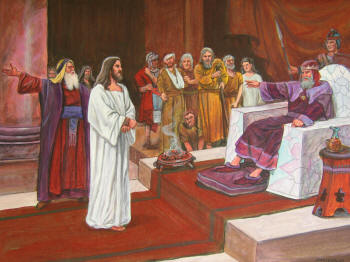 Did Jesus claim to be God when he was in court, on trial for his life? Like Jesus’ enemies, Trinitarians often assert that Jesus was “claiming to be God” (John 10:33 REB). However, Jesus flatly refuted that false charge by saying, “I am God’s Son” (John 10:36). Like Jesus’ enemies, once again, Trinitarians also falsely assert that Jesus “was claiming equality with God” (John 5:18 REB). Jesus flatly refuted that false charge also, by saying: “In all truth I tell you, by himself the Son can do nothing; he can do only what he sees the Father doing” (John 5:19 NJB).

 The Bible’s final book, Revelation, predicts the future for the Church and humankind. The Trinity doctrine is said to be the main doctrine of Christianity, so we would expect to find the Trinity in Revelation, if the doctrine is true. The very first verse of the Book of Revelation gives us a clue as to the answer to the question of whether the Trinity doctrine is in Revelation: