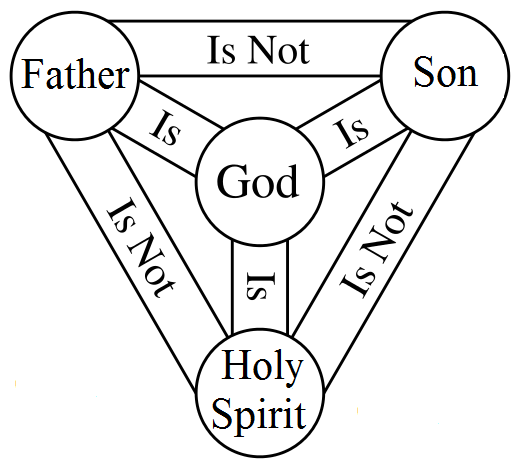
Is the Trinity doctrine in the book of John? Is Jesus Christ Almighty God? The gospel of John opens with the words:
“The Word was God”—John 1:1
The Bible itself is completely reliable and trustworthy (2 Timothy 3:16,17). It “actually is, the word of God” (1 Thessalonians 2:13 NIV). However, there are some “false doctrines” (1 Timothy 1:3,4 NIV) taught by many religions, churches, and preachers as though they were “the truth” (John 17:17). The Trinity doctrine is commonly preached and believed, but it is controversial. The gospel of John is the Bible book most often used in support of the Trinity doctrine. We need to know whether the Trinity doctrine is in the book of John, or whether it is what these Bible scholars say it is:
“No doctrine is more fundamental to the Faith than the Trinity”—Dr Norman L Geisler
“The Trinity is a doctrine where error is especially deadly”—Dr John MacArthur
We believe that John MacArthur is onto something when he says, The Trinity is a doctrine where error is especially deadly”, although we disagree about exactly what that error is.
There are a few scriptures in the Gospel of John are often used by Trinitarians to provide evidence of the Trinity doctrine. However, it is quite notable that the holy Spirit is conspicuously absent from most of these texts that Trinitarians use in the gospel of John to support the Trinity. And where the holy spirit is mentioned in John, it is sometimes called “it”, which is indicative of the fact that the holy Spirit is not a person. Let’s first take a look at Trinitarians’ main “proof texts” in John, for their Trinity doctrine, and then do an analysis of many pertinent scriptures from the entire book:
John 1:1 — “The Word was God”. This scripture from John is used most often by Trinitarians attempting to “prove” their Trinity doctrine.
John 2:19,21 –“Jesus answered them, ‘Destroy this temple, and I will raise it again in three days.’ But the temple he had spoken of was his body” (NIV). This one is often used by Trinitarians to prove that Jesus “resurrected himself.”
John 5:18 — “Making himself equal to God.” Equality is central to the Trinity doctrine.
John 8:58 —“‘Very truly I tell you,’ Jesus answered, ‘before Abraham was born. I am!'” (NIV).
John 10:30 – “I and the Father are one”
John 14:9 – “Anyone who has seen me has seen the Father”
John 20:28 – “My Lord and my God”
When these seven Scriptures are viewed together, and in isolation from their context, and/or poorly translated, it can be made to appear that Jesus Christ is Almighty God, and that the Trinity doctrine is in John.
Let’s consider all relevant verses in John and see what the overwhelming weight of evidence is. When we do this honestly, we see that the Gospel of John is actually the most devastating book in the New Testament, in fact, in the entire Bible, to the Trinity doctrine/dogma!
John 20:31 –- “These are written that you may believe that Jesus is the Messiah, the son of God, and that by believing you may have life in his name” (NIV). Thus, the stated purpose of the book – is ‘that people may believe Jesus is the Christ, the Son of God’, not ‘God the Son’, as the Trinity dogma asserts! In fact, the expression “God the Son”, while frequently used by Trinitarians, is never used in the book of John, not even once! This, along with the lack of any use of the word Trinity in the John, makes the doctrine highly suspect, even just on face value.
John 3:16 – “God gave his only begotten Son” (NASB). “Only begotten” means that Jesus had a beginning. “Whose origins are from of old, from ancient times” (Micah 5:2 NIV), which clearly shows that Jesus had an “origin”, a beginning to his life, indicating that he was created by God. The Trinity doctrine claims that Jesus had no beginning, which means he’s God, so the most famous verse of the entire Bible (John 3:16) flatly contradicts the Trinity! This famous verse also shows us that “he gave his only Son” (NAB) in death for “the world”, meaning that Jesus died. Since “God . . . will never die” (Habakkuk 1:12), this also proves that Jesus cannot be Almighty God, and the Trinity doctrine false.
John 1:1-2– “In the beginning was the Word, and the Word was with God, and the Word was God. He was with God in the beginning” (NIV). Trinitarians claim this means Jesus is their “God the Son”. Is Jesus “God the Son’? Twice it is stated in these two scriptures that Jesus “was with God”. A reasonable and logical question is: How could Jesus be with Almighty God, and be Almighty God at the same time, as the Trinity asserts? – The fact is, he can’t! That is impossible nonsense! Another question is, “Is the God that the Word was with the Trinity?” If so, the Word, plus the Trinity, equals four (3 + 1 = 4). Another question, “Is the God the Word was with the Father?” If so, how do we know who the is God the Word was is? Another question, does, “In the beginning was the Word”, mean Jesus is eternal, as Trinitarians claim? Which “beginning” is John 1:1 referring to? Could it be “the beginning” referred to in Genesis 1:1?
The most accurate translation of John 1:1 is: “In the beginning the Word was, and the Word was with God, and a god was the Word” (John 1:1 Sahidic Coptic). Why? “Lack of a definite article with ‘God ‘in Greek signifies predication rather than identification.”
“Yahweh created me, first-fruits of his =&0=&Jesus, as “the wisdom of God” personified (1 Corinthians 1:24), says that Yahweh created him says the very first of Yahweh’s creations, before anything else was created. This explains why, “In the beginning the Word was”. It’s because Jesus existed prior to the beginning that Genesis 1:1 refers to, “In the beginning God created the heavens and the earth”, that is, the beginning of the physical, material creation.
“But you, O Bethlehem of Ephrathah, who are one of the little clans of Judah, from you shall come forth for me one who is to rule in Israel, whose origin is from of old, from ancient days” (Micah 5:2 NRSV). Matthew 2:1-6 confirms that Micah 5:2 accurately predicted the birthplace of the Messiah, Jesus of Nazareth. But Micah 5:2 also does something else very significant. It says that Jesus had an “origin”, a beginning, not with his birth on earth, but long before that, in the distant past. This scriptural fact overturns the key Trinitarian claim that the Son of God, Jesus Christ, has always been eternal. Jesus’ having an “origin” is powerful proof that he has not always been eternal, but was created.
Yes, Jesus is “God“, but only in the sense of being “the only begotten God” (John 1:18 LSB), meaning that Jesus was created, so he is obviously not the Almighty “God”, whom “no one has seen . . . at any time”, who created everything. Jesus is also “God” in a similar sense like Moses, Israelite kings, rulers and judges were called “God” (Exodus 7:1 EB; Psalm 45:6 NAB; Psalm 82:6 NAB).
This is similar to the Biblical use of “God” to describe a prominent human, and the footnote that explains it:
“Your throne, O God, stands forever”—Psalm 45:7 NAB (45:6 in most =&1=&
“O God: the king, in courtly language, is called ‘god,’ i.e., more than human representing to the people. Heb[rews] 1:8,9 applies Ps[alm] 45:7,8 to Christ”—footnote in NAB on Psalm 45:6
These three translations make it very clear that there is a difference between the God that the Word was with, and the Word who is “divine”, and is “god”, but in a different sense, as the lower case “g” in “god” suggests.
However, even if we accept the more commonly translated, “and the Word was God”, other scriptures in context clear up the difference. The Word, Jesus, is with God, therefore, they must be different individuals, with separate identities. They are not of the same “essence”, “substance”, or “being”, as Trinitarians claim. Is this, in any way whatsoever, asserting that Jesus is Almighty God? Is Jesus eternal? Let’s look at other scriptures in John for clarification on whether on the question of whether God is a Trinity:
John 1:3,10 – “Through him all things were made; without him nothing was made that has been made . . . the world came to be through him” (NIV). We notice that Almighty God the Father created everything “through” Jesus, which indicates that Jesus is not the creator, but is “God’s agent in the creation of all things” (NAB note on Colossians 1:16). The scriptures here also testify to the fact that “God” is someone other than Jesus, and is, in fact, superior to, and, “greater than” Jesus (John 14:28).
John 1:14 – “The Word became flesh and dwelt among us. and we have beheld His glory, the glory as of the only begotten of the Father, full of grace and truth” (NKJV). Jesus, the Word, became flesh; people saw his glory, which was that of God’s only begotten Son, not the so-called ‘God the Son.’ This verse also makes clear that Jesus came from the Father. He not only isn’t the Father, he’s not God. Trinitarians assert that Jesus was “God-man” on earth, in other word, he was both God and man at the same time. However, notice what NAB Study Bible note on John 1:14 says, “Flesh: the whole person,” which means Jesus was completely flesh, and no part of him. was “spirit.” Jesus said that “God is spirit” (John 4:24), which excludes Jesus from being God. Additionally, Jesus being “begotten” means his life had a beginning. He was created by God the Father. Isaac was Abraham’s “only begotten son” (Hebrews 11:17 NKJV; NASB), and other humans had “only begotten” children (Luke 7:12; 8:42; 9:38 LSB margin). The Trinitarian claim that “only begotten” means “eternally begotten” is thus soundly debunked by the scriptures.
“Whose origin is from of old, from ancient days” (Micah 5:2 NRSV). The Bible is very clear that Jesus had an “origin”, a beginning to his life. Only “Yahweh” “God” is “from everlasting” (Psalm 90:2,13 LSB).
Since Jesus’ life had a beginning, he has not been eternal. This fact from John eliminates the ‘eternal’ pillar from the Trinity doctrine. Additionally, by saying “we beheld His glory,” that means many people saw Jesus. But, “no one has ever seen God” (1 John 4:12 NIV), because “the only God” is “invisible” (1 Timothy 1:17 NIV). For this reason also, Jesus cannot be Almighty God.
John 1:17 – “For the law was given through Moses; grace and truth came through Jesus Christ” (NIV). God’s love came through Jesus, not ‘from’ Jesus.
John 1:18 – “No one has seen God at any time; the only begotten God who is in the bosom of the Father, He has explained Him” (LSB; NASB). Jesus is “God”, in the sense of being “the only begotten God,” meaning that Jesus was created, but is obviously not the Almighty God, who created everything. Jesus is also “God” in a similar sense that Moses, Israelite kings, rulers and judges were called “God” (Exodus 7:1 EB; Psalm 45:6 NAB; Psalm 82:6 NAB). “O God: the king, in courtly language is called ‘god,’ i.e., more than human, representing God to the people” (NAB note on Psalm 45:7).
For more information about John 1:18, please see:
=&2=& – She knew that Jesus was a prophet, but not God, because God is not a prophet. In fact, there is not one single confession in the scriptures by anyone that Jesus is God, as Trinitarians would have us believe!
John 4:22 — “You people worship what you do not understand, we [Jews] worship what we understand, because salvation is from the Jews” (NAB). Who did the Jews worship? Yahweh, who can be understood, Jesus said. “The Son of God has come, and has given us understanding so that we may know Him who is true” (1 John 5:20 LSB). Contrast this with the “mysterious” Trinity, which even its most ardent worshippers admit they cannot understand. The Jews worshipped the singular God “Yahweh”, who is “one Yahweh” (Deuteronomy 6:4 LSB margin), not 3-in-1. Never do we see Jesus criticizing his fellow Jews for not having a good understanding of the number of persons in the so-called “Godhead”, a “3-in-1” monstrosity concocted from their “own imaginations” (Ezekiel 13:3 NLT).
John 4:23 — “the true worshippers will worship the Father in spirit and truth” (LSB). Trinitarians have turned God’s Son into a false God, an idol, by worshipping him. How atrocious that is! Who did Jesus say should be worshipped? Himself? No, Jesus identifies God as the Father who is to be worshipped. Jesus also said, “YOU SHALL WORSHIP Yahweh YOUR GOD, AND SERVE HIM ONLY” (Matthew 4:10 LSB margin). Jesus thus identifies Yahweh as God, who is to worshipped exclusively. The scriptures confirm that “Yahweh” is “God” the “Father” (Malachi 2:10,12 LSB; NASB). Neither Jesus, nor his apostles, ever said the true worshippers would worship the Son, the holy Spirit, or the Trinity, but only the Father. The apostle Paul didn’t recognize any other God than the God of Israel. He wrote that Gentiles were being “grafted” into the “Israel of God” (Romans 11:24; Galatians 6:15,16), and were worshipping the same God. “Is God the God of the Jews only? Is He not the God of the Gentiles also? Yes, of Gentiles also” (Romans 3:29 LSB). The Jews knew nothing of any Trinity, or any worshipping Jesus. Jesus was “human” (John 1:14 NLT; 1 John 4:2), so he could not be Almighty God (Numbers 23:19)!
John 4:24 — “God is a spirit. Those who worship him must worship in spirit and truth” (GWT). Jesus was “fully human in every way” (Hebrews 2:17 NIV), but since, ”God is a spirit” (John 4:24 GWT), and therefore, “God is not human” (Numbers 23:19 NIV), how can Jesus be God? According to the scriptures — he can’t be! Since “God is A spirit”, he cannot be “God the Father, God the Son, and God the Holy Spirit”, because that is three spirits. Most translations render John 4:24 as, “God is Spirit”, to cover up the fact that God is only one spirit, not three. The Trinity is certainly not the “truth” to worship God in.
John 4:25 –- “‘Messiah’ (called Christ) ‘is coming'” (NIV). Not ‘God is coming.’ God is not the “Messiah”. This means that Jesus can’t be God.
John 4:26 – “I am he” (NIV). – Jesus admits he is the Christ, but he never says he’s God. Why? — Because he’s not God.
John 4:34 – “‘My food,’ said Jesus, ‘is to do the will of him who sent me and to finish his work'” (NIV) – Jesus does God’s will, not his own. He submits humbly to God the Father. God sends Jesus– The greater one (God) sends the lesser one (Jesus).
John 5:17 – “My Father is always at his work to this very day, and I too am working” (NIV) – Jesus explains why his healings do not violate the Sabbath law against working. Thus, Jesus highlights the Father-Son relationship.
John 5:18 – “This made the Jews try harder to kill him. They said, “First Jesus was breaking the law about the Sabbath day. Then he said that God is his own Father! He is making himself equal with God!” (ICB). Jesus’ murderous enemies admitted that Jesus referred to God as his Father. They falsely accused him of breaking the Sabbath, but since “he never sinned” (1 Peter 2:21), the accusation is demonstrably false. They also falsely accused him of “making himself equal with God,” by “calling God his own Father.” Since God is Jesus’ Father, he told the truth, but that doesn’t make him God. The fact is that, even if it was true that he is equal to God, that means that God is someone other than himself, which, in and of itself, defeats Trinitarian claims that Jesus is God. Plus, Jesus said that “the Father is greater than I am” (John 14:28 NET; ISV; GWT).
John 5:19 — “Jesus said . . . ‘the Son can do nothing of his own accord, but only what he sees the Father doing. For whatever the Father does, that the Son does likewise'” (ESV) – Jesus freely confesses that he has no power or authority to act on his own, independent from God the Father. The Trinity doctrine assert that the Son is Almighty God, and equal to the Father. However, this verse proves that Jesus is not only not Almighty God, he is not even equal to God, but is actually dependent on God the Father. As Jesus later emphasized, “the Father is greater than I am” (John 14:28 NLT). While Jesus is unable to operate independently of his Father, God the Father is able to operate independently of Jesus. “From whom does he receive directions?” (Isaiah 40:14 NET Bible). Two examples of this are: (1) prior to Jesus’ creation (Micah 5:2; Colossians 1:15); and (2) while Jesus “was dead” (Revelation 1:18).
John 5:20 – “The Father loves the Son and shows him all he does. Yes, and he will show him even greater works than these, so that you will be amazed” (NIV). Jesus clearly explains the superior position that his Father has in relation to himself.
John 5:22 – “The Father judges no one, but has entrusted all judgment to the Son” (NIV). Trinitarians have claimed this makes Jesus God. However, the scripture says that Jesus’ Father has delegated all judgment to his Son, clearly showing that the Father is in the superior position, since those in higher positions delegate to those in lower positions. “The Father is greater than I am” (John 14:28 GWT), which clearly eliminates the equality between the Father and the Son that Trinitarians claim exists. “God . . . has established a day on which he will judge the world justice through a man he has appointed, and he has provided confirmation of this for all by raising him from the dead” (Acts 17:30-31). “God is not a man” (Numbers 23:19), so Jesus can’t be God.
John 5:23 – “That all may honor the Son just as they honor the Father. Whoever does not honor the Son does not honor the Father, who sent him” (NIV) – The harmony and unity that exists between the Father and the Son are stressed here, but there is nothing that supports the Trinity dogma, because the greater one (“the Father”) is said to have “sent” the lesser one (“the Son”). John 5:23 thus gives evidence against the equality aspect of the Trinity doctrine, and is, in fact, self-defeating for Trinitarians to attempt to use this scripture to defend their dogma.
John 5:24 – “Whoever hears my word and believes him who sent me has eternal life” (NIV)– Thus, the master-servant relationship is stressed once again. The one who “sent” Jesus is his Father, Almighty God.
John 5:25 – “The dead will hear the voice of the Son of God” (NIV). The voice “the dead” will hear is that of “the Son of God”, not :God the Son”, a Trinitarian concocted expression which is never used in the Bible.
John 5:26 – “As the Father has life in himself, so he has granted the Son to have life in himself” (NIV) – Jesus’ power comes from his Father, entirely by the Father’s grant of authority.
John 5:27 – “He [the Father] has given him [the Son] authority to execute judgment, because he is the Son of Man” (ESV). Clearly, once again, Jesus says his authority comes from his Father, the ultimate authority.
John 5:30 – “By myself I can do nothing, I judge only as I hear, and my judgment is just, for I seek not to please myself but him who sent me” (NIV) – Jesus admits that he is completely dependent on his Father in his judging. The lesser, Jesus, depends upon the greater, the one who “sent” Jesus.
John 5:31,32 – “If I testify about myself, my testimony is not true. There is another who testifies in my favor, and I know that his testimony about me is true” (NIV). Thus, two entirely different beings are mentioned here, and they cannot have the same “being”, “substance”, “essence”, or “nature”, Trinitarian concocted terms. Why not? Jesus mentions someone else (“another”, God) who is also testifying about him.
John 5:36 – “I have testimony weightier than that of John. For the works that the Father has given me to finish–the very works that I am doing–testify that the Father has sent me” (NIV). Jesus says, ‘I have greater witness than John, because my works – miracles and teachings, which the Father gave me – they prove he sent me’ – power for miracles, etc. comes from his Father, not himself.
John 5:37 – “The Father who sent me has himself testified concerning me. You have never heard his voice nor seen his form” (NIV). Jesus himself says the Father who sent me testified about me – you’ve never heard his voice or seen him, thus highlighting the master-servant, and the fact that they are separate two people, and the Father has never been seen. Since “no one has ever seen God” (1 John 4:12 NIV), Jesus can’t be Almighty God.
John 5:38 – “You do not believe the one he sent” (NIV). Jesus continually emphasizes his subservience to his Father, the fact that the Father is the superior one, the one who “sent” him on his mission to earth.
John 5:43 – “I have come to you in my Father’s name” (NIV) – Coming in someone’s name, means a recognition of that one’s authority. Jesus plainly states that his authority comes from his Father, who is Almighty God. “I came as my Father’s representative” (John 5:43 Williams New Testament). The lesser one (Jesus) represents the greater one (the Father). This eliminates the “equality aspect of the Trinity doctrine.
John 5:44 – “You accept glory that comes from one another but do not seek the glory that comes from the only God” (NIV). Jesus clearly says that all real honor comes from “the only God”. “The only God” is not Jesus. It’s his Father! Jesus calls himself “the Son of God” and “the Son of Man” (John 5:25,27), and refers to his “Father” as “God” (John 5:26,42,44).
John 5:45 – “Do not think that I will accuse you before the Father. Your accuser is Moses . . . ” (NIV) – Thus, Jesus here clearly shows us the distinctive and separate personalities between he and his Father, by referring to his making accusations before his Father.
John 6:11 – “Jesus then took the loaves, gave thanks . . . ” (NIV)–Jesus gave thanks to God – He did not pray to himself. Trinitarians often pray to Jesus, but prayers should be directed to his Father (Matthew 6:9).
John 6:27 – “Do not work for the food which perishes, but for the food that endures to eternal life, which the Son of Man will give you. For on him the Father, God, set His seal of approval” (LSB) – Jesus here takes pains to distinguish his Father as being “God”. The Son of Man is Jesus; the Father is not Jesus, but is identified as being “God”, that is, Yahweh (Psalm 110:1; Matthew 22:44). Jesus here says that “God the Father has placed his seal of approval” (NIV) on him, which clearly shows that God the Father is the superior one, the one who is ultimately in control (John 14:28).
John 6:29 – “Jesus answered, ‘The work of God is this: to believe in the one he has sent'” (NIV). – Jesus plainly states that God “sent” him on his mission to earth. Jesus not only highlights the master-servant relationship with his Father, but makes clear that he is not God, who sent him. Trinitarians overlook the obvious.
John 6:32 – “It is not Moses who has given you the bread from heaven, but it is my Father who gives you the true bread from heaven” (NIV). — Jesus, “the true bread from heaven,” is given to mankind by his Father, God, which again proves that Jesus is not God, and is in a master-servant relationship with his Father.
John 6:33 – “The bread of God is He who comes down from heaven” (LSB). – The true bread of God is Jesus, not God, nor any so-called Trinity.
John 6:37 – “Those the Father gives me will come to me” (NIV). – Jesus was given his disciples by the Father, thus showing the Father’s superiority over Jesus.
John 6:38 – “I have come down from heaven, not to do My own will, but to do the will of Him who sent Me” (LSB). Jesus mentions two very separate and distinct wills here–“My own will”, and “the will of Him who sent Me”. This verse shows that Jesus has his own independent will, entirely separate and distinct from his Father’s will, but emphasizes that he submits his own will to his Father’s will. Jesus also says here that his Father “sent Me”. Jesus later gave the principle that “no servant is greater than his master, nor is a messenger greater than the one who sent him” (John 13:17 NIV). Being “sent” by God the Father proves that Jesus is not equal to his Father, as the Trinity doctrine claims, but rather, as Jesus said, “the Father is greater than I am” (John 14:28 GWT).
John 6:39 – “This is the will of him who sent me, that I shall lose none of all those he has given me” (NIV). This is more proof of the master-servant relationship, showing God the Father’s superiority over Jesus.
John 6:40 – “My Father’s will is that everyone who looks to the Son and believes in him shall have eternal life” (NIV). – Jesus emphasizes the supreme will of God the Father, who sent the Son of Man, Jesus, and is in reverent submission to him, which gives additional powerful proof that there is no equality between the Father and Son.
John 6:44 – “No one can come to me unless the Father who sent me draws them” (NIV). The Father is the one who directs things, not Jesus, nor any Trinity.
John 6:45 – “It is written in the Prophets: ‘They will all be taught by God.’ Everyone who has heard the Father and learned from him comes to me” (NIV). – Ultimately all true teaching and learning comes from God, not Jesus. Notice in this verse that Jesus equates “God” with “the Father.”
John 6:46 – “No one has seen the Father except the one who is from God; only he has seen the Father” (NIV). Jesus literally saw God when he was in heaven, prior to his coming to earth (John 3:13; 31; 6:38). Jesus again equates “God” with “the Father.” Jesus says that he “is from God,” which means that he is not God. Thus, a clear distinction is drawn between the Son of God, Jesus, and his Father, Almighty God.
John 6:51,53 – “I am the living =&3=&Jesus is “the Son of Man,” “who came down from heaven,” who is “the living bread,” whose flesh must be eaten and his blood drunk, figuratively speaking. This makes it obvious that Jesus cannot be God Almighty, whom the Bible describes as “the God of heaven” (Genesis 24:7; 2 Chronicles 36:23 NIV; Ezra 1:2; Nehemiah 1:5). Jesus said that his “Father” was “in heaven” (Luke 11:13 NIV).
John 6:57 – “I live because of the Father” (NIV). – Jesus not only states his dependence upon his Father for life itself, but also plainly implies that his Father created him. Micah 5:2, which foretold that the Messiah, Jesus, would be born in “Bethlehem,” and would be the “ruler over Israel,” but also said that his “origins are from of old, from ancient times” (NIV). Thus, the Bible, in both the Old and the New Testaments, makes clear that Jesus had an ‘origin,’ that he was created, and is not eternal, as Trinitarians claim.
John 6:58 – “This [referring to himself] is the true bread that came down from heaven” (NIV). Jesus said, “It is my Father who gives you the true bread from heaven. For the bread of God is the bread that comes down from heaven” and “I am the bread of life” (John 6:32,33,41 NIV), therefore clarifying that he, Jesus, is not God, since “God” is not “bread”, and “No one has ever seen God” (John 1:18).
John 6:65 – “No one can come to me unless the Father has enabled him” (NIV). – The Father directs things, and brings people to Jesus, proving that the Father is one who is in ultimate control, not Jesus, not a Trinity.
John 6:69 – “We have come believe and to know that you are the Holy One of God” (NIV) – That is, Jesus, not God, not God the Son, nor the Trinity, is “the Holy One of God”.
John 7:16 – “My message is not my own. It comes from the one who sent me” (NIV). Jesus says, ‘my message is not mine, it comes from God, who sent me’ – Here he admits his complete dependence on God, his Father, which disproves the equality aspect of the Trinity dogma.
John 7:17 – “If anyone’s will is to do God’s will, he will know whether the teaching is from God, or I speak on my own authority” (ESV). – Jesus is obviously implying that his teaching comes from God the Father, and that he is not speaking on his own authority. Notice how Jesus contrasts ‘the teaching that comes from God’ with his ‘own authority.’ Jesus very strongly implies here that he is not God.
John 7:18 – “The one who speaks on his own authority seeks his own glory, but the one who seeks the glory of him who sent him is true, and in him there is no falsehood” (ESV). Jesus says a person who seeks to honor the one who sent him speaks the truth, not lies – Jesus honors God the Father, who sent him. Jesus makes clear that he does not ‘speak on his own authority,’ but on that of God the Father. “The Father has sent me” (John 20:21 NIV), Jesus made clear.
John 7:26 – “Have the authorities really concluded that he is the Messiah?” (NIV). – The issue is not whether Jesus is God, as Trinitarians like to assert, but whether Jesus is the Christ. Do not be fooled by the unscriptural teaching that presents Jesus as God, rather than the Christ.
John 7:28 – “Jesus . . . cried out, ‘ . . . I am not here on my own authority, but he who sent me is true. You do not know him'” (NIV). – Jesus said that he wasn’t even here on earth on his own authority, but was sent by his Father, whose authority he is under, because, as Jesus said, “the Father is greater” (John 14:28). The equality aspect of the Trinity doctrine is thus obliterated by such Biblical truths.
John 7:29 – “I know him because I am from him and he sent me” (NIV)– Jesus came from God who sent him; and Jesus knows him. The scriptures clearly say that, “God sent his Son” (Galatians 4:4). This means Jesus is not God.
John 7:31 — “Still, many in the crowd believed in him. They said, ‘When the Messiah comes, will he perform more signs than this man?'” (NIV) – Trinitarians would have us believe that Jesus is God, and that was the issue when Jesus was on earth. It wasn’t! The issue with the crowd was whether Jesus was the Messiah, not whether he was God.
John 7:39 – “He said this about the Spirit. Those who believed in Jesus were going to receive the Spirit, for the Spirit had not yet been given because Jesus had not yet been glorified” (CSB). Trinitarians claim the holy Spirit is a person, and we see that bias reflected in most translations of this verse. “By this he meant the Spirit, whom those who believed in him were later to receive” (NIV). However, we see that twice in this verse, the holy Spirit is described as “the Spirit”, which is not descriptive of a person. Trinitarians claim the holy Spirit existed from eternity as the 3rd person of the Trinity (Genesis 1:2), and there are others who claim the holy Spirit didn’t even exist until it was poured out at Pentecost (Acts 2). The scriptures prove both wrong. “The LORD . . . taking some of the spirit that was on Moses, he bestowed it on the seventy elders, and as the spirit came to rest on them, they prophesied, but did not continue” (Numbers 11:25 NAB). “The Spirit of Yahweh came upon him mightily” (Judges 14:6 LSB). These actions show that the spirit existed in Old Testament times, but never as a person.
John 7:40,41 – “On hearing his words, some of the people said, ‘Surely this man is the Prophet.’ Others said, ‘He is the Messiah'” (NIV)– Trinitarians would have us believe that Jesus is God, and that was the issue when Jesus was on earth. It wasn’t! Jesus was thought to be “the Prophet” by some and “the Messiah” by others. But what is interesting is that he was never thought of by anyone as being God.
John 8:12 – “Jesus spoke to them again, saying, ‘I am the light of the world'” (NAB). This declaration by Jesus is reminiscent of the prophecy given about him over 700 years beforehand, “So now says Yahweh, who formed Me from the womb to be his Servant . . . ‘It is too small a thing that You should be My Servant . . . I shall also give you as a light of the nations” (Isaiah 49:6 LSB). Jesus, as foretold, is Yahweh God’s “servant” (Acts 3:13), who also has made him to be “the light of the world.” Therefore, Jesus, God’s servant, cannot be God, proving Trinitarian claims of his “Godship” to be false.
John 8:16-18 – “If I do judge, my decisions are true, because I am not alone. I stand with the Father, who sent me. In your own Law it is written that the testimony of two witnesses is true. I am one who testifies for myself; my other witness is the Father, who sent me” (NIV). Trinitarians claim that, yes, “there is only one God”, but he’s not “the Father” only (1 Corinthians 8:6 NASB), they claim, as the Bible says he is. Oh no, they claim that God is three persons, but they are not separate persons, which stretches credulity beyond its outer limits. Their blind unscriptural belief, is, of course, without any scriptural evidence whatsoever. In John 8:16-18, Jesus twice says “the Father . . . sent” him, which means they are two entirely separate and distinct people, because the sender and the one sent cannot be of the same “essence”, “substance,” or “being”. Jesus also says the Father is “with” him, indicating they are entirely separate and distinct individuals.
Jesus also says the witness of “two” individuals is true. ‘I’m one and my Father who sent me is the other,’ he says. Here’s what the “law” said: “On the mouth of two witnesses or three witnesses, he who is to die shall be put to death; he shall not be put to death on the mouth of on witness” (Deuteronomy 17:6 LSB). We notice there had to be “two witnesses“, not just “one”.
Jesus says, ‘I’m one witness . . . the Father is the other witness”. Jesus and his Father could not qualify as “two witnesses” if they were not entirely separate individuals.
One plus one equals two (1 + 1 = 2) according to Jesus, and the rules of mathematics . When we view the matter this way, we can clearly see that Jesus and his Father are two entirely separate and distinct individuals.
John 8:26 – “He who sent me is trustworthy, and what I have heard from him I tell the world” (NIV) – Being sent and repeating what he heard from his Father, both give evidence that Jesus is subordinate to his Father. As he later said, “the Father is greater than I am” (John 14:28 GWT). Thus, the equality aspect of the Trinity doctrine is exposed by the scriptures as being false.
John 8:24 —“If you do not believe that I am he, you will indeed die in your sins” (NIV). Some equivocate, or read into, Jesus’ expression, “I am he” —“I am God”. However, that is not what Jesus taught, and it isn’t what the gospel of John teaches. Jesus himself taught, “I am the Son of God” (Jojo 10:36). John’s stated purpose of his gospel is, “that you may believe that Jesus is the Christ, the Son of God” (John 20:31 LSB). To assert that Jesus was telling people he was God is a gross distortion of scripture.
John 8:28 —“Jesus said to them, ‘When you have lifted up the Son of Man, then you will know that I am he and that I do nothing on my own authority, but speak just as the Father taught me” (ESV) – Calling himself “the Son of Man,” and saying that he does nothing ‘on his own authority,’ but only ‘spoke what his Father taught him, shows his complete and total submission to his Father. By contrast, the Bible says that no one has taught Almighty God, Yahweh, anything (Isaiah 40:14). So Jesus cannot be Almighty God!
John 8:29 – “The one sent me is with me; he has not left me alone, for I always do what pleases him” (NIV) – The subordination here between Jesus and his Father is obvious. Jesus always does what pleases his Father, and never the other way around. The holy Spirit is not mentioned here, because it is not a person.
John 8:38 – “I am telling you what I have seen in my Father’s presence” (NIV)–Jesus says ‘I’m telling you what I saw when I was with my Father’ – He was “with God” (John 1:1,2) the Father in heaven, but he was not Almighty God himself.
John 8:42 – “I have come here from God. I have not come on my own; God sent me” (NIV) — Jesus says, ‘I have come to you from God. I’m not here on my own, but God sent me.’ “I came from the Father” (John 16:28 NAB). This shows that Jesus cannot be God, since he came from God. Also, God the Father is the one who is in control, sending Jesus from heaven to earth. Saying that “God sent me” is very powerful evidence that Jesus is not God. Also, the fact that Jesus was here on earth, and his Father was in heaven, as always, shows that they are entirely separate individuals.
John 8:49,50 – “I honor my Father . . . I am not seeking glory for myself; but there is one who seeks it, and he is the judge” (NIV)–This clearly shows Jesus and his Father are two different, entirely separate and distinct, people!
John 8:54 – “Jesus replied, ‘If I glorify myself, my glory means nothing. My Father, whom you claim as your God, is the one who glorifies me'” (NIV). Jesus says, ‘If I want to glorify myself, it doesn’t count. It’s my Father who will glorify me.’ – Jesus has no authority to glorify himself, and neither does he desire to do so. This eliminates the equality aspect of the Trinity doctrine.
John 8:57-58 – “So the Jews said to Him, ‘You are not yet fifty years old, and you have seen Abraham?’ Jesus said to them, ‘Truly, truly, I say to you, before Abraham was, I am’” (LSB). As we see here, this verse is usually erroneously translated in a Trinitarian biased way that makes it appear that Jesus is the “I Am” of Exodus 3:14 When we examine the context, we see that the issue is: “‘You are not yet fifty years old,’ they said to him, ‘and you have seen Abraham?'” (John 8:57 NIV). The issue discussed in context is how old are you, not are you Almighty God! Therefore, in complete harmony with the Koine’ Greek of John 8:58, accurate translations read: “I existed before Abraham was born” (AAT); “Before Abraham was born, I was” (Lamsa). Did Jesus say “I Am” to identify himself as being the Almighty God Yahweh of Exodus 3:14, as Trinitarians claim? John quoted his Old Testament verses from the Greek Septuagint version, so let’s see:
“And God said to Moyses, ‘I am The One Who Is.’ And he said, ‘Thus shall you say to the sons of Israel, “The One Who Is has sent me to you”‘” (Exodus 3:14 LXX NETS).
If Jesus had wanted to identify himself as the Yahweh of Exodus 3:14, he would have used the term, “The One Who Is,” to identify himself. Jesus had previously said: “If I testify on my own behalf, what I say is not to be accepted as real proof” (John 5:31 GNB). Yet, Trinitarians would have us believe that Jesus is testifying only on his own behalf in John 8:58! Also, just moments before Jesus’ statement at John 8:58, Jesus said: “If I glorify myself, my glory means nothing. My Father, whom you claim as your God, is the one who glorifies me” (John 8:54 NIV). But, that is exactly what Trinitarians, in contradiction to this, claim that Jesus is doing at John 8:58, by saying that he’s Almighty God. This is idea is also contradicted by Philippians 2:5-9, where we are are told that Jesus made himself nothing when he left heaven and came to earth. Trinitarians claim that Jesus’ Jewish opposers correctly understood that Jesus was claiming to be Almighty God Yahweh in John 8:58, so that is why “they picked up stones to stone him” (John 8:59 NIV). Such an idea is flatly contradicted by Jesus’ own words in the same conversation at John 8:43-47, as he makes clear that these opposers “do not. understand what I am saying” (NAB). At Matthew 16:20, Jesus “ordered his disciples not to tell anyone that he was the Messiah” (NIV). In contradiction to Jesus’ order, Trinitarians would have us believe that Jesus is going around telling everyone, including his enemies, that he is the Almighty God Yahweh at John 8:58. As we can see from the abundant scriptural evidence, John 8:58 does nothing to support any Trinitarian ideas.
John 9:4 – “We must work the works of him that sent me” (NIV). This is another statement by Jesus that he was ‘sent by God the Father’, indicating his submission to God, and lack of equality with God the Father.
John 9:5 – “While I am in the world, I am the light of the world” (NIV). Once again, this repeated declaration by Jesus is reminiscent of the prophecy, “Now Yahweh has spoken . . . ‘It is not enough for you to be my servant . . . I shall make you a light to the nations'” (Isaiah 49:6 NJB). Jesus is Yahweh God’s “servant” (Acts 3:13), who has made him to be “the light of the world.” Therefore, God’s “servant”, Jesus, cannot be God.
John 9:8-9 – “His neighbors and those who had seen him earlier as a beggar said, ‘Isn’t this one who used to sit and beg?’ Some said, ‘It is,’ but others said, ‘No, he just looks like him.’ He said, ‘I am'” (NAB). Based on Jesus’ saying, “I am”, as most translations render it at John 8:58, and ignoring the context, Trinitarians make the leap to claim that Jesus Christ is the “I am” of Exodus 3:14, and he therefore is God Almighty. In Exodus 3:14, Almighty God makes a statement about his identity, whereas in John 8:58, Jesus explains that he was alive before Abraham was born. However, if saying “I am” makes a person God, the healed blind man must be God Almighty, because he said “I am” at (John 9:9 NAB).
John 9:16 – “Some of the Pharisees said, ‘This man is not from God, for he does not keep the Sabbath'” (NIV) – We notice here that Jesus’ enemies claimed that Jesus wasn’t “from God”, but they did not say that Jesus claimed to be God, or that he was God. The issue was not whether or not Jesus was God, but whether he was “from God.” Someone that comes from God cannot be God.
John 9:22 – “The Jewish leaders . . . had already decided that anyone who acknowledged that Jesus was the Messiah would be put out of the synagogue” (NIV). Anyone saying that Jesus was the Messiah would be expelled -Notice that “the Jewish leaders” murderous hatred of Jesus’ followers was over the issue of Jesus being “the Messiah”, not whether Jesus was God.
John 9:33 – “If this man were not from God, he could do nothing” (NIV) – Notice, the issue here was about Jesus being ‘from God’. This issue was not about Jesus being God. That wasn’t mentioned, because Jesus’ followers never thought, or said, any such thing.
John 9:38 – “Then the man said, ‘Lord, I believe,’ and he worshipped him” (NIV). The way the the Greek word “proskyneo” is translated in most English translations (“worship”) makes it look like Jesus may be God, especially since Jesus did not correct the man. However, “proskyneo” is often accurately translated another way, as in Matthew 8:2: “a man with leprosy came, and knelt before him” (NIV). John 9:38 is more accurately translated as, “The man bowed in front of Jesus and said, ‘I believe, Lord'” (GWT), and, “‘Lord, I believe,’ he said, and fell down on his knees before him” (REB). If this healed man had actually “worshipped” Jesus, there is no doubt that Jesus would have corrected him. Why? Because Jesus himself said, “the true worshippers will worship the Father” (John 4:24).
Let’s look at another use of how “proskyneo” is translated: “Indeed I will make those of the synagogue of Satan, who say they are Jews and are not, but lie—indeed I will make them come and worship before your feet, and to know that I have loved you” (Revelation 3:9 New King James Version). Most translations render “proskyneo” as “bow down to” here. Regardless of the accuracy, however, the point is that Jesus wasn’t predicting that Christians would actually be “worshipped”. He was predicting the future humiliation of Christian opposers.
The use of “proskyneo” at John 9:38 is similar, kneeling down is what happened, not worship.
John 10:2,9 – “The one who enters by the gate is the shepherd of the sheep . . . I am the gate for the sheep . . . I am the gate; whoever enters through me will be saved” (NIV). ‘I’m the gate, or the door,’ Jesus says – These are metaphors for entryways to God, but they clearly show that Jesus is not Almighty God.
John 10:11 – “I am the good shepherd. The good shepherd lays down his life for the sheep” (NIV)—But of whose flock? Jesus said he would die for his sheep, which is something Yahweh God can’t do (Habakuk 1:12 NIV). However, he also said: “My Father, who has given them to me is greater than all; no one can snatch them out of my Father’s hand” (John 10:29 NIV). Jesus states the obvious—-that his Father is more powerful than anyone else (including Jesus), and thus ultimately owns the flock, and has turned it over to his Son, Jesus, for management. These three truths devastate the Trinity doctrine.
John 10:15 – “Just as the Father knows me and I know the Father–and I lay down my life for the sheep” (NIV). – Two people are discussed in this verse; Jesus dies, but God cannot die (Habakkuk 1:12 NIV). Therefore, Jesus cannot be God.
John 10:17-18 – “For this reason the Father loves Me, because I lay down My life so that I take it again. No one takes it away from Me, but from Myself, I lay it down. I have authority to lay it down, and I have authority to take it up again. This commandment I received from My Father” (LSB) – Jesus says he submits to God’s command to die and be resurrected, which indicates his submission and subordinate position to the Father. But, notice that his authority to do so comes from his Father commanding him do so. This clearly shows that “the Father is greater than” Jesus (John 14:28), and thus there is no equality.
John 10:24 – “The Jews who were there gathered around him, saying, ‘How long will you keep us in suspense? If you are the Messiah, tell us plainly'” (NIV) – The issue was whether Jesus is the Messiah, not whether he was God. If the Jews thought Jesus might be God, surely they would have asked him.
John 10:25 – “The works I do in my Father’s name testify about me” (NIV) – For Jesus to work in the Father’s name, by his own admission, shows the Father’s superiority over Jesus.
John 10:29 – “My Father, who has given them to Me, is greater than all; and no one is able to snatch them out of My Father’s hand” (LSB). Jesus said his Father gave the sheep to him to care for, and no one can snatch them out of his Father’s hand. – Jesus said his Father is more powerful than anyone else, including Jesus! This scripture eliminates two key components of the Trinity dogma–equality, and each of the three being Almighty.
John 10:30 – “I and the Father are one”. Trinitarians often equivocate the meaning of John 10:30, and claim this means Jesus is God. Notice that Jesus said ‘he and his Father are one.’ The Greek word translated “one” here is “hen”, is in the neuter gender, which means it represents unity, and it’s not the Greek word “heis”, which is the numerical one. Thus, we read, “I and the Father are of one accord” (John 10:30 Lamsa). Jesus’ prayer for the unity of his disciples shows that the oneness, or union, between Jesus and his Father was not as to the identity of person, but rather, as to purpose and action.
Notice the frank admission by a scholarly Trinitarian, “The Father and the Son are in perfect unity in their natures and actions, but the neuter form of ‘one’ rules out the meaning that they are one person” (Ryrie Study Bible note). John 11:52 says that Christ was to die that he might make all of God’s “children” into “one”. Does that mean Christians would become “one being”? In John 17:11,21,22 Jesus prays that all his followers would become “one” just as he and his Father are “one”. Does that mean they would also become “one substance”, “one essence”, “one nature”, or “one being”, as Trinitarians claim that three members of their Trinity are? How foolish it would be to think so!
In 1 Corinthians 3:8, “he who plants and he who waters are one [“hen”]” (NKJV]. This verse is also accurately translated as, “The one who plants and the one who waters have one purpose” (NIV). This shows that the Greek word “hen” means “one purpose”.
An example of how Jesus used “heis” is in John 8:17,18 — “In your own Law it is written that the testimony of two witnesses is true. I am one who testifies for myself; my other witness is the Father, who sent me” (NIV). ‘I’m one (“heis”) and my Father who sent me is the other,’ he says. Obviously, Jesus and his Father are two separate and distinct people. The numeral “one” (“heis”), Jesus says, stands for himself, and his “other witness” is his “Father“. Obviously, 1 + 1 =2.
Thus, the scriptures themselves undermine the very foundation of the Trinity doctrine.
John 10:32 – “I have shown you many good works from the Father” (NIV) — Jesus is saying that, ‘at my Father’s direction I have done many good works’. – The superior (Father) directs. Jesus follows, as the subordinate, and obeys. This gives more evidence there is no equality between the Son and the Father.
John 10:33 – “We’re stoning you not for any good work, but for blasphemy! You, a mere man, claim to be God” (NLT). Jesus’ enemies falsely accused him of claiming to be “a god”, or “God”. Trinitarians often lift this out of context, and claim that’s exactly what Jesus did, in their desperation to find verses to support their dogma. However, the anarthrous Greek text lacks the article “ho” (“the”) describing “theos” (“God”). Therefore, the Greek text is more accurately translated as:
“The Judeans answered him, ‘We stone you not on account of a good work, but rather on account of blasphemy, and because you who are a man make yourself out to be a god” (John 10:33 Hart).
“the Jews answered him, saying, it is not for any good work that we stone thee; but for blasphemy, inasmuch as you, being a man, pretend to be a God” (John 10:33 Mace New Testament)
However, when we consider this in context, the Trinitarian claim is exposed as a sham, as we can see from the context. Jesus had just said he had shown them many good works, ‘from the Father”. The Jews equated the Father with God. Trinitarianism admits that the Son is not the Father. As noted Trinitarian Bible scholar J. A. T. Robinson expressed it:
=&4=& – Jesus was thankful to his Father, and was not praying to himself. He wanted people to believe his Father sent him, not that he himself was God.
John 12:12,13 – “The large crowd . . . took the branches of palm trees and went out to meet Him, and began to shout ‘=&5=&Notice that Jesus was not said to come in his own name, but rather in the name of Yahweh God, his Father’s name. Jesus, in his teaching, emphasized, “I have come in my Father’s name” (John 5:43). Also, notice that Jesus was called “the king of Israel”, not God.
John 12:15 – “As it is written: “Do not be afraid, Daughter of Zion; see your king is coming, seated on a donkey’s colt'” (NIV). Notice, “your king” is coming – Not ‘your God’ is coming.
John 12:20,21 – “There were certain Greeks . . . these came near to Philip . . . and were asking him, saying, ‘Lord, we wish to see Jesus'” (LSV). These Greeks addressed Philip as, “Lord” here. “Lord” simply means something like, “master”, or “sir”. In the scriptures, sometimes humans are addressed as “lord(s)” (Matthew 18:31,32 LSV; John 20:15 LSV); Acts 16:30 LSV).This proves false the Trinitarian claim that Jesus being called “Lord” makes him Almighty God, or equal to God the Father.
John 12:23 – “Jesus replied, ‘The hour has come for the Son of Man to be glorified'” (NIV). Notice, the time has come for the Son of Man to enter into his glory – It’s time for “the Son of Man”, not God, to enter into his glory. Jesus said, “if I glorify myself, my glory in nothing” (John 8:54). “Christ did not glorify himself” (Hebrews 8:5). Jesus prayed, “Father . . . glorify your Son” (John 17:1). The Father is the one who glorifies “the Son of Man”.
John 12:26 –“My Father will honor the one who serves me” (NIV). Jesus said ‘the Father will honor anyone who serves me’. – The Father, not Jesus, giving the honor shows the Father’s superiority over Jesus.
John 12:27,28 – “Now my soul is troubled and what shall I say? ‘Father, save me from this hour’? No, it was for this very reason I came to this hour. Father, glorify your name!” (NIV). Jesus asked his Father to bring glory to his [the Father’s] name – not his [Jesus’] name, thus showing the superiority of the Father over Jesus.
John 12:29 –“Then a voice came from heaven, ‘I have glorified it and will glorify it again'” (NIV). The Father speaks here and his statement indicates that he, not Jesus, is the one who is in control.
John 12:37-41 – “Though He had done so many signs before them, they still were not believing in Him, so that the word of Isaiah the prophet might be fulfilled, which he spoke: ‘Lord, who has believed our report? And to whom has the arm of Yahweh been revealed?’ For this reason they could not believe, fo Isaiah said again, ‘He has blinded their eyes and He has hardened their heart, lest they see with their eyes and understand with their heart, and return and I heal them’. These things Isaiah said because he saw His glory and spoke about Him” (LSB margin). The Lord Yahweh, according to Isaiah, has blinded their eyes and hardened their hearts … they cannot turn to me and have me heal them. – This shows that Yahweh God, Father is in ultimate control. Those who claim “Jesus is God” imagine. that, because John’s second quote here is from Isaiah 6:9,10, that his reference to Isaiah seeing Jesus’ glory refers to Isaiah 6:1-5. This is where Isaiah is shown a vision of “the King, Yahweh of hosts” (=&6=&, and the “Jesus is God” claimants imagine that this means that Jesus is Yahweh. However, that is not the case! Jesus is not “Yahweh of hosts”. Isaiah 6:9,10 refers to the reasons people did not believe in Jesus. Notice that John 12:41 says, “These things Isaiah said.” John did not quote Isaiah 6:9,10 only. The “Jesus is God” claimants imagine that John has quoted Isaiah 6:1-5 right into the text here. However, John did not quote Isaiah 6:1-5! The other scripture John quoted isIsaiah 53:1, which they blindly ignore. The glory of Jesus, the Messiah, that Isaiah saw, comes from his first quote of Isaiah 53:1, which is from the Suffering Servant Song predictions of Isaiah 52:13-53:12. Both of these quotes John uses here are from the Greek Septuagint (LXX) version, which the early church commonly used, and the New Testament writers often quoted from. This Suffering Servant Song section is introduced by: “See, my servant shall understand, and he shall be exalted and glorified exceedingly be astonished at you–so shall your appearance be without glory from men” (Isaiah 52:13,14 LXX NETS). “Yahweh of hosts” (Isaiah 6:5 LSB) “exalted and glorified =&7=&the one he called “my servant”, who is Jesus, the Messiah, but his “appearance” was “without glory from men”. This prediction over 700 years in advance matches the fulfillment that John recorded, but it does not identify Jesus as Yahweh, as is so often asserted.
That Jesus was not who Isaiah saw in Isaiah 6, is confirmed by Acts 28:25-27, “well did the holy Spirit speak to your ancestors through the prophet Isaiah, saying: ‘Go to this people and say: You shall indeed hear but not understand, You shall indeed hear but not understand . . . ‘” (NAB). God the Father uses the holy spirit to speak for him, as we can see from,“I heard the voice of the Lord saying . . . ” (Isaiah 6:8 NAB), combined with, “well did the holy Spirit speak to your ancestors” (Acts 28:25 NAB). “The holy Spirit” is not Jesus, and Jesus is not “the holy Spirit”, even Trinitarians admit. The scriptures that follow below from John 12 indicate that Jesus, like Isaiah, was called and sent by God the Father to speak for him. For example, “I don’t speak on my own authority. The Father who sent me has commanded me what to say and how to say it” (John 12:49 NLT). However, “the Lord” who is the speaker in Isaiah 6:8, is obviously “Yahweh of hosts”.
John 12:44 – “Then Jesus cried out, ‘Whoever believes in me does not believe in me only, but in the one who sent me” (NIV). Jesus said, ‘If you trust me, you are trusting not only me, but also God who sent me’ – because God is the power behind, or supporting, Jesus. Also, the one doing the sending (God the Father) is greater than the one who is sent. Thus, there is no equality between Jesus and his Father, Almighty God, as the Trinity doctrine claims.
John 12:45 – “The one who looks at me is seeing the one who sent me” (NIV). When you see me, Jesus says here, you are seeing the one who sent me, which is not the same as saying he is God. He is saying that he perfectly imitates his Father, who sent him. Jesus said, “nor is a messenger greater than the one who sent him” (John 13:16 NIV), proving the Father is greater than he is.
John 12:49,50 – “I have not spoken on my own authority, but the Father who sent me has given me a commandment–what to say and what to speak. And I know that his commandment is eternal life. What I say, therefore, I say as the Father has told me” (ESV). Jesus says that he doesn’t speak on his own authority, but his authority is given him by his Father. As Jesus said, “the Father who sent me commanded me what to say and speak” (John 12:49 NAB). The Father is the ‘commander’ of Jesus. A commander is superior to the ones he commands. There is obviously no equality, as Trinitarian doctrine claims!
John 13:1 – “Jesus knew that the hour had come for him to leave this world and go to the Father” (NIV). “It was now just before the Passover Feast, and Jesus knew that His hour had come to leave this world and return to the Father” (John 13:1 Berean Standard Bible). – Obviously “return to” God the Father (see verse 3) means he is not part of any so-called “Godhead.” Jesus is entirely separate and distinct from God the Father.
John 13:3 – “Jesus knew that the Father had put all things under his power, and that he had come from God and was returning to God” (NIV). – His authority is given by God – and he’s entirely separate and distinct from God. “He was with God in the beginning” (NIV), prior to his coming to earth, and after his resurrection, “ascended into heaven”, as the “great high priest” (Hebrews 4:14 NIV), but not as God
John 13:19,20 – “I am telling you now before it happens, so that when it happens you will believe that I am who I am . . . whoever accepts anyone I send accepts me; and whoever accepts me accepts the one who sent me” (NIV). – If he was God, he surely would want his disciples to know. Who did Jesus say he was? This would have been a good time to say he was God, if that was true. But what did Jesus say? “I said, ‘I am God’s Son'” (John 10:36 NIV). “‘Are you the Messiah, the Son, the Son of the Blessed One?’ ‘I am,’ said Jesus. ‘And you will see the Son of Man sitting at the right hand of the Mighty One'” (Mark 14:61,62 NIV).
John 13:31,32 – “Jesus said, ‘The time has come for the Son of Man to enter his glory, and God will be glorified because of him. And since God receives glory because of the Son he will give his own glory to the Son'” (NLT). – Jesus, in these verses, says he is “the Son of Man” and “the Son”, and he indicates that “God” is someone else. “God” is to get the glory, ultimately. What glory the Son has comes from the Father. Thus, the Father’s superiority over the Son, is highlighted.
John 14:1 – “You believe in God; believe also in me” (NIV). – This point in this verse is one that glides right over the heads of Trinitarians. Jesus is indicating that he is not God, by saying, “You believe in God, =&8=&By saying, “believe ALSO in me,” Jesus emphasized the fact that he and his Father are two entirely separate, distinct and different people. This means they are NOT ‘of the same essence, substance, nature, or being’, as Trinitarians like to claim about God and their “God-man”.
John 14:6 – “No one comes the Father except through me” (NIV) – Notice that people must go through the Son of God, Jesus Christ, to get to the Father. Jesus is the way of approach to the Father. If Jesus is Almighty God, as many claim, why not stop at Jesus? Why not pray to Jesus, and worship him, if he’s God, as so many do? Here’s why! . . . “For this reason Christ is the mediator of a new covenant” (Hebrews 9:15 NIV), the “one mediator between God and mankind” (1 Timothy 2:5 NIV). As such, Jesus cannot be Almighty God. Once again, Jesus’ own words tell us that he and his Father are “two” entirely separate, distinct, and different people (John 8:17-18). This means they are NOT ‘of the same essence, substance, nature, or being’, as so many claim about God and their “God-man”. Additionally, the goal of getting to the Father through Jesus means that the Father is the superior one, debunking the equality claim (John 14:28). “No one can come to me unless the Father who sent me draws them” (John 6:44 NIV). If Jesus is Almighty God, why does the Father have to draw them to Jesus? If Jesus is Almighty God, why did the Father have to “send” him? Why couldn’t he come on his own?
John 14:7 – “If you had really known me, you would know who my Father is” (NLT). – He reveals his Father, and who he is.
John 14:9 – “Anyone who has seen me has seen the Father” (NIV). This verse is sometimes construed this mean that Jesus is God, although it is admitted that the Son is not the Father. If “seen” in this verse was literal, Jesus, the Son of God, would be the Father, something that glides over the heads of those claiming Jesus is God. But those who claim Jesus is God use equivocation, by converting the figurative use of “seen” in this verse into a literalism, and then converting, “Father” to “God”. The fact that Jesus uses “seen” in a figurative sense in John 14:9, similar to two other Biblical examples of the word “seen’ being used figuratively: “No one who remains in Him sins continually; no one who sins continually has seen Him or knows Him” (1 John 3:6 NASB). “Anyone who does what is evil has not seen God” (3 John 11 NIV). Obviously, “seen” is not used in a literal sense in these verses. Those who claim Jesus is God blindly ignore this truth in order to grasp for any straw to prop up their dogma. Of course, people who do what is good have not literally seen God, but they do see God with “the eyes of your understanding” (Ephesians 1:18 NKJV; KJV). Because Jesus so perfectly imitated his Father, he truthfully could say, “Anyone who has seen me has seen the Father”. In other words, ‘Anyone who knows me, knows my Father also’. In the very next verse, Jesus elaborates further on this subject.
John 14:10 – “Do you not believe that I am in the Father and the Father is in me? The words that I speak to you I do not speak my own. The Father who dwells in me is doing his works” (John 14:10 NAB). Some Trinitarians have misconstrued Jesus’ words here in a very literal way, and then asserted they mean that Jesus and his Father are part of a Trinity. However, if that is what Jesus meant here, why isn’t the holy Spirit mentioned? Why isn’t the holy Spirit “in” the Father and “in” the Son, and vice-versa? By stretching Jesus’ words far beyond his intended meaning, the most that could be gathered from this is a duality. The holy Spirit’s absence here precludes Jesus’ words from referring to any sort of a Trinity. Jesus and his Father are clearly shown here to operate together in unity, or, “in union with” each other, but this doesn’t mean they are part of “one being” in the Trinitarian sense “of the same essence”, or the same “substance”, “nature”, or “being”. The following is a more accurate rendering of this verse that reflects Jesus’ meaning is: “Do you not believe that I am in union with the Father and the Father is in union with me? I am not the source of the words that I say to you, but the Father who is united with me is doing these things himself” (John 14:10 AAT). Jesus is certainly “united with” his “Father”, that is, they operate in complete harmony, with the Father operating through Jesus. This verse, and the entire Bible shows they are entirely separate individuals. Why? Jesus says he is “not the source of the words” that he speaks, but the Father is the source. This is because only the Father is the only Almighty, not the Son or the holy Spirit or the Trinity. “The words that I say to you I do not speak on my own authority, but the Father who dwells in me does his works” (John 14:10 ESV). Jesus admits that he is not the ultimate authority, nor the source of his words, but his Father is. This fact also eliminates the “equality” aspect of the Trinity dogma.
John 14:11 – “Believe Me that I am in the Father and the Father is in Me; otherwise believe because of the works themselves” (LSB). Because Trinitarians want us to believe that we should worship Jesus as being equally God, they sometimes reason something like this: “When you know and understand that The Father is in The Son, and The Son is in the Father, you will see that it is impossible for you to truly worship the Father without worshiping The Son.” However, this notion is debunked in this same context, by Jesus himself. “On that day you will know that I am in My Father, and you in me and I in you” (John 14:20 LSB). Jesus’ statement that he “is in the Father and the Father is in” him, is obviously not meant in a literal, or spatial, sense. If Trinitarian reasoning was correct, when we worship the Father, we would, at the same time, not only be worshipping the Son, but we would be worshipping Jesus’ disciples also! Trinitarian “imaginations” seem to know no bounds (Ezekiel 13:3 NLT). Such a thought of worshipping Christian disciples, is, of course, pure nonsense. But that is the nature of Trinitarian reasoning – pure nonsense! A more understandable and helpful translation of John 14:11 is, “You must believe that I am in union with the Father and that the Father is in union with me . . . When that day comes you will know that I am in union with my Father and you are with me and I am with you” (John 14:11,20 AAT).
John 14:12 – “Whoever believes in me will do the works that I do, and will do greater works than these, because I am going to the Father” (NAB). Trinitarians sometimes claim that Jesus’ performance of miracles, etc., means he’s God. If that is true, what does Jesus disciples doing “greater works” than Jesus did make them?
John 14:13-14 – “Anything you ask in my name I will do, so that the Father may be glorified in the Son. If you ask anything in my name I will do it” (REB). – Glory goes to the superior Father “through the Son” (NIV) ultimately. Trinitarians teach that prayer to Jesus is proper. In fact, some Greek manuscripts include the word “me”, thus the common rendering, “If you ask me anything in my name, I will do it” (ESV). However, that doesn’t make sense to pray to Jesus in his own name, thus the rendering based on some Greek manuscripts, as in the REB. Jesus taught that Christian prayer should be directed to the “Father in heaven” (Matthew 6:9), not to himself, and that these prayers to the Father should be ‘in his name’. We can further see the truth of this supported by other related scriptures. “Go and bear fruit that will remain, so that whatever you ask of the Father in my name he may give to you” (John 15:16 NAB). “In that day you will no longer ask me anything. Very truly I tell you, my Father will give you whatever you ask in my name” (John 16:23 NIV). Christians are in “that day”, therefore, we ‘no longer ask Jesus about anything’, much less pray to him!
John 14:16 – “I will ask the Father and he will give you another Advocate to help you and be with you forever” (NIV) – Notice Jesus has to ask his Father. He does not have independent, or equal, power. Jesus said the “Advocate” is “the Spirit of truth”, identified as an “it” (John 14:16,17 NAB). In its marginal note on John 14:16, the LSB says: “Gr paracletos, one called alongside as a helper”. Jesus identified “the Advocate” as being “the holy Spirit” (John 14:26 NAB). “In a few days you will be baptized with the holy Spirit” (Acts 1:5 NAB). People cannot be baptized with a person. “Exalted at the right hand of God, he received the promise of the holy Spirit from the Father and poured it forth” (Acts 2:33 NAB). A person was not poured forth on the disciples. This gives evidence that the holy Spirit is not a person.
John 14:17 – “The Spirit of the truth, which the world cannot accept, because it neither sees it nor knows it. But you know it because it remains in you and will be in you” (NAB). – As accurately translated here, the holy Spirit is called “it” three times in this scripture, because the holy Spirit is not a person. Persons are not called “it”. The reason the NAB uses “it” for the Spirit here is because of the Greek word: “While it has been customary to use masculine personal pronouns in English for the Advocate, the Greek word for ‘spirit’ is neuter” (NAB note on John 14:17). “The Spirit of truth” is no more a person than “the spirit of error” is a person (1 John 4:6), no more than “wisdom” literally has human “children” (Luke 7:35), or “the Spirit, the water and the blood” literally “testify” (1 John 5:8). The holy Spirit is obviously personified in these scriptures. Inanimate things, such as the holy Spirit, are sometimes personified in the scriptures.
John 14:23 – “Jesus replied, ‘Anyone who loves me will obey my teaching. My Father will love them, and we will come to them and make our home with them” (NIV). – Notice the plurals “we” and “us”, meaning, in this case, Jesus and his Father. Jesus refers to himself and his Father in the singular, i. e. “me” and “my Father”. If the Trinity is true, where is it in this scenario? It’s not, because it’s not a person.
John 14:24 – “These words you hear are not my own; they belong to the Father who sent me” (NIV) – Jesus said the words he speaks don’t belong to him. He does not speak on his own authority, his Father is the source of Jesus’ authority and his teaching. Jesus’ Father, as the superior, sends him and empowers him to speak. If the Trinity doctrine was true, Jesus would be able to speak on his own.
John 14:26 – “The Helper, the holy Spirit, which the Father will send in my place, will teach you everything and remind you of everything that I have told you” (AAT). ‘ The Father will send the Holy Spirit in my name’, Jesus says – the source of the Holy Spirit is his Father, the superior one who has and controls the force of the holy Spirit. If Jesus was God, he wouldn’t need the Holy Spirit to be sent by his Father, he would send it himself. Trinitarians have tried to claim verses like this “prove” the holy Spirit is a person. However, “The” indicates that the holy Spirit is not a person, and certainly has no “equality” with the Father, or the Son. Many translations render the verse like this: “The Advocate, the holy Spirit that the Father will send in my name — he will teach you everything and remind you of all that I told you” (NAB). Here, the holy Spirit is personified as “he”, as are other inanimate things in the Bible. Some other examples that are personified are:”death”, “sin”, “creation” (Romans 5:14,21: 8:19); “blood” (Genesis 4:10; Hebrews 12:24); “waters”, “rivers” (Psalms 77:16; 98:8). Without the holy Spirit being a person, the 3-in-1 Trinity doctrine collapses.
John 14:28 – “The Father is greater than I am” (NET; ISV; GWT). – Trinitarianism asserts that, “the whole three persons are coeternal and coequal” (Athanasian Creed). In contrast, Jesus indicates he is separate and distinct from his Father, by saying his Father is “greater than”, or superior to, him, and obviously not “coequal”. Without equality, the Trinity doctrine collapses.
John 14:31 – “The world may learn that I love the Father and do exactly what my Father has commanded me” (NIV). – Jesus says that he does “exactly what [his] Father has commanded [him]” (NIV). Jesus thus shows that his Father is the one who is in control, and Jesus, as his subordinate, obeys his Father’s commands. Jesus indicates the relationship he has with his Father is very close, but is not a relationship of equals. Without equality, the Trinity doctrine collapses.
John 15:1 – “I am the true vine , and my Father is the gardener” (NIV). – Who is in control – the grape vine or the gardener? The way Trinitarians often preach, one would get the impression that Jesus is the one in control. However, according to Jesus, the gardener, Jesus’ Father, obviously is the one in control.
John 15:8 – “This is my Father’s glory, that you bear much fruit, showing yourselves to be my disciples” (NIV). My Father is glorified, Jesus says, when you prove yourselves my disciples by producing much fruit – The Father, not Jesus, gets the primary glory.
John 15:9 – “As the Father has loved me, so I have loved you” (NIV). – Jesus says he and his Father are separate, but Jesus is dependent on his Father. The Trinity doctrine, claiming they’re equal, contradicts this.
John 15:10 – “I have kept my Father’s commands and remain in his love” – The lesser (Jesus) obeys the superior (God the Father). Thus, the equality aspect of the Trinity doctrine is thoroughly contradicted by Jesus.
John 15:15 – “Everything that I learned from my Father I have made known to you” (NIV). – Why did Jesus need to learn anything? Because he’s not Almighty God! If Jesus was Almighty God, he would not need to learn anything. Here, we clearly see that Jesus’ Father knows more than Jesus does, which dispels the equality aspect of the Trinity dogma.
John 15:23,24 – “Whoever hates me hates my Father as well . . . and yet they have hated both me and my Father” (NIV). – These verses clearly show that he and his Father are two entirely separate and distinct entities
John 15:26 – “The helper, the spirit of the truth which I will send you from the Father, will come and testify about me” (21st Century NT). – Jesus acknowledges he is not the source of the holy Spirit, but the source, who is the Father, channels it through Jesus (Acts 2:33). This verse is usually rendered, “When the Advocate comes whom I will send from the Father, the Spirit of truth that proceeds from the Father, he will testify to me” (John 15:26 NAB). The holy Spirit is here personified as “the Spirit of the truth” (“whom,” “he”). However, the holy Spirit is not a person, just as many other inanimate things, such as wisdom, death, sin, creation, water and blood are personified in the Bible, but they are not persons (Luke 7:35; Romans 5:14,21; 6:9,12,14,16; 7:11,23; 8:19,23; 1 John 5:8).
John 16:3 – “They have not known the Father or me” (NIV). – Jesus mentions the two of them, himself and his Father. Jesus shows they are separate and distinct individuals. But why isn’t the holy Spirit mentioned, the so-called third person of the Trinity? Why have they also not known the holy Spirit? Because it’s not person, and therefore can’t be known. Without the holy Spirit being a person, the Trinity doctrine collapses.
John 16:5 – “Now I am going to him who sent me” (NIV). – Jesus was still on earth, and would soon be returning to his Father in heaven. He is obviously separate from, and subordinate to, his Father. The greater sends the lesser on a mission. Being “sent” means that Jesus is subordinate, and submissive to, his Father, and there is no equality between them, as the Trinity doctrine claims.
John 16:13 – “The Spirit of the truth . . . will not speak on his own authority” (ESV). If the holy Spirit was God, as is so often claimed, it could speak on its “own authority”. For example, “Since there was no one greater to swear by, God took an oath in his own name” (Hebrews 6:13 NLT). Obviously the holy Spirit isn’t God, because it couldn’t speak on its own authority. Then, how can the holy Spirit speak if it’s not a person? Because, the holy Spirit is personified as “the Spirit of the truth”. How do we know the holy Spirit is not being identified as a person? “John bore witness: ‘I saw the Spirit descend from heaven like a dove, and it remained on him'” (John 1:32 ESV). The holy spirit is called “it.” Persons are not described by the pronoun “it”. “It” is not a person. (John 14:17; Acts 2:33; 8:16; 11:15; Romans 8:16,26,27; 1 Peter 1:11). “God raised this Jesus . . . Exalted at the right hand of God, he received the promise of the holy Spirit from the Father and poured it forth” (Acts 2:32,33 NAB). The holy Spirit is called “it”, which is indicative of its nonhuman nature. Jesus was given “the Spirit that is from God” (1 Corinthians 2:12), the holy Spirit to distribute by his Father. He “poured it forth” is not language that describes a person. The holy Spirit is not a person, just as many other inanimate things, such as wisdom, death, sin, creation, water and blood are also personified in the Bible, but they are not persons (Luke 7:35; Romans 5:14,21; 6:9,12,14,16; 7:11,23; 8:19,23; 1 John 5:8).
John 16:17 – “I am going to the Father” (NIV). – More evidence of the separateness and distinction between Jesus and his Father.
John 16:21,22 (NAB) – “I came from God. I have come from the Father”. Jesus further emphasizes the point that he is not God, as he also identifies exactly who “God” is here. Jesus identifies “God” as being “the Father”. This debunks the Trinitarian notion that Jesus and the holy Spirit are also God.
John 16:23 – “In that day you will no longer ask me anything. Very truly I tell you, my Father will give you whatever you ask in my name” (NIV). – The Father, not Jesus, is shown to be the ultimate source of all knowledge and power, being the only “one perfect in knowledge”, “the Almighty” (Job 36:4; 37:23).
John 16:25-28 – “I will tell =&9=& – God the Father is the one that must be asked, in Jesus’ name, for something. He, not Jesus, ultimately has the power to answer prayers. Jesus said, “I came from the Father… going back to the Father”. Jesus said he would tell them about his Father, showing that they are entirely separate and distinct individuals. Additionally Jesus says he came from God the Father, and he is returning to God the Father, clearly showing their separateness and distinction.
John 16:29,30 – “Jesus disciples said, ‘. . . This makes us believe that you came from God'” (NIV) – His disciples realized that God is Jesus’ source. Saying that Jesus “came from God”, is evidence they did not believe that Jesus was himself God.
John 16:32 – “I am not alone, for my Father is with me” (NIV). – Being with someone makes two individuals. But that doesn’t make them the same “being”, “substance”, “essence”, or “nature”. In fact, on earth, Jesus was “fully human in every way” (Hebrews 2:17 NIV), and his Father, “God is a spirit” (John 4:24 GWT).
John 17:1 – “=&10=& – Jesus prays to his Father, not to himself, and asks his Father to glorify his name, so that Jesus could glorify his Father, which indicates they are two separate and distinct individuals.
John 17:2 – “You granted him authority over all people that he might give eternal life to all people that he might give eternal life to all those you given him” (NIV). God the Father granted Jesus the authority that he has to give people eternal life. The Father doesn’t need to get his authority from anyone, as he is the source of all authority. Jesus later said, “I have received authority from my Father” (Revelation 2:27 NIV). This clearly shows that Jesus’ authority comes entirely from his Father, and thus there is no equality between Jesus and his Father.
John 17:1,3 – “Father . . . Glorify your Son . . . this is eternal life: that they know you, the only true God, and Jesus Christ, whom you have sent” (NIV). – When the founder of Christianity, Jesus Christ, in prayer to his “Father”, stated his Father alone is “the only true God”, he excluded himself and everyone else. Jesus said that our eternal life depends on knowing both he and his Father, which would certainly include knowing who they are. Despite overwhelming the evidence, some Trinitarians try to claim that Jesus is included in the expression, “the only true God”. However, Jesus uses the word “and” to set himself apart and distinct from, “the only true God”, as the one whom his Father “sent” to earth. The word “only” in the Greek is “monos”, which means “only”, “alone”, “solitary”. The Greek word for “true” is “alethinos”, which means true in the sense of being genuine or real. When these two Greek words are put together, it can be seen that Jesus describes his Father as the only real and genuine God. “Only” limits and excludes. Anything described as “only” is in a class all by itself, it’s one of a kind, unique. Everything and everyone else is excluded. For example, when Paul said to the church at Philippi, “No church shared with in the matter of giving, except you alone” (Philippians 4:15 NRSV), all other churches were excluded. In another example, Jesus said, “About that day and hour no one knows, neither the angels of heaven, nor the Son, but only the Father” (Matthew 24:36 NRSV), everyone but the Father is excluded from knowing the exact time of the end of the world. The Father, “the greater” (John 13:16 NIV), sent the lesser – Jesus. Once again, the scriptures debunk the Trinitarian “equality” dogma. Jesus said, “God sent me” (John 8:42 NIV), which means he cannot be God.
John 17:4 – “I have brought you glory on earth by finishing the work you gave me to do” (NIV). – Ultimate glory goes to the Father. The Father assigns Jesus’ work. This is a “master-servant” relationship, not a relationship of equals.
– =&11=& – Jesus’ glory is dependent on his Father.
– =&12=& – Obviously, the Father is in ultimate control, and “greater than” Jesus.
– – The Father, not Jesus, is the source of all that Jesus has. All that Jesus has came from his Father
– – It was God the Father who sent Jesus, who came from God the Father, who gave him the words to say. Obviously God the Father is superior to Jesus.
– The Father is the ultimate owner, but he shares with his Son Jesus, who here acknowledges that his Father is the one who is ultimately in control.
– – The Father and the Son are entirely separate individuals, in separate locations. (Greek, “hen”) here means unity. Trinitarians claim that “I and the Father are one” (John 10:30) means that Jesus is equal to God. This claim is debunked by “they may one as we are one”. The sender is superior to the one(s) he sends. Obviously the disciples are not equal to God and Jesus. Notice how Jesus words are accurately and understandably rendered in the following translation:
“I won’t be in the world much longer, but they are in the world, and I’m coming back to you. Holy Father, keep them safe by the power of your name, the name that you gave me, so that their unity may be like ours. I pray that all of these people continue to have unity in the way that you, Father, are in me and I am in you. I pray that they may be united with us so that the world will believe that you have sent me. I have given them the glory that you gave me. I did this so that they are united in the same way we are. I am in them, and you are in me. So they are completely united. In this way the world knows that you have sent me and that you have loved them in the same way you have loved me” (John 17:11,21-23 GWT). The Greek word for “one” used here is “hen”, meaning unity, not the Greek word “heis”, meaning the numeral “one”, as Trinitarians would like us to believe. read more

.jpg)