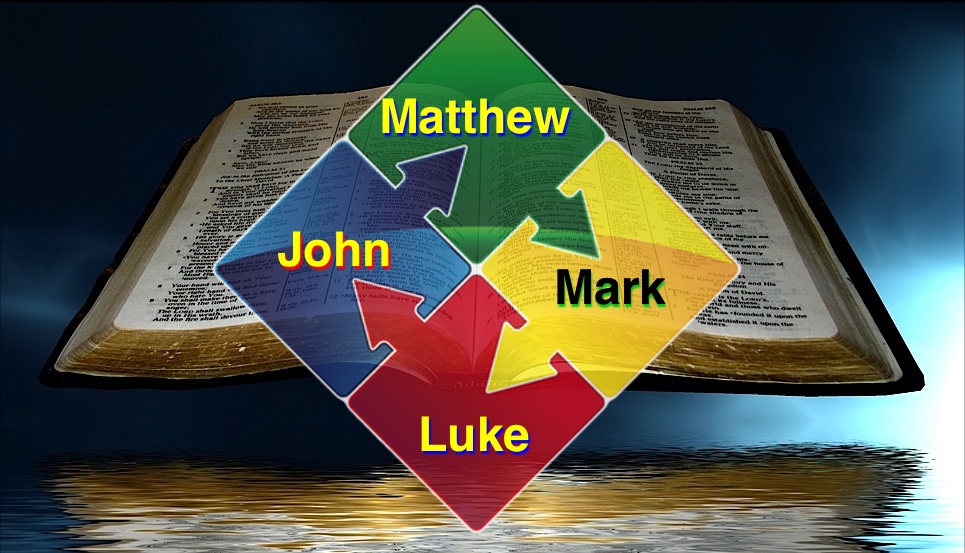
Skeptics and critics claim the Bible is full of contradictions, and, therefore, can’t be trusted. One of these is that the gospels contradict about the disciples carrying a staff.
The Staff “Contradiction” Examined
Here is the supposed “contradiction”:
Did Jesus allow his disciples to carry a staff on their journey? (a) Yes (Mark 6: 8) (b) No (Matthew 10:9; Luke 9:3)
A cursory reading of the parallel accounts in the gospels makes it appear that there is a contradiction between the gospels of Mark and Luke about whether Jesus wanted his disciples to carry a staff on their journey.read more
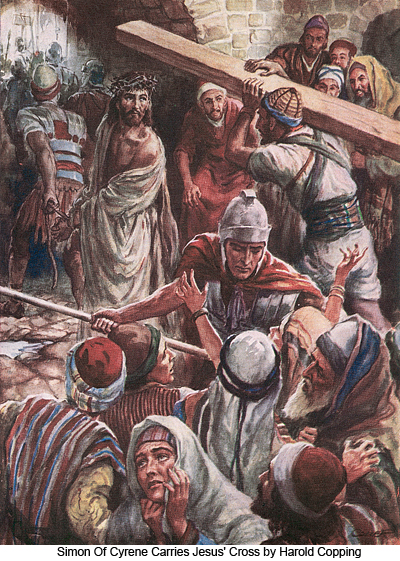
Do Gospels Contradict? Who Carried Jesus’ Cross/Stake?
Who carried the crossbeam or pole? Let’s look at the four gospels, and see who each gospel names as the one who carried Jesus’ execution stake to Golgotha:
Skeptics and critics have claimed the gospels contradict about what time Jesus was crucified.
Alleged “contradiction”:
Where was Jesus at the sixth hour on the day of the crucifixion? (a) On the cross (Mark 15:23) (b) In Pilate’s court (John 19:14)
The issue here is:
What was the time of day when Jesus handed over to be crucified and put on cross:
· Mark 15:25 – “It was the third hour when they crucified him” (ESV). “That is, 9 A. M.” – ESV footnote on Mark 15:25
· John 19:14-16 –“Now it was the day of Preparation of the Passover. It was about the sixth hour. He said to the Jews, ‘Behold your king!’ They cried out, ‘Away with him, away with him, crucify him!’ Pilate said to them, ‘Shall I crucify your king?’ The chief priests answered, ‘We have no king but Caesar.’ So he delivered him over to them to be crucified. So they took Jesus” (ESV). “That is, about noon” – ESV footnote on John 19:14read more
Contradiction About When Jesus’ Disciples Returned To Galilee?
When did Jesus return to Galilee?
Skeptics and critics have sometimes claimed that the gospels have a contradiction about when Jesus’ disciples returned to Galilee.
Alleged contradiction:
When did the disciples return to Galilee?
(a) Immediately, because when they saw Jesus in Galilee “some doubted” (Matthew 28:17). This period
of uncertainty should not persist
(b) After at least 40 days. That evening the disciples were still in Jerusalem (Luke 24:33). Jesus
appeared to them there and told them, stay in the city until you are clothed with power from on high”
(Luke 24:49). He was appearing to them “during forty days” (Acts 1:3), and “charged them not to depart
from Jerusalem, but to wait for the promise … “(Acts 1:4)
When we actually analyze the gospels and Acts, we find that the alleged “contradiction” clears up.
“The eleven disciples traveled to Galilee, to the mountain where Jesus had directed them.” (Matthew 28:16 CSB). The report does not say the eleven faithful apostles went all the way to Galilee that same day.
In fact, “that same day”, Jesus’ apostles were still in Jerusalem (Luke 24:13,33 NIV). There was no rush to get to Galilee, which was about 60 miles away, and would take about 2 to 3 days travel time.
Jesus “appeared to them over a period of forty days and spoke about the kingdom of God” (Acts 1:3NIV). There are eleven recorded appearances in gospels of Jesus appearing to his disciples during this time
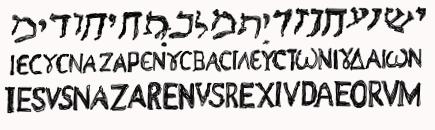
What was the exact wording on the sign above Jesus’ head while he was being publicly executed? Do the four gospels contradict?
Alleged contradiction:
What was the exact wording on the cross? (a) “This is Jesus the King of the Jews” (Matthew 27:37) (b) “The King of the Jews” (Mark 15:26) (c) “This is the King of the Jews” (Luke 23:38) (d) “Jesus of Nazareth, the King of the Jews” (John 19:19)
This accusation assumes that each gospel writer was required to be exactly precise in his reporting.
A second key point to keep in mind, however, is that all four gospel writers report in agreement that the sign had the words, “The king of the Jews”, at a minimum.read more
Do Gospels Contradict About the Earthquake & the Stone Moved?
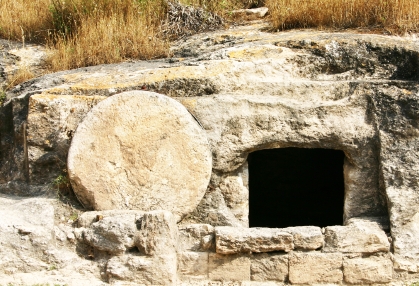
Do the gospels contradict about when the earthquake occurred and the stone was moved at the resurrection of Jesus?
Critics claim that the gospels Matthew, Mark, Luke and John contradict about the time when the earthquake occurred and the stone was moved at the time of Jesus’ resurrection.
“I am struck by a certain consistency among otherwise independent witnesses in placing Mary Magdalene both at the cross and at the tomb on the third day. If this is not a historical datum but something that a Christian storyteller made up and then passed along to others, how is it that this specific bit of information has found its way into accounts that otherwise did not make use of one another? . . . all of our early gospels–not just John and Mark (with Matthew and Luke as well) but also the Gospel of Peter, which appears to be independent of all of them–indicate that it was Mary Magdalen who discovered Jesus’ empty tomb. How did all of these independent accounts happen to name exactly the same person in this role? It seems hard to believe that this just happened by way of a fluke of storytelling. It seems much more likely that, at least with the traditions involving the empty tomb, we are dealing with something actually rooted in history”—Peter, Paul, and Mary Magdalene, p 226, by Bart Ehrman read more
Did Matthew, Mark, Luke and John really use any eyewitness testimony when they wrote the Gospels? Were any of these four gospel writers eyewitnesses themselves?
Do we have eyewitness testimony in the gospels?
“Even though we might desperately want to know the identities of the authors of the earliest Gospels, we simply don’t have sufficient evidence. The books were written anonymously and evidently not by eyewitnesses”—Bart D. Ehrman
The Gospels were not written by eyewitnesses, nor did they include any eyewitness testimony, so says the popular agnostic Bible scholar, who has quite a following. While such claims were rare prior to the 1800’s, they have been increasing, and ever more so in recent times.read more
History says Matthew, Mark, Luke and John wrote the books with those titles. People seem to have a highly variable standard in their assessment of what ancient writings are genuine, especially the Bible. What do we mean? Here is an example:
Did Matthew, Mark, Luke and John really write the Gospels, or were these names attributed later?
Most people accept Alexander the Great as a real historical figure. Yet, the two earliest biographies of Alexander the Great were written by Arrian and Plutarch more than 400 years after the Great One’s death 323 BCE. Legends about him developed centuries after these two writers. Yet, Alexander’s true, accurate history is viewed as being preserved for hundreds of years prior to these legends.
Let’s clear up a misunderstanding about the titles of the Gospels by considering the manuscript evidence: True, there was no “uniformity of the titles.” Yes, there were many variances. But, the one thing that is 100% consistent about the titles is that in the reservoir of several thousand manuscripts of the gospels, they all attribute writership to Matthew, Mark, Luke and John respectively. The exact wording of the titles in various early manuscripts were different, not the same, but they all list Matthew, Mark, Luke and John as the writers. None of the titles indicates anonymity..
In every single instance, the names included Matthew, Mark, Luke, and John respectively. While there was not uniformity of the titles, there was 100% agreement on writership.
The popular agnostic Bible scholar Bart Ehrman claims that the titles of the Gospels were added by later scribes. But, as is well known, even experts can be wrong. Ehrman’s theory about the titles contradicts the facts.
An interesting point to note here is that while there are four gospel accounts, there is in reality only one gospel that runs through the entire New Testament – the Gospel of, and about, Jesus Christ. As Mark opens his account:
“The beginning of the gospel of Jesus Christ, the Son of God.” (Mark 1:1LSB; NASB)
The Gospel is the theme of the four accounts of Jesus’ life, ministry, death and resurrection. Hence, the titles were drawn from this. Notice:
“Jesus went throughout Galilee, teaching in their synagogues, proclaiming the good news of the kingdom, and healing every disease and sickness among the people.” (Matthew 4:23)
“The Spirit of the Lord is on me, because he has anointed me to proclaim good news to the poor. He has sent me to proclaim freedom for the prisoners and recovery of sight for the blind, to set the oppressed free” (Luke 4:18)read more
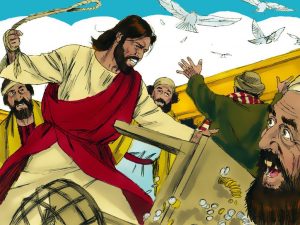
Does the temple cleansing in John contradict the Synoptic Gospels?
Critics claim that the temple cleansing in the Gospel of John is either the same temple cleansing reported by the three Synoptics, Matthew, Mark and Luke, or is out of place, therefore, constituting a “contradiction” in the Gospels.
Below are listed a number of reasons why the temple cleansing in John is accurate and was performed by Jesus around the time of the first Passover after his baptism, which was probably about six months earlier. John clearly states in John 20:31 and John 21:25 that he was highly selective in his reporting on the events of Jesus’ life.
The other three Gospel writers had already reported on the second temple cleansing by the time John wrote his gospel. Upon close examination, it seems fairly obvious that John was very familiar with these other three Gospels, and quite possibly had copies of them in his possession as he wrote the fourth Gospel.
John filled in many gaps that the Synoptics did not report on. In fact, about 92% of his gospel is unique. John reports the following details about the first temple cleansing, that are omitted from the second temple cleansing recorded in Matthew, Mark, and Luke:
John 2:1 – “on the third day a wedding took place in Cana of Galilee.”
John 2:11 – “was the first of his signs“. John’s Gospel states that Jesus’ turning water into wine at a marriage feast was the first of the seven signs, or miracles, reported by John that Jesus performed prior to his death.
John 2:12 – “After this,” was when Jesus cleansed the Temple for the first time.
John 2:13 – “When it was almost time for the Jewish Passover, Jesus went up to Jerusalem.” This was Jesus’ first Passover that he attended after his baptism.
These significant differences in details between the Temple cleansing in John and the Temple cleansing in Matthew, Mark, and Luke, are strong evidence that these two cleansing occurred on two widely separated occasions in different years. Notice, also, how John places the Temple cleansing he records and the Temple cleansing recorded in Matthew, Mark, and Luke:
“Once more he visited Cana in Galilee where he had turned the water into wine . . . This was the second sign Jesus performed after coming from Judea to Galilee (John 4:46,54 NIV).read more
 eg 514w, https://tips.translation.bible/wp-content/uploads/2023/11/send12-150x300.jpeg 150w, https://tips.translation.bible/wp-content/uploads/2023/11/send12-768x1531.jpeg 768w, https://tips.translation.bible/wp-content/uploads/2023/11/send12-770x1536.jpeg 770w, https://tips.translation.bible/wp-content/uploads/2023/11/send12-1027x2048.jpeg 1027w, https://tips.translation.bible/wp-content/uploads/2023/11/send12.jpeg 1284w" alt="" width="421" height="839" />