Trinitarians say that places in the Bible in which God, Jesus, and the Holy Spirit, are mentioned together prove the doctrine of the Trinity is true. However, the Trinity doctrine goes far beyond acknowledging the existence of God, Jesus, and the Holy Spirit. What exactly is the Trinity doctrine?
WHAT IS THE TRINITY DOCTRINE?
A very good, concise, definition by a devoted Trinitarian expert is:
“Within the One Being that is God, there exists eternally three coequal and coeternal persons, namely, the Father, the Son and the Holy Spirit”—The Forgotten Trinity, page 23read more
REVELATION 4-5–GOD ALMIGHTY, JESUS SUBMISSIVE, HOLY SPIRIT NOT A PERSON
Trinitarians claim that God, Jesus, and the Holy Spirit are all three equals persons within a supposed “Godhead”. But, the scriptures prove otherwise.
“Instantly, I came under the Spirit’s power. I saw a throne in heaven and someone was sitting on it”—Revelation 4:2 GWT
This verse shows us that the Holy Spirit is not a person, but God’s power, as John comes under its influence. As will be shown in this vision, God is sitting on the throne.
“In front of the throne, seven lamps [“the sevenfold Spirit”–margin] were blazing. These are the seven spirits [“the sevenfold Spirit”–margin] of God”—Revelation 4:5 NIV
The NIV marginal readings, in brackets here, are very helpful in identifying “the seven spirits” as “the sevenfold Spirit”, that is, the Holy Spirit. “Sevenfold” helps us to understand that the spirit is perfectly complete, fully equipped for its work of accomplishing God’s work. However, there is no indication of personhood.
“Around the throne, there were four living creatures . . . Day and night they never stop saying: ‘Holy, holy, holy is the Lord God Almighty . . . ‘ Whenever the four living creatures give glory, honor and thanks to him who sits on the throne . . . the twenty-four elders fall down before him who sits on the throne and worship him who lives forever and ever . . . and say: ‘You are worthy, our Lord and our God, to receive glory and honor and power, for you created all things, and by your will they were created'”—Revelation 4:6,8-11 NIVread more
Did Jesus Claim To Be God, or God’s Son, In Court?
Did Jesus claim to be God when he was in court, on trial for his life? Like Jesus’ enemies, Trinitarians often assert that Jesus was “claiming to be God” (John 10:33 REB). However, Jesus flatly refuted that false charge by saying, “I am God’s Son” (John 10:36). Like Jesus’ enemies, once again, Trinitarians also falsely assert that Jesus “was claiming equality with God” (John 5:18 REB). Jesus flatly refuted that false charge also, by saying: “In all truth I tell you, by himself the Son can do nothing; he can do only what he sees the Father doing” (John 5:19 NJB).
When, finally, Jesus was brought before the Jewish Supreme Court, the Sanhedrin, what was the real issue that they were concerned about?
“The high priest said to him, ‘I order you to tell us under oath before the living God whether you are the Messiah, the Son of God'” (Matthew 26:63 NAB).
This was the real issue, whether Jesus claimed to be “the Messiah, the Son of God.” They obviously knew he never ‘claimed to be God’. Notice Jesus’ response:
“The words are yours. But I tell you this: ‘from now on you will see the Son of man seated at the right hand of the Almighty and coming on the clouds of heaven'” (Matthew 26:64 REB).read more
Are Jesus, God, and the holy Spirit a Trinity in 1 Timothy?
It is frequently asserted by Bible preachers and teachers that Jesus Christ is “God the Son”, along with “God the Father”, and “God the Holy Spirit,” they are part of a Trinity “Godhead”. If this is so, then we should find plenty of scriptural evidence to support it. Do we find the Trinity in 1 Timothy? Since 1 Timothy was written by the renowned Bible scholar and teacher, the apostle Paul, to counter false teachers and false teachings, including “false doctrines”(1 Timothy 1:3-4), let’s see what it says.
“Paul, an apostle of Christ Jesus by the command of God our Savior and of Christ Jesus our hope” (1 Timothy 1:1 NIV). God and Christ are here clearly portrayed as two separate and distinct individuals. As if this is not enough, this point is further emphasized in verse 2: “Grace, mercy and peace from God the Father and Christ Jesus our Lord” (1 Timothy 1:2 NIV). “Grace, mercy and peace” are said to come from both God and Christ, with no mention of the holy Spirit. This omission of greetings from the holy Spirit would be surprising, and even confusing if the Trinity doctrine were true, but since the holy Spirit is not a person, this statement makes perfect sense.
“Now to the King eternal, immortal, invisible, the only God, be honor and glory for ever and ever” (1 Timothy 1:7 NIV). This sets Almighty God totally apart as being “eternal, immortal, invisible, the only God”, since Christ was created, died, and was visible while on earth (Colossians 1:15 KJV; 1 Corinthians 15:3; John 1:14; Hebrews 2:17 NIV). The “prayer of Moses” to “Yahweh” says, “from everlasting to everlasting you are God” (Psalm 90:2,13 LSB). In the entire Bible, only Yahweh God is referred to as “eternal”, and “from everlasting”. Jesus told us he is not Yahweh (Matthew 22:41-46). Lots of people saw Jesus when he was on earth (John 1:14), which means he cannot be God, because God has always been “invisible”.
“There is one God. There is also one mediator between God and the human race, the man Christ Jesus” (1 Timothy 2:5 NAB). The verse plainly states “there is one God”. In addition to that, “there is also one mediator . . . Christ Jesus”. The Greek word used for “one” in both cases is “heis”, which is the numeral “one”, so the possibility that God could be more than one person, such as a God in three persons, is completely eliminated by this verse. By definition, the mediator cannot be either of the two parties that he mediates “between”, because a mediator mediates between two parties who are at variance. The two parties are “God and the human race.” How are they at variance? Because “there is no one on earth who . . . never sins” (Ecclesiastes 7:20 NIV), whereas ‘Yahweh God’ “cannot tolerate wickedness” (Habakkuk 1:12-13, “Christ Jesus” operates as the “mediator” between the two parties at variance, which makes it is obvious that Christ cannot be either”God” or “mankind”.Christ is “the man”, the “one mediator”, who stands between “God and the human race”. This one scripture is enough to obliterate Trinitarian notions, such as “God the Father, God the Son, God the Holy Spirit”, and these three are each Gd Almighty..
“Who gave himself as a ransom for all people” (1 Timothy 2:6 NIV). “Sacrificed himself” (REB). Jesus “Christ died for our sins”” as a ransom sacrifice (1 Corinthians 15:3). By contrast, Almighty “God”, “Yahweh . . . never dies” (Habakkuk 1:12 NJB). In flagrant contradiction of scripture, Trinitarians equivocate this scriptural truth by claiming that only the human part of Jesus died, but the God part of Jesus never died. However, if any part of Jesus had not died, he could not have died for our sins. The scripture that Christ “gave himself as a ransom”, which eliminates any possibility that Jesus wasn’t “dead” as the scriptures plainly say (Revelation 1:18). Therefore Jesus cannot be Almighty God, who has existed “immortal'” “from eternity” (1 Timothy 1:17 NIV; Psalm 90:2 NAB). This one fact also obliterates the Trinity doctrine itself.
“The household of God, which is the church of the living God, the pillar and foundation of truth” (1 Timothy 3:15 NAB). What is the truth? “Your word is truth”, “the word of God . . . scripture” (John 17:17; John 10:35). Therefore, we can safely conclude that the scriptures in the Bible are truth. This “foundation of truth” that “the church of the living God” operates on is “the faith delivered once for all to God’s people” (Jude 3 Weymouth), the 66 books of the inspired scriptures” (2 Timothy 3:16), back in the first century. Accurate history reports that the Trinity doctrine was not part of the “truth”, that is, “the faith delivered once for all to God’s people” in the 1st century. Even the Trinitarian Catholic Church admits this.
=&0=&
 is true. However, the Trinity doctrine goes far beyond acknowledging the existence of God, Jesus, and the Holy Spirit. What exactly is the Trinity doctrine?
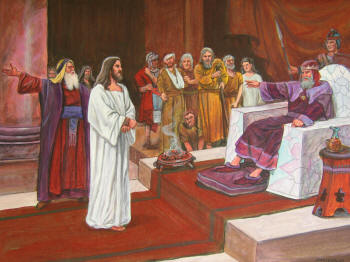 Did Jesus claim to be God when he was in court, on trial for his life? Like Jesus’ enemies, Trinitarians often assert that Jesus was “claiming to be God” (