Many translations of Philippians 2:6 give the impression that Jesus Christ is equal with his Father, Almighty God. For example:
(ESV) “who, though he was in the form of God, did not count equality with God, a thing to be grasped, / Ora thing to be held on to for advantage” but emptied himself,
(NIV) “Who, being in very natureGod, did not consider equality with God something to be used to his own advantage;” rather, he made himself nothing,
(NLV) “Jesus has always been as God is. But He did not hold to His rights as God.” He put aside everything that belonged to Him, read more
Is Jesus Christ equal to God? Based on the following scripture, and what they have heard, or been told, many people think so.
“For this reason the Jews were seeking all the more to kill him, because not only was he breaking the sabbath, but was also calling God his own Father, thereby making himself equal to God” (John 5:19 NRSV).
If we look at this scripture closely, and think about it logically, there are three serious problems with the claim that Jesus made himself equal with God, and so he must be God..read more
Are God, Jesus, and the holy Spirit a Trinity? – 2 Corinthians
The New Testament book of 2 Corinthians was written about 25 years after Jesus’ death and the start of Christianity. Is the Trinity doctrine in 2 Corinthians?
“The Trinity is one of the most important teachings of the Christian faith. It defines God’s very essence and describes how he relates to us”—The Forgotten Trinity, back cover
Since Second Corinthians was written about twenty-fives after the start of Christianity, we would expect to see at least some evidence of such an important doctrine as the Trinity in the letter’s 13 chapters, if it is a true Christian doctrine. Let’s examine scriptures from this book which tell us something about God, Jesus, and the holy Spirit.read more
Is the Trinity in Philippians? Is Jesus Christ Almighty God?
This article is part of our series about what is stated concerning God, Jesus and the holy Spirit, and whether they together comprise a Trinity, in the various books of the New Testament. We will examine the four chapter book of Philippians. Notice the distinctive relationship between God and Jesus throughout this book of Philippians, especially the superior role of God compared to Jesus. What does it say about the holy Spirit? Is the Trinity in Philippians?
Is the Trinity found in Philippians? The superior role of God compared to Jesus is evident from the Bible book of Philippians
“To all God’s holy people in Christ Jesus at Philippi.” (Philippians 1:1) Notice they are God’s, not Christ’s, holy people. God is always the one in control, and is using Christ to gather his people, which shows his superiority over Christ, and eliminates the equality aspect of the Trinity doctrine (John 14:28).
“Grace and peace to you from God our Father and the Lord Jesus Christ . . . God can testify how I long for all of you with the affection of Christ Jesus.” (Philippians 1:2,8) God and Jesus are presented as separate and distinct, not of the same “being”, “substance”, or “essence”. The holy Spirit, since it is not a person, does not give greetings. Neither does the Trinity, since it doesn’t exist.
“Filled with the fruit of righteousness that comes through Jesus Christ – to the glory and praise of God.” (Philippians 1:11) Fruitage from God flows through Jesus and brings glory and praise to God. God is presented is someone other than Jesus, and superior to Jesus (John 14:28), which doesn’t support the Trinity doctrine.
“Participation in the Spirit” (Philippians 2:1 ESV). Since some versions render this as “fellowship of the Spirit”, Trinitarians have claimed this means the holy Spirit is a person. However, the rendering “participation in the Spirit” is more accurate. We can’t participate in a person. But we can “have a share in his Spirit” (1 John 4:13 NJB). All this gives evidence that the holy Spirit isn’t a person. Without the holy Spirit being a person, the Trinity doctrine collapses.
“Have this attitude in yourselves which was also in Christ Jesus, who although he existed in the form of God, did not regard equality with God a thing to be grasped.” (Philippians 2:6 LSB; NASB).
“Who, although he was in the form of God, did not regard equality with God something to be grasped. Rather he emptied himself, taking the form of a slave, coming in human likeness, and found human in appearance”—Philippians 2:6,7 NAB
“What the man Jesus refused to grasp at to attain divinity . . . Jesus, though . . . in the form of God (Gn 1:26-27) did not reach out for equality with God, in contrast with the first Adam in Gn 3:5-6”—NAB note
“Ureil ben-Mordechai[1] points out that the Greek negative in this verse (ouk) is not attached to the verb (hegesato) but rather to the noun harpagmon. That means the reading of this verse should be “counted not something to be grasped,” instead of “not counted something to be grasped.” Let me make the difference clearer. The standard Christian translation of this Greek phrase suggests that Yeshua did not consider equality something to be grasped. But the actual Greek text reads, “counted equality not something that could be grasped.” In other words, if the negative particle ouk is tied to the noun rather than the verb, the implication is the Yeshua saw equality with God as something unattainable. Do you realize what this means? It means that this verse does not say that Yeshua gave up equality with God voluntarily because it did not serve the purposes of the Messiah. It says that Yeshua never aspired to be equal with God because equality with God is not possible.”—Skip Moen, Phd
Since many translations render Philippians 2:6 with Trinitarian bias, let’s look at some other accurate translations of Philippians 2:6:
“He was in the form of God, yet he laid no claim to equality with God, but made himself nothing, assuming the form of a slave. Bearing the human likeness”—Philippians 2:6,7 REB
“who, though he was in the form of God, did not count equality with God a thing to be grasped”—ESV
“Who, being in the form of God, did not count equality with God something to be grasped”—NJB
“Who, existing in the form of God, did not consider equality with God something to be grasped”—BSB; BLB
“who, although existing in the form of God, did not regard equality with God a thing to be grasped”—LSB
“who, being in the form of God, counted it not a prize to be on an equality with God”—ERV
“In God’s own form existed he, and shared with God equality, deemed nothing needed grasping.”—LSV
“Who, existing in the form of God, did not consider equality with God something to be grasped”—MSB
“who though he existed in the form of God did not regard equality with God as something to be grasped”—NET
“who, existing in the form of God, did not consider equality with God a thing to be grasped”—NHB
“who, existing in the form of God, didn’t consider equality with God a thing to be grasped”—WEB
“who, being in the form of God, thought [it] not something to be seized to be equal to God”—LSV
“who, though he was in the form of God, did not consider equality with God something to be seized”—CPDV
Being,”in the form of God”, means that Jesus is not God! Someone who already has something does not have to ‘grasp’ for it. Jesus would not even think about trying to be equal to God. Christians are to have the same attitude of humility. Obviously, Jesus is separate from, and inferior to, God. Philippians 2:5,6 flatly debunks the equality aspect of the Trinity doctrine.
“He humbled Himself by becoming obedient to the point of death, even death on a cross. For this reason also, God highly exalted him.” (Philippians 2:8,9 NASB) God is clearly shown to be someone other than Christ. Jesus’ obedience bespeaks of his submission to his Father. His death means he is not God, and not eternal, since he was not in existence while he “was dead” (Revelation 1:18). The scriptures make clear that “Yahweh . . . God . . . never dies” (Habakkuk 1:12 NJB). God, the superior one, highly exalted Jesus, not the other way around. Thus, three Trinitarian pillars of Jesus being God, eternal, and equal are eliminated by these scriptures.
Philippians 2:10,11a – “At the name of Jesus every knee should bow . . . and every tongue should acknowledge that Jesus Christ is Lord” (NIV). Trinitarians often stop their quote of the scripture at this point, and use this to “prove” that Jesus is God. Here is a typical example of a Trinitarian claim:
“God the Father stated, “To me every knee shall bow, every tongue shall swear” (Isaiah 45:23). The same exact description is also applied to Jesus (Philippians 2:10-11). This means that both the Father and the Son are Yahweh.”read more
The Trinity is said to be the main doctrine of Christianity. Verses from Hebrews chapter 1 are often used to support the doctrine. However, there are some very valid and legitimate questions about what the verses in Hebrews actually say about the Trinity issue that need to be answered.
Hebrews 1:1 – “In the past God spoke to our ancestors through the prophets at many times and in various ways” (NIV). Who is the “God” mentioned here?
Hebrews 1:2 – “in these last days he has spoken to us by his Son, whom he appointed heir of all things and through whom he made the universe” (NIV).
·Who is “his Son” that God has spoken by?
·Who appointed Jesus to be “heir”?
·What does it mean that God made the universe through Jesus?
Hebrews 1:3 – How does being “the radiance of God’s glory and the exact representation of his being” make Jesus equal to God?
Hebrews 1:5 – Who made the Father-Son declaration? Who decided this relationship? Explain how this makes the Father and Jesus equal?
Hebrews 1:8 – Does “about the Son he says, ‘Your throne, God'” make Jesus equal to the Father? If so, then what does it make the human king about which it was originally said at Psalm 45:6?
Does the Trinity matter? It matters because the Bible says:
“There is no wisdom, there is no discernment And there is no counsel against Yahweh”—Proverbs 21:30 LSB
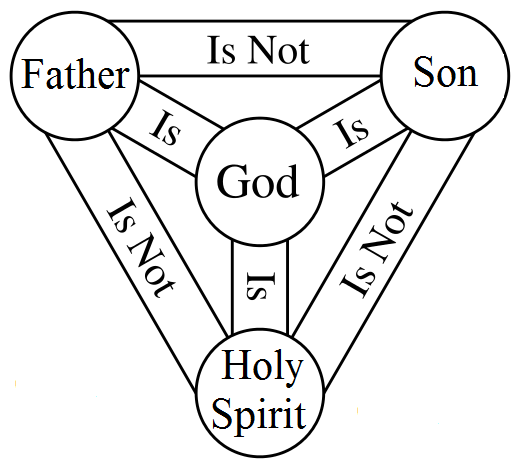
Does this picture make sense? It is confusing and contradictory!
“Now this is eternal life, that they should know you, the only true God, and the one whom you sent, Jesus Christ.” (John 17:3)
The Bible says our eternal life depends on knowing the only true God the Father, and His Son, whom he sent, Jesus Christ. “Knowing” would have to include knowing who they are.
The Athanasian Creed, which many denominations accept, says a person’s eternal life depends on acceptance of certain statements of belief about God, Jesus, and the Holy Spirit (Ghost).
“Whosoever will be saved, before all things it is necessary that he hold the catholic faith. Which faith except every one do keep whole and undefiled; without doubt he shall perish everlastingly.”
“So that in all things, as aforesaid; the Unity in Trinity, and the Trinity in Unity, is to be worshipped. He therefore that will be saved, let him thus think of the Trinity.”
“Furthermore, it is necessary to everlasting salvation; that he also believe faithfully the Incarnation of our Lord Jesus Christ. For the right Faith is, that we believe and confess; that our Lord Jesus Christ, the Son of God, is God and Man; God, of the Substance [Essence] of the Father; begotten before the worlds; and Man, of the Substance [Essence] of his Mother, born in the world. Perfect God; and perfect Man, of a reasonable soul and human flesh subsisting.”
“And they that have done good shall go into life everlasting; and they that have done evil, into everlasting fire. This is the catholic faith; which except a man believe truly and firmly, he cannot be saved.”—Book of Common Prayer translation. See Schaff (1877b, pp. 66–71)read more
As part of our series about what is stated in the Bible concerning whether God, Jesus and the holy Spirit are a Trinity in the various books of the New Testament, this article examines the book of Galatians.
Galatians was possibly the earliest book of the New Testament that was written, and focuses on correct Christian doctrine. Was the Trinity part of Christian doctrine discussed in Galatians? Is any aspect of the Trinity doctrine mentioned in the book?
Galatians 1:1 – “Through Jesus Christ and God the Father who raised him from the dead” (NAB). – God is shown to be the Father. Jesus is not referred to as God. God and Jesus are revealed to be two separate and distinct individuals – the superior, God, resurrects the lesser one, Jesus, from the dead. “Yahweh . . . God . . . never dies” (Habakkuk 1:12 NJB). Jesus “was dead” (Revelation 1:18). Therefore, Jesus cannot be Almighty God.
Galatians 1:3– “Grace to you and peace from God our Father and the Lord Jesus Christ” (NAB). – Two separate and distinct individuals, namely “God our Father” and “Jesus Christ,” are mentioned, but there is no mention of the holy Spirit. Why not? There is no question the holy Spirit is real. Trinitarians claim it is a person. If the holy Spirit is the third part of a Trinity “Godhead,” as Trinitarians assert, it should have been mentioned here in these greetings. It’d not mentioned because it’s not a person, and therefore can’t send greetings. Why are there no greetings from the Trinity? Why is the Trinity never mentioned in the Bible? – Because it’s a ‘myth’ (1 Timothy 4:7).
Galatians 1:4 – “…who gave himself for our sins… according to the will of our God and Father.”(NIV)– Jesus’ willing sacrificial death was according to his Father’s “will,” which shows Jesus to be the subordinate to his “Father” who “is greater” (John 1:14).
Galatians 1:6 – “You are so quickly deserting the one who called you to live in the grace of Christ” (NIV). – God and Christ are presented as two different people, with God, the superior, doing the calling. God is clearly shown to be someone other than Jesus Christ.
Galatians 1:15-16 – “God… set me apart… was pleased to reveal his Son to me, so that I might proclaim him to the Gentiles.” (NAB) – “God” reveals “his Son” Jesus Christ to Paul, and uses Paul to “proclaim him to the Gentiles”. God, not Christ is shown to be the one who is in control. “His Son” is here clearly shown to be someone other than “God”.
Galatians 2:20-21 – “I live by faith in the Son of God, who loved me and gave himself for me. I do not set aside the grace of God, for it if righteousness could be gained through the law, Christ died for nothing” (NIV). Once again, we see from the scriptures that “God” is someone other than “Christ” and that “Christ died”, which means Christ can’t be God because “God . . . will never die” (Habakkuk 1:12 NJB). Over and over in the scriptures the important point that “Christ died” is emphasized. Trinitarians have invented “a different Jesus” (2 Corinthians 11:4 NLT), a so-called “God-man”, who, they claim, died “in his human nature, but not in his God nature”. However, the scriptures plainly state that “Christ died for our sins” (1 Corinthians 15:3). If any part of Christ had remained alive, he could not have died for our sins, which would mean “Christ died for nothing”.
Galatians 3:2,5,14 – “Did you receive the Spirit by the works of the law . . . does God give you his Spirit . . . by the works of the law” (NIV). “Through Christ Jesus, God has blessed . . . so that we who are believers might receive the promised =&0=&Here we see that God the Father, the Almighty God, operates through Christ Jesus so that believers can ‘receive the holy Spirit through faith’. The holy Spirit is referred to as “the Spirit”, “his Spirit”, and “the promised Holy Spirit”. These descriptions are not descriptive of a person, but of an entity, and provides evidence that the holy Spirit is not a person, contrary to Trinitarian dogma.
Galatians 3:16-18 –“To your seed, who is Christ… God granted it to Abraham through the promise.” (NIV) – God gave Abraham the promise that through his seed (Christ), all nations will be blessed. God is shown to be someone other than “your seed, who is Christ,” and superior to “Christ”, thus eliminating the equality aspect of the Trinity doctrine.
Galatians 3:20 – “Now a mediator is not for one person only, whereas God is only one” (NASB). “Now the mediator or go-between [in a transaction] is not [needed] for just one


 The Trinity is said to be the main doctrine of Christianity. Verses from Hebrews chapter 1 are often used to support the doctrine. However, there are some very valid and legitimate questions about what the verses in Hebrews actually say about the Trinity issue that need to be answered.