Browsed by
Tag: Biblical archaeology

ISRAELITE KING OMRI IN ARCHAEOLOGICAL DOCUMENTS

ISRAELITE KING OMRI IN ARCHAEOLOGICAL DOCUMENTS

Is the Bible reliable?
Artifacts discovered confirm some of the detailed facts the Bible mentions about Israelite king Omri.

Like many other ancient sacred books upon which religions are based, the Bible has been criticized as being largely a work of fiction and myth. However, many discoveries have proven otherwise. Archaeological documents mentioning Israelite king Omri, have been discovered, and have added to the growing mountain of evidence favoring the Bible’s authenticity.

“Then the people of Israel were split into two factions; half supporting Tibni son of Ginath for king, and the other half supported Omri. But Omri’s followers proved stronger than those of Tibni son of Ginath. So Tibni died and Omri became king. In the thirty-first year of Asa king of Judah, Omri became king of Israel, and he reigned twelve years, six of them in Tirzah. He bought the hill of Samaria from Shemer for two talents of silver and built a city on the hill, calling it Samaria, after Shemer, the name of the former owner of the hill. But Omri did evil in the eyes of the LORD [Yahweh] and sinned more than all those before him. He followed completely the ways of Jeroboam son of Nebat, committing the same sin Jeroboam had caused Israel to commit, so that they aroused the anger of the LORD [Yahweh], the God of Israel, by their worthless idols. As for the other events of Omri’s reign, what he did and the things he achieved, are they not written in the book of the annals of the kings of Israel? Omri rested with his ancestors and was buried in Samaria. and Ahab his son succeeded him”—1 Kings 16:21-26 NIV read more
Evidence of the Great Earthquake in Amos & Zechariah

Evidence of the Great Earthquake in Amos & Zechariah

Is the Bible reliable?
Is there any external evidence of the great earthquake in Amos and Zechariah?

Critics have claimed the Bible is mostly fiction, including  the great earthquake referred to in the Bible books of Amos and Zechariah.

“The words of Amos, one of the shepherds of Tekoa–the vision he saw concerning Israel two years before the earthquake, when Uzziah was king of Judah and Jeroboam son of Jehoash was king of Israel”— Amos 1:1  NIV).

RECENT GEOLOGICAL DISCOVERY

Recent geological studies have detected a massive seismic event, apparently a huge 8.2 earthquake, in the area where Amos lived. This event, which has been dated to around 760-750 BCE,  which was during the latter part of the long reign of Judean king Uzziah (792–740 BCE), and was the largest ever detected on the Dead Sea Transform Fault.  read more

POOL OF SILOAM DISCOVERED IN 2004 CONFIRMS JOHN 9:7

POOL OF SILOAM DISCOVERED IN 2004 CONFIRMS JOHN 9:7

“‘Go,’ he told him, ‘wash in the Pool of Siloam’ (this word means ‘Sent’). So the man went and washed, and came home seeing'” (John 9:7 NIV). The actual location of the Biblical Pool of Siloam has been discovered, thus confirming the Bible’s authenticity.

BIBLICAL BACKGROUND

“The Pool of Siloam” is just just one of many locations that were once doubted to exist until archaeology confirmed its existence. Until 2004, the pool and church built by Byzantine empress Eudocia to commemorate the site was thought by some Bible believers to have likely been the Pool of Siloam. Also, many “experts” doubted the existence of the Pool of Siloam, period. Many of these “experts” also doubted the authenticity of the entire gospel of John, thinking that it was written by someone other than the apostle John, sometime after the apostle John had died, and was a book of facts, mixed with legend and fiction.

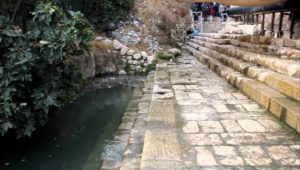
Pool of Siloam steps
In 2004, the stepped remains of the ancient Siloam Pool, long thought to be located elsewhere, were uncovered near the City of David. According to the Gospel of John, it was at this sacred Christian site that Jesus healed the blind man.

Archaeological discoveries are forcing more and more skeptics to rethink their positions. The actual, genuine, Pool of Siloam that was in use in Jesus day was unexpectedly discovered in 2004. During construction work to repair a large water pipe south of Jerusalem’s Temple Mount, at the southern end of ridge known as the City of David, archaeologists began to uncover what we now know is the Pool of Siloam. Numismatic evidence—coins from the late Hasmonean period (circa 90 BCE) and from the Jewish revolt (circa 63 CE)—prove that this pool was in use in Jesus’ day. This and other evidence has convinced archaeologists beyond any doubt that this was indeed the Pool of Siloam in John 9:7.

“Hezekiah stopped the upper outlet for water from Gihon and redirected it underground westward to the City of David”—2 Chronicles 32:30 NAB read more

WP2Social Auto Publish Powered By : XYZScripts.com