Why do many people not believe in God or his word the Bible? Why are so many people lacking faith? A person with genuine Bible-based faith is referred to as “one who sees Him who is invisible.” (Hebrews 11:27 CSB)
WHAT THE BIBLE SAYS
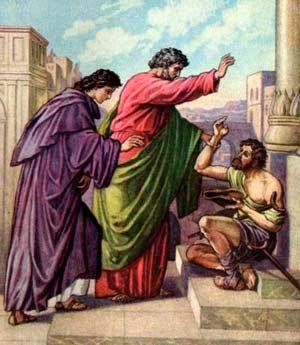
In one special case, Elisha’s servant was given the ability to see otherwise invisible angelic forces, arrayed against the Syrian army: “Elisha prayed: ‘Yahweh,’ he said, ‘open his eyes and make him see.’ Yahweh opened the servant’s eyes, and he saw the mountain covered in fiery horses and chariots surrounding Elisha” (Kings 6:17 NJB). Although miraculous things like this don’t happen today, these events are recorded in the most reliable record in existence, God’s Word, the Bible. God, Jesus, and angels are just as real today, and we can see evidence of this with “the eyes of [our] understanding” (Ephesians 1:18 NKJV) “by faith” (2 Corinthians 5:7). read more
Can a Believer in the Trinity Have a Relationship with God?
The vast majority of Christian churches and preachers teach that the Trinity doctrine is true, and is a vitally important Biblical message. On this basis, therefore many sincere Christians believe in the Trinity doctrine. Can a believer in the Trinity have a relationship with God?
Below are some excerpts from a debate with a Trinitarian on an online forum, with the Trinitarian’s comments quoted verbatim :
Trinitarian said…
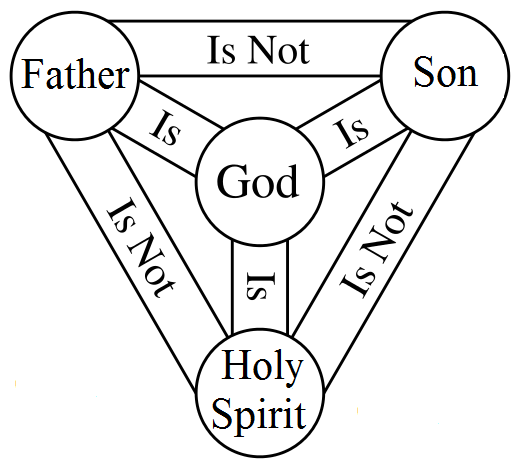
“ONLY ONE DIVINE BEING who exists within himself eternally and simultaneously as three distinct Personal Self-Awarenesses, Father, Son, and Holy Spirit”
These type of statements are pure fiction, as this premise has no Biblical support. Actually, there are three problems with them:
No Biblical proof
Contradicts the Bible
Makes no sense – eternal life depends on knowing God – John 17:3. Something that is nonsensical, like the Trinity God, cannot be known.
Trinitarian said…
“And it is true, since the Almighty IS Father, Son, and Holy Spirit. Yet not three Almighties, but only ONE Almighty…and he has NO equal. There is none like our God. And our God is Father, Son, and Holy Spirit.”read more
The Universe is Expanding Rapidly, at an Ever Increasing Rate
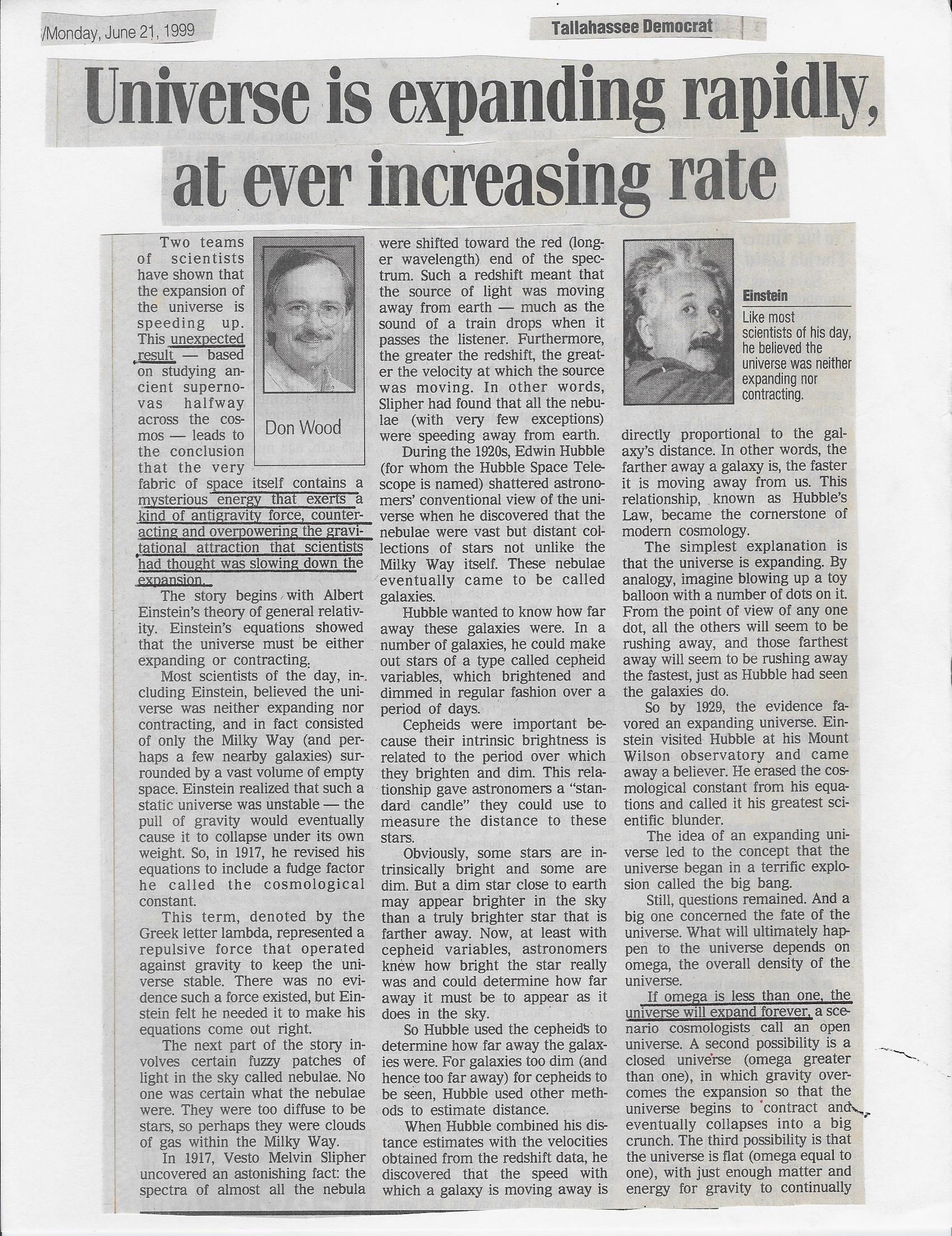
On Monday, June 21, 1999, the Tallahassee Democrat published a newspaper article entitled: “Universe is expanding rapidly, at ever increasing rate.” A scan of the article can be view below:
ge 1 of article)" width="231" height="300" />Page 1 (Click to enlarge)ge 2 of article)" width="235" height="300" />Page 2 (Click to enlarge)
This discovery surprised scientists back in 1998. Being generally agnostic or atheistic, they don’t much like this. Why? Because as Stephen Hawking said, it has “religious overtones and implications.” Why? Because, as he said, the universe is confirmed to be “expanding at the critical rate.” That is, not only to continue expanding at an ever increasing rate, but at just exactly the precise rate to go on expanding forever. There is no way this could happen by accident, or without a guiding hand – in other words, by a “Creator” (Isaiah 42:5).read more
Is it possible that God the Father is the only one who is Almighty, and his Son, Jesus Christ and the holy Spirit are not Almighty?
“The Father is Almighty, the Son Almighty, and the Holy Spirit Almighty. And yet there are not three Almighties, but one Almighty”—Athanasian Creed
The Trinity doctrine asserts that the three Trinitarian beings “are co-equal and co-eternal.” Let’s examine what the Bible says about Almighty God.
ALMIGHTY GOD IS THE FATHER
“If I am indeed father, where is the honor due to me? says Yahweh Sabaoth” (Malachi 1:6 NJB). “Do we not all have one Father? Has not one God created us?” (Malachi 2:10 NASB). The “one God” is identified with “Yahweh”, the Father. These scriptures thus contradict the Trinity doctrine, which claims the one God is the Trinity – the Father, the Son, and the holy Spirit. God is identified as “one” [Hebrew “echad”], not three-in-one. “Echad” is the numeral “one.” It is not a compound unity.read more
Does God love us unconditionally? What does the Bible say?
Does God love us unconditionally? There is no doubt that God loves us, as John 3:16, says, “For God so loved the world that He gave His only begotten Son, that whoever believes in Him should not perish but have everlasting life” (NKJV). The principle expressed in John 3:16 means that God does love everyone, in a sense. In another sense, however, there are conditions relative to God’s love.
“If you keep my commandments, you will remain in my love”—John 15:10 NABread more
Hebrews is a comprehensive treatise about Christian doctrine. Since the Trinity doctrine is asserted to be the main doctrine of Christianity, we would expect Hebrews to include significant mention of the Trinity doctrine, if it is true.
Is the Trinity doctrine in the book of Hebrews?
In our series about what is stated concerning God the Father, his Son Jesus, and the holy Spirit in the various books of the New Testament, we examine all the relevant scriptures of each particular book. In this article, we will examine the Letter to the Hebrews, and discover powerful testimony about whether or not the doctrine of the Trinity is in Hebrews. Hebrews says God speaks to through his Son.read more
Why Does the Trinity Matter? – Is Jesus Christ Almighty God?
Does the Trinity matter? It matters because the Bible says:
“There is no wisdom, there is no discernment And there is no counsel against Yahweh”—Proverbs 21:30 LSB
Does this picture make sense? It is confusing and contradictory!
“Now this is eternal life, that they should know you, the only true God, and the one whom you sent, Jesus Christ.” (John 17:3)
The Bible says our eternal life depends on knowing the only true God the Father, and His Son, whom he sent, Jesus Christ. “Knowing” would have to include knowing who they are.
The Athanasian Creed, which many denominations accept, says a person’s eternal life depends on acceptance of certain statements of belief about God, Jesus, and the Holy Spirit (Ghost).
“Whosoever will be saved, before all things it is necessary that he hold the catholic faith. Which faith except every one do keep whole and undefiled; without doubt he shall perish everlastingly.”
“So that in all things, as aforesaid; the Unity in Trinity, and the Trinity in Unity, is to be worshipped. He therefore that will be saved, let him thus think of the Trinity.”
“Furthermore, it is necessary to everlasting salvation; that he also believe faithfully the Incarnation of our Lord Jesus Christ. For the right Faith is, that we believe and confess; that our Lord Jesus Christ, the Son of God, is God and Man; God, of the Substance [Essence] of the Father; begotten before the worlds; and Man, of the Substance [Essence] of his Mother, born in the world. Perfect God; and perfect Man, of a reasonable soul and human flesh subsisting.”
“And they that have done good shall go into life everlasting; and they that have done evil, into everlasting fire. This is the catholic faith; which except a man believe truly and firmly, he cannot be saved.”—Book of Common Prayer translation. See Schaff (1877b, pp. 66–71)read more
In the book of Acts, did the Apostles teach or preach the Trinity doctrine?
This article is part of our series about what is stated concerning God, Jesus and the holy Spirit, and whether they comprise a Trinity, in the various books of the Bible. This article examines whether the Trinity was taught or preached the book of Acts of the Apostles.
Jesus had foretold that, “the Helper, the Holy Spirit which the Father will send in my place, will teach you everything and remind you of =&0=&“The Helper, the Holy Spirit” would “guide [them] into all the truth” (John 16:13 NIV). Acts records for us how this was done, by documenting the spread of Christianity during its first three decades, including its beginning, when the holy Spirit was “poured out” (Acts 2:33). If the Trinity is true, then the doctrine should be evident in the book of Acts, because it records what the early Christians taught and how Christianity was established throughout the Roman Empire.
Acts 1:3 – “During the forty days after he suffered and =&1=&The resurrection of Christ is the foundation of the Gospel, and it’s the affirmation of Jesus’ Sonship and Messiahship. This is what the early Church preached, as recorded in the Book of Acts and the New Testament letters. However, today many theologians and preachers are “preaching” “a different gospel” (Galatians 1:6-9 NIV), asserting that the essence of the Gospel is that “God became a man and died for our sins. In contrast, for the early church it was,“God has resurrected this Jesus.” (Acts 2:32 HCSB)
Acts 1:4 – “Wait for the gift my Father promised” (NIV). – The Father alone is the one who is in control. “The “gift” refers to the Holy Spirit, as promised in the Old Testament (e.g.,
As part of our series about what is stated in the Bible concerning whether God, Jesus and the holy Spirit are a Trinity in the various books of the New Testament, this article examines the book of Galatians.
Galatians was possibly the earliest book of the New Testament that was written, and focuses on correct Christian doctrine. Was the Trinity part of Christian doctrine discussed in Galatians? Is any aspect of the Trinity doctrine mentioned in the book?
Galatians 1:1 – “Through Jesus Christ and God the Father who raised him from the dead” (NAB). – God is shown to be the Father. Jesus is not referred to as God. God and Jesus are revealed to be two separate and distinct individuals – the superior, God, resurrects the lesser one, Jesus, from the dead. “Yahweh . . . God . . . never dies” (Habakkuk 1:12 NJB). Jesus “was dead” (Revelation 1:18). Therefore, Jesus cannot be Almighty God.
Galatians 1:3– “Grace to you and peace from God our Father and the Lord Jesus Christ” (NAB). – Two separate and distinct individuals, namely “God our Father” and “Jesus Christ,” are mentioned, but there is no mention of the holy Spirit. Why not? There is no question the holy Spirit is real. Trinitarians claim it is a person. If the holy Spirit is the third part of a Trinity “Godhead,” as Trinitarians assert, it should have been mentioned here in these greetings. It’d not mentioned because it’s not a person, and therefore can’t send greetings. Why are there no greetings from the Trinity? Why is the Trinity never mentioned in the Bible? – Because it’s a ‘myth’ (1 Timothy 4:7).
Galatians 1:4 – “…who gave himself for our sins… according to the will of our God and Father.”(NIV)– Jesus’ willing sacrificial death was according to his Father’s “will,” which shows Jesus to be the subordinate to his “Father” who “is greater” (John 1:14).
Galatians 1:6 – “You are so quickly deserting the one who called you to live in the grace of Christ” (NIV). – God and Christ are presented as two different people, with God, the superior, doing the calling. God is clearly shown to be someone other than Jesus Christ.
Galatians 1:15-16 – “God… set me apart… was pleased to reveal his Son to me, so that I might proclaim him to the Gentiles.” (NAB) – “God” reveals “his Son” Jesus Christ to Paul, and uses Paul to “proclaim him to the Gentiles”. God, not Christ is shown to be the one who is in control. “His Son” is here clearly shown to be someone other than “God”.
Galatians 2:20-21 – “I live by faith in the Son of God, who loved me and gave himself for me. I do not set aside the grace of God, for it if righteousness could be gained through the law, Christ died for nothing” (NIV). Once again, we see from the scriptures that “God” is someone other than “Christ” and that “Christ died”, which means Christ can’t be God because “God . . . will never die” (Habakkuk 1:12 NJB). Over and over in the scriptures the important point that “Christ died” is emphasized. Trinitarians have invented “a different Jesus” (2 Corinthians 11:4 NLT), a so-called “God-man”, who, they claim, died “in his human nature, but not in his God nature”. However, the scriptures plainly state that “Christ died for our sins” (1 Corinthians 15:3). If any part of Christ had remained alive, he could not have died for our sins, which would mean “Christ died for nothing”.
Galatians 3:2,5,14 – “Did you receive the Spirit by the works of the law . . . does God give you his Spirit . . . by the works of the law” (NIV). “Through Christ Jesus, God has blessed . . . so that we who are believers might receive the promised =&0=&Here we see that God the Father, the Almighty God, operates through Christ Jesus so that believers can ‘receive the holy Spirit through faith’. The holy Spirit is referred to as “the Spirit”, “his Spirit”, and “the promised Holy Spirit”. These descriptions are not descriptive of a person, but of an entity, and provides evidence that the holy Spirit is not a person, contrary to Trinitarian dogma.
Galatians 3:16-18 –“To your seed, who is Christ… God granted it to Abraham through the promise.” (NIV) – God gave Abraham the promise that through his seed (Christ), all nations will be blessed. God is shown to be someone other than “your seed, who is Christ,” and superior to “Christ”, thus eliminating the equality aspect of the Trinity doctrine.
Galatians 3:20 – “Now a mediator is not for one person only, whereas God is only one” (NASB). “Now the mediator or go-between [in a transaction] is not [needed] for just one



 ge 1
ge 1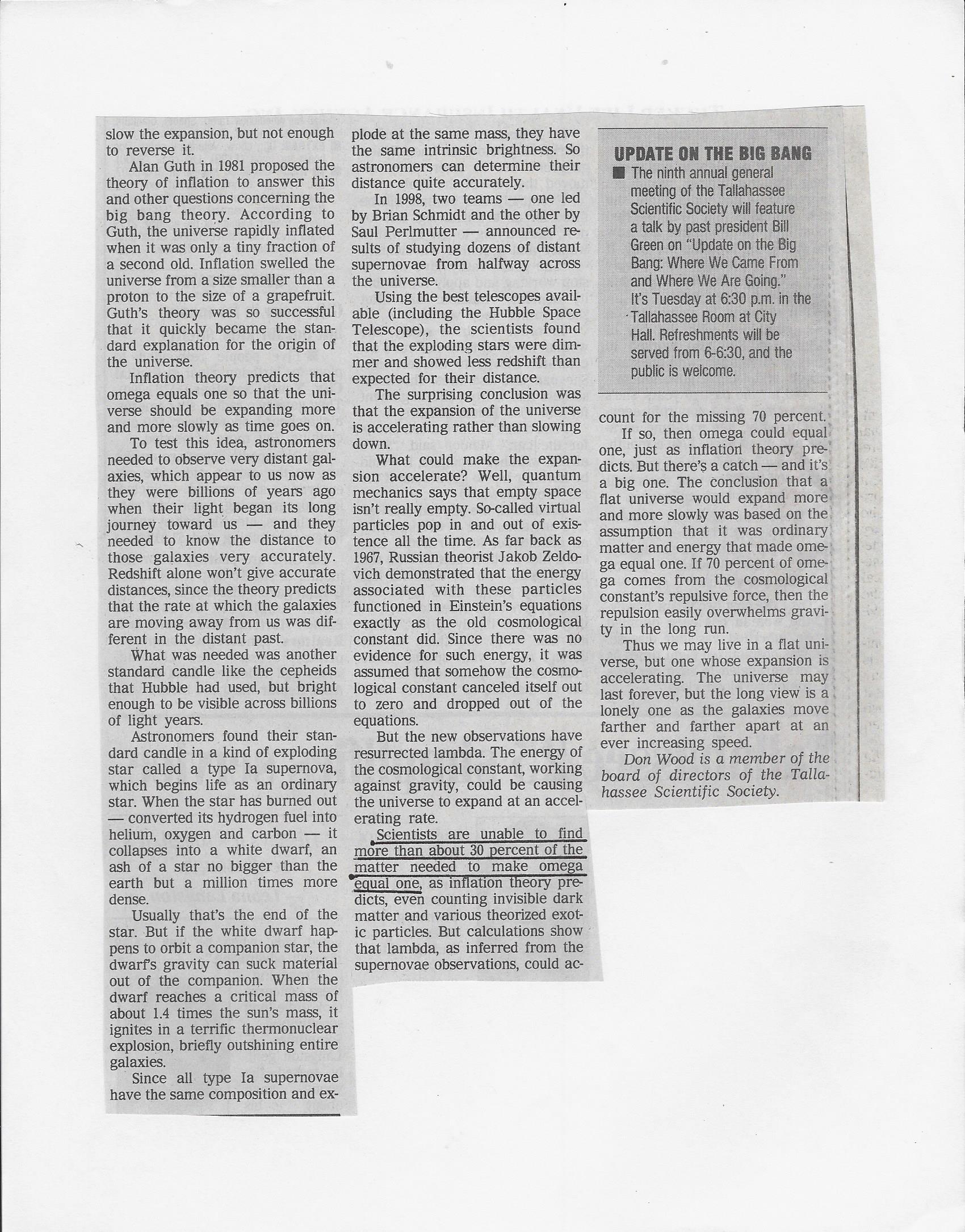 ge 2
ge 2 Is it possible that God the Father is the only one who is Almighty, and his Son, Jesus Christ and the holy Spirit are not Almighty?