“God replied to Moses: I am who I am. Then he added: This is what you are to tell the Israelites: I AM has sent me to you”—Exodus 3:14 NAB
“Truly I say to you, before Abraham was born, I am”—John 8:58NASB. Many translations of John 8:58 capitalize “I Am” so as to convey the idea of a title. As a prominent Bible study guide says,
“The ‘I am’ denotes absolute eternal existence, not simply existence prior to Abraham. It is a claim to be Yahweh of the OT” (Ryrie Study Bible note on John 8:58).`read more
Did Jesus Claim To Be God, or God’s Son, In Court?
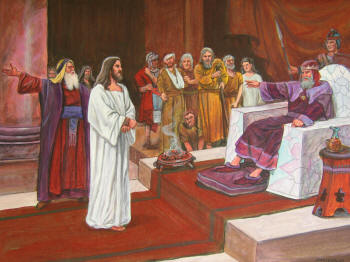
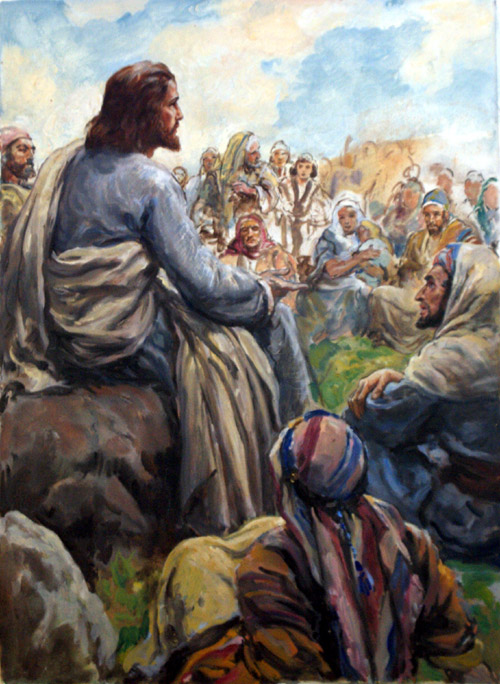
Did Jesus claim to be God when he was in court, on trial for his life? Like Jesus’ enemies, Trinitarians often assert that Jesus was “claiming to be God” (John 10:33 REB). However, Jesus flatly refuted that false charge by saying, “I am God’s Son” (John 10:36). Like Jesus’ enemies, once again, Trinitarians also falsely assert that Jesus “was claiming equality with God” (John 5:18 REB). Jesus flatly refuted that false charge also, by saying: “In all truth I tell you, by himself the Son can do nothing; he can do only what he sees the Father doing” (John 5:19 NJB).
When, finally, Jesus was brought before the Jewish Supreme Court, the Sanhedrin, what was the real issue that they were concerned about?
“The high priest said to him, ‘I order you to tell us under oath before the living God whether you are the Messiah, the Son of God'” (Matthew 26:63 NAB).
This was the real issue, whether Jesus claimed to be “the Messiah, the Son of God.” They obviously knew he never ‘claimed to be God’. Notice Jesus’ response:
“The words are yours. But I tell you this: ‘from now on you will see the Son of man seated at the right hand of the Almighty and coming on the clouds of heaven'” (Matthew 26:64 REB).read more
“The Father eternal, the Son eternal, the Holy Spirit eternal. The Father is God, the Son is God, and the Holy Spirit is God. And yet, there are not three Gods, but one God”—Athanasian Creed
“No doctrine is more fundamental to the Faith than the Trinity”—Dr Norman L Geisler
“The Trinity is a doctrine where error is especially deadly”—Dr John MacArthur
“A cornerstone belief of the Christian faith, the doctrine of the Trinity . . . What is the doctrine of the Trinity? . . . There is only one God, but in the unity of the Godhead there are three eternal, coequal Persons where each Person is independently conscious and self-directing but never acting independently of one another and always manifesting the same character attributes and the same nature. Where in the Bible is the Trinity taught? . . . It is taught in 25 of the 27 books of the New Testament and in 13 of the 39 books of the Old Testament”—“Does the Book of Isaiah Teach the Trinity?”, Reasons to Believe (RTB) blogsite, by Hugh Ross, July 20, 2020read more
Does 1 John 5:13 Prove “Once Saved, Always Saved”?
Is “Once saved, always saved,” a Biblical teaching?
Is the doctrine of eternal security supported by the Bible?”
“These things I have written to you who believe in the name of the Son of God, so that you may know that you have eternal life” (1 John 5:13 NASB; LSB).
THE ASSERTIONS
It is asserted by the proponents of the “Once Saved, Always Saved” doctrine that 1 John 5:13, among other scriptures, proves this belief to be Scriptural. One of the main fallacies of reasoning is “over-simplification.” While every scripture in the “inspired” word of God, from Genesis through Revelation, is true (2 Timothy 3:16; John 17:17), the scriptures must be “accurately” handled (2 Timothy 2:15 NASB: LSB). As is very typical of all false doctrines, 1 John 5:13 is taken out of context, and used in a way that John never intended, to prove the “Once Saved, Always Saved” doctrine.read more
Who should we worship? “The true worshippers will worship the Father” (John 4:23). Jesus very clearly and unmistakably said that we should “worship the Father”. Trinitarians often claim “we should worship the Trinity” as their Athanasian Creed says. Most often they talk about worshipping Jesus, and sometimes they even claim to worship the Holy Spirit. But, the Bible is crystal clear on this subject. This is not a gray area. There are no accurately translated scriptures that either direct us to worship, or have anyone worshipping, Jesus, as is often heard. Jesus said in prayer that his “Father” is “the only true God” (John 17:1,3).read more
Today, there are many “faith healers” in the world who claim that they are empowered by God to perform various miracles, including healing people of sickness and disease.
HISTORICAL BIBLICAL HEALINGS
Some Christians have been claiming to perform these healing miracles all through the ages, ever since genuine healings were actually performed, as recorded in God’s written word, the Bible.
Easter is by far the most prominent celebration for most Christian churches, with Lord’s Supper celebrated occasionally, but without the prominence given to Easter. Jehovah’s Witnesses only celebrate the Lord’s Supper, which they call “The Memorial of Christ’s Death”, but not Easter. Do Christians need to celebrate either of these two events, or only one of them, and, if so, when?
“The Lord’s Supper . . . do this in remembrance of me . . . For whenever you eat this bread and drink this cup, you proclaim the Lord’s death until he comes”—1 Corinthians 11:20,24,26 NIV
While the dates from year to year vary within certain guidelines, for the year 2020, most Christian churches observed Easter on April 12th, and Jehovah’s Witnesses (JW’s) observed “the Lord’s Supper” (1 Corinthians 11:20), which they call the “Memorial of Christ’s Death,” on April 7th. For the year 2025, these dates are April 12, and April 20, respectively. The guidelines regarding the dating of these celebrations of these events are rigidly set and observed each year, and carry a very huge importance. Please see the article: “What Is Memorial Day for Christians?” on this website for further details regarding the proper Biblical celebration of “the Lord’s Supper.” Also, please see the article, “Is Easter a Biblical Celebration?” on this website.
The facts are that “the Lord’s Supper” is Biblically commanded to be celebrated, while Easter is not. Easter, which is not even mentioned in the Bible, is said to be the celebration of Jesus Christ’s resurrection, but mixes in ancient pagan springtime fertility rites along celebrating Christ’s resurrection. Christians,
Does being called “Savior” mean Jesus that is God?
Trinitarians often use the following scripture to “prove” that Jesus is God. Does being called “savior” mean that Jesus is God?
“I, even I, am the LORD, and apart from me there is no savior” (=&0=&
=&1=&there is no other Saviour but me” (Isaiah 43:11 NJB)
Trinitarians will then point out that Jesus Christ is referred to as “Savior” many times in the New Testament, as if there are no other saviors. However, this assertion is easily debunked by the Scriptures themselves. One very good example of this scriptural proof is:
“Through the preaching entrusted to me by the command of God our Savior, To Titus, my true son in our common faith: Grace and peace from God the Father and Christ Jesus our Savior” (Titus 1:3,4 NIV)
These verses show us very clearly that both Almighty God the Father and Jesus Christ are called
Jehovah’s Witnesses published an article entitled “An Attack Coming From the North” (The Watchtower–Study Edition, April 2020), in which they admit that their prior explanation of the prophecy of Joel 2:7-9 was out of context, and therefore inaccurate. To accurately understand Bible prophecy, we must consider the context!
Their new explanation of this prophecy is very similar to the one that what they call “Christendom” has explained for a long time, that is, the Babylonians would invade Judah and Jerusalem from the north and take over. Unfortunately for the JW’s, however, they still hold to their 607 BCE date for the destruction of Jerusalem, since it fits in with their ill-fated 1914 date. In their explanation, the Witnesses make an astounding statement:
“To understand a prophecy correctly, we generally have to consider its context” (The Watchtower, April 2020, Study Article 14, paragraph 2).
“Generally“???—Why would we not always need to “consider its context”? Would there ever be a Bible prophecy that we could take out of context, and come up with an explanation that is correct?—-Absolutely not. It would be like trying to float a ship on dry land.
Then they go on to make another equally astounding statement. “If we focus on only one aspect of the prophecy and ignore the rest, we may draw the wrong conclusion”. — “May draw the wrong conclusion”??? This is unbelievable. If we ignore every aspect of a Bible prophecy except one, how could we not draw the wrong conclusion?
At least the JW Organization admits they were wrong about Joel 2:7-9. However, they seem to downplay a vital point about wise decision making. Wise decision makers take into account all relevant facts–not just one–before making a final decision. This also applies to understanding Bible prophecy.
Why would they make statements such as these? It appears that it may be to cover up for a number of erroneous prophetic interpretations that they have made, including their most important ones; namely,Matthew 24:45 and 1914.
Jesus gave his great long range prophecy that is recorded in Matthew 24, 25. He concludes this with four parables that exhort each Christian to be faithful, always active, and working for Christ and his Kingdom’s interests (Matthew 24:45-25:46), all the while without any figuring out when the Master will return, since Jesus admitted he didn’t know that date himself (Matthew 24:36-44).
It is the parable of the faithful and wise servant (Matthew 24:45-51) that the Witness organization has long used out of context to assert that their leaders fulfill this prophecy. The way the JW’s explain it, their leaders, guided by Almighty God, have been dispensing “spiritual food at the proper time since the year 1919”. If that is so, then why have the Witnesses had to change their explanations so many times? When they change their explanation, the former explanation becomes obsolete, or no longer correct.
The Bible’s final book, Revelation, predicts the future for the Church and humankind. The Trinity doctrine is said to be the main doctrine of Christianity, so we would expect to find the Trinity in Revelation, if the doctrine is true. The very first verse of the Book of Revelation gives us a clue as to the answer to the question of whether the Trinity doctrine is in Revelation:
“The revelation from Jesus Christ, WHICH GOD GAVE HIM to show his servants what must soon take place” (Revelation 1:1 NIV). [Emphasis ours]. Trinitarians claim that the Son of God, Jesus Christ, is “fully God”. How can that be, since, first of all, in this verse, we see that “God” is someone other than “Jesus Christ”. Next we notice that “God gave him” “the revelation”. If Jesus was Almighty God, as Trinitarians claim, he would not have to be “given” anything, much less the Revelation by God–he would already have it–and know it! The Trinity doctrine not only is not in the scriptures, it contradicts the scriptures, and it makes no sense! “God is not the author of confusion” (1 Corinthians 14:33 KJV).read more
 Did Jesus claim to be God when he was in court, on trial for his life? Like Jesus’ enemies, Trinitarians often assert that Jesus was “claiming to be God” (

 The Bible’s final book, Revelation, predicts the future for the Church and humankind. The Trinity doctrine is said to be the main doctrine of Christianity, so we would expect to find the Trinity in Revelation, if the doctrine is true. The very first verse of the Book of Revelation gives us a clue as to the answer to the question of whether the Trinity doctrine is in Revelation: